
Somula
Macquart, 1847
Species Guides
1- Somula decora(spotted wood fly)
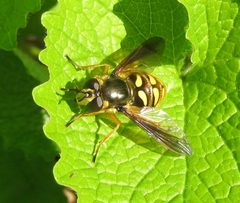
Somula is a of syrphid flies (flower flies) in the Syrphidae, established by Macquart in 1847. The genus contains at least two described : Somula decora and Somula mississippiensis. Members of this genus are notable for their -mimicking appearance, particularly resembling yellowjackets or scoliid wasps in coloration and pattern. These flies are part of the diverse mimicry complex found within Syrphidae.
Pronunciation
How to pronounce Somula: /ˈsɔː.mjʊ.lə/
These audio files are automatically generated. While they are not always 100% accurate, they are a good starting point.
Identification
Somula can be distinguished from other yellow-and-black syrphid mimics by its specific pattern of golden yellow markings on a black background. The Helophilus has vertical yellow stripes on the , which Somula lacks. Temnostoma wave their front legs to mimic , a not reported for Somula. Sphecomyia vittata has notably longer, thicker antennae than most syrphids. Accurate species-level identification within Somula requires examination of specific morphological characters.
Images
Habitat
Found in woodland edges and areas where forest meets open . Associated with patches of touch-me-not (jewelweed, Impatiens ) where bask on leaves. Requires proximity to decaying plant matter or wood for larval development.
Distribution
North America. Records include the United States (Illinois, Mississippi, Vermont) and possibly Canada. The two described have distinct distributions: Somula decora has been recorded in Illinois and likely broader eastern/central North America; Somula mississippiensis is known from the southern United States.
Seasonality
active in spring, with observations in mid-May in Illinois. Activity coincides with of yellowjackets, which may serve as models for mimicry.
Behavior
are sun-loving and frequently bask on leaves, particularly of touch-me-not plants. Has been observed on leaf surfaces. The specific has not been described in detail, but as a yellowjacket mimic may fly in a slow, deliberate manner similar to its models.
Ecological Role
likely contribute to pollination through visitation of flowers, though specific floral associations are not documented. As larvae, probably contribute to decomposition processes in their development . participates in mimicry complexes that may influence -prey dynamics.
Human Relevance
Beneficial as non-stinging mimics that may deter human interference without posing sting risk. Potential . No known pest status.
Similar Taxa
- HelophilusAlso yellowjacket mimics with yellow thoracic stripes, but distinguished by vertical yellow stripes on versus Somula's different marking pattern.
- TemnostomaMason wasp mimics that carry mimicry to extreme by waving front legs like ; Somula does not exhibit this .
- SphecomyiaStunning yellowjacket mimic with longer, thicker than almost any other syrphid; Somula has typical short syrphid antennae.
- Vespula (yellowjackets)The putative model for Somula's mimicry; distinguished by waist, two pairs of wings, and ability to sting.
More Details
Mimicry model
Somula decora has been hypothesized to mimic scoliid wasps, but given its spring timing, the yellowjacket (Vespula maculifrons) is considered a more likely model for its mimicry.
Taxonomic history
established by Macquart in 1847 with Somula decora as type . Somula mississippiensis was described by Hull in 1922.