
Sphecomyia
Latreille, 1829
Yellowjacket Flies
Species Guides
13- Sphecomyia brevicornis(Short-horned Yellowjacket Fly)
- Sphecomyia columbiana(Columbian Yellowjacket Fly)
- Sphecomyia cryptica
- Sphecomyia dyari(Dyar's Yellowjacket Fly)
- Sphecomyia hoguei
- Sphecomyia interrupta
- Sphecomyia metallica
- Sphecomyia oraria
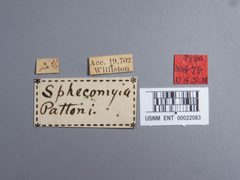
- Sphecomyia pattonii(Patton's Yellowjacket Fly)
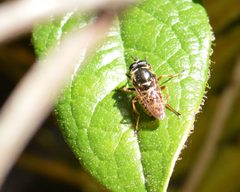
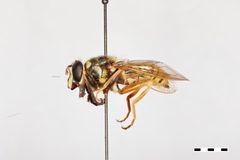
Sphecomyia is a Holarctic of large hoverflies (Syrphidae) comprising 16 recognized . Most species are striking mimics, closely resembling yellowjackets in size, coloration, and . The genus was redefined in 2019 based on distinctive morphological characters including a bare medial facial vitta, bare gena, and scutellum. One species, S. metallica, is an exception as a hairy mimic rather than wasp mimic.
Pronunciation
How to pronounce Sphecomyia: /ˌsfɛkoʊˈmaɪjə/
These audio files are automatically generated. While they are not always 100% accurate, they are a good starting point.
Identification
Sphecomyia are among the largest syrphid flies, comparable in size to yellowjackets. They possess longer, thicker than most other flies, enhancing their -like appearance. Key diagnostic features include: bare medial vitta extending ventrally from the oral margin; bare gena; bare katepimeron; scutellum with at least the margin densely ; and anterior half of wing C before crossvein h without setae. The is divided into three species groups: the S. vittata group (pruinose scutellar vittae), S. pattonii group (lacking pruinose scutellar vittae), and S. metallica (hairy, completely pruinose , mimic).
Images
Habitat
frequent woodland edges and sunny clearings. Larval remains unknown but is inferred to resemble other subtribe Criorhinina, likely involving rot holes, decaying wood, or roots.
Distribution
Holarctic distribution, with records from North America, Europe, and Asia. Specific regional occurrences include the United States (including Vermont), Sweden, and Norway.
Life Cycle
Larvae have never been illustrated or described; development remains undocumented.
Behavior
exhibit remarkably convincing mimicry, including lazy, zig-zag patterns that closely resemble yellowjackets searching for nest sites. Most are wasp mimics; S. metallica is a hairy mimic. Scattered floral visitation and mating records exist.
Human Relevance
S. vittata and related are notable for their exceptional mimicry, which can deceive observers into believing they are stinging . This makes them among the most impressive examples of in North American insects.
Similar Taxa
- CriorhinaPreviously congeneric; separated by Sphecomyia's bare medial facial vitta, bare gena, and other redefined characters. Several transferred between in 2019 revision.
- Somula decoraAnother large syrphid mimic, but with golden yellow markings on black background and different thoracic pattern; lacks Sphecomyia's distinctive facial vitta and antennal proportions.
- TemnostomaSyrphid mimics that wave front legs to simulate wasp ; Sphecomyia achieves similar effect through genuinely elongated antennae rather than behavioral compensation.
More Details
Taxonomic Revision
The was comprehensively revised in 2019 (Moran, ZooKeys 836), resulting in seven new descriptions, redefinition of generic boundaries, and transfer of several species between Sphecomyia and Criorhina. barcode data were provided for all 16 species.
Mimicry Quality
Sphecomyia vittata is considered one of the most convincing hymenopteran mimics among Diptera, with experienced entomologists occasionally mistaking live specimens for actual until close examination.