
Criorhina
Meigen, 1822
Bumble Flies
Species Guides
13- Criorhina aurea
- Criorhina bubulcus(Whiskered Bumble Fly)
- Criorhina caudata(Red-tailed Bumblefly)
- Criorhina coquilletti(Coquillett's Bumble Fly)
- Criorhina fusca(Dusky Yellowjacket Fly)
- Criorhina kincaidi(Kincaid's Bumble Fly)
- Criorhina nasica(Black-backed Yellowjacket Fly)
- Criorhina nigripes(Williston's Bumble Fly)
- Criorhina nigriventris(bare-cheeked bumble fly)
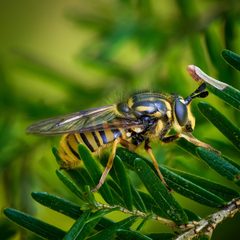
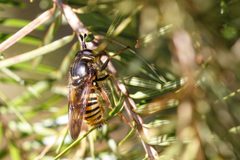
Criorhina is a of medium to large hoverflies (Syrphidae) that exhibit of bumblebees. The genus is characterized by a flattened, broad and distinctive antennal placement on a prominent conical frontal process. Larvae develop in rot holes and decaying hardwoods. Several show pronounced geographical variation in abdominal colour patterns, with morphological differences correlated with the distribution of their hymenopteran models.

Pronunciation
How to pronounce Criorhina: //kriˈoʊrɪnə//
These audio files are automatically generated. While they are not always 100% accurate, they are a good starting point.
Identification
Distinguished from other hoverfly by the combination of: much flattened and broader than ; situated on prominent conical frontal process; bare ; and bumblebee-mimicking coloration. The broad head and antennal placement are particularly diagnostic. Within the genus, may be separated by abdominal pattern details and geographical distribution. Criorhina pachymera shows six distinct abdominal forms divided into two main groups separated by the Alps and Carpathians.
Images
Appearance
Medium to large hoverflies with black or greenish-black coloration, with or without light ground markings. markedly flattened and broader than the . arise from a prominent conical frontal projection. moderately produced below the , directed downward or forward in profile. Eyes bare (without hairs). elliptical to very short oval in shape.
Habitat
occur in woodland and forest-edge . Larvae are found in rot holes and decaying hardwoods, indicating dependence on mature trees with cavities and decaying wood.
Distribution
Widespread across Europe with confirmed records in Denmark, Norway, Sweden, and extending to North America (Vermont, USA). Eastern distribution includes India (confirmed for C. vivida) and previously indicated for Pakistan. Geographical variation in C. pachymera shows two main groups: Group A (western, northern, central Europe) and Group B (south-eastern Europe), separated by the Alps and Carpathians.
Life Cycle
Larval stage develops in rot holes and decaying hardwoods. are flower-visiting. Specific details of -laying, larval instars, and are not documented in available sources.
Behavior
exhibit of bumblebees, with geographical variation in abdominal banding patterns matching the pollinose band width of local . The geographical pattern of slender versus broad bands in C. pachymera corresponds to the separation of two main European honey bee recolonization lineages.
Ecological Role
Larvae contribute to decomposition processes in decaying hardwoods. likely serve as of flowering plants. The mimicry complex suggests involvement in deception networks.
Similar Taxa
- Other bumblebee-mimicking hoverfly genera (e.g., Pocota, Mallota)Also mimic bumblebees but differ in shape—Criorhina has a characteristically flattened head broader than the and on a conical frontal process
- Criorhina pachymera formsSix abdominal forms (A1–A3, B1–B3) distinguished by band width and extent of orange coloration; require geographical context and detailed abdominal pattern examination for identification
More Details
Geographical colour variation
Criorhina pachymera exhibits clinal variation in abdominal coloration correlated with latitude, with increasing orange coloration at lower latitudes. Temperature appears to be an additional factor influencing this variation alongside mimicry selection.
Mimicry model
The two main colour pattern groups in C. pachymera correspond to the two main postglacial recolonization lineages of honey bees in Europe, which differ in pollinose band width on tergites 3–5.
Sources and further reading
- BugGuide
- Wikipedia
- GBIF taxonomy match
- iNaturalist taxon
- NCBI Taxonomy
- Catalogue of Life
- Geographical variation in abdominal colour pattern in Criorhina pachymera (Egger, 1858) (Diptera: Syrphidae)
- Confirmed record of Criorhina vivida Brunetti, 1923 (Diptera, Syrphidae) in India with description of the male, and notes on the distribution and checklist of the genus in the country