
Sphecomyia oraria
Moran, 2019
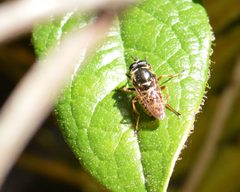
Sphecomyia oraria is a of hoverfly (Syrphidae) described in 2019. It belongs to the S. pattonii species group within the Holarctic Sphecomyia, which comprises large -mimicking flies in subtribe Criorhinina. The species exhibits of vespid wasps, particularly yellowjackets. Like other members of its genus, it is presumed to have larvae that develop in rotting wood or tree holes, though this has not been confirmed for S. oraria specifically.
Pronunciation
How to pronounce Sphecomyia oraria: /ˌsfɛk.oʊˈmaɪ.ə oʊˈrɛər.i.ə/
These audio files are automatically generated. While they are not always 100% accurate, they are a good starting point.
Identification
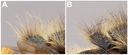
Sphecomyia oraria is distinguished from by the following combination of characters: scutellum completely black pilose; sternites 2–4 mostly with shiny to dull black narrow border and transverse subapical band that reaches lateral sides of sternite; only the anterior third or less of the scutellum pruinose; mostly non-pruinose with distinct regions of pruinosity; and broadened fore . Belongs to the S. pattonii group, characterized by lacking pruinose scutellar vittae (unlike the S. vittata group).
Images
Distribution
United States.
Similar Taxa
- Sphecomyia vittataSimilar -mimicking appearance, but distinguished by presence of scutellar vittae (S. oraria lacks these); S. vittata has longer, thicker and more extensive pruinosity patterns
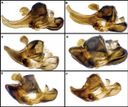
- Sphecomyia pattoniiCongeneric member of same group; morphological distinctions require examination of male genitalia and specific pruinosity patterns on sternites and scutellum
- Criorhina speciesFormerly congeneric; distinguished by presence of setae on half of C before crossvein h, and different wing venation characteristics