
Sphecomyia hoguei
Moran, 2019
Sphecomyia hoguei is a of syrphid fly (flower fly) described in 2019, belonging to the S. pattonii species group within the Sphecomyia. Like other members of its genus, it exhibits mimicry, a characteristic defensive in this lineage. The species was formally described in a comprehensive taxonomic revision of the world Sphecomyia fauna.
Pronunciation
How to pronounce Sphecomyia hoguei: /ˌsfɛkəˈmaɪə hoʊˈɡweɪ/
These audio files are automatically generated. While they are not always 100% accurate, they are a good starting point.
Identification
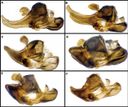
Distinguished from the similar Sphecomyia dyari by surstylus : in S. hoguei, the narrowest part of the surstylus is about half the width of the base, whereas in S. dyari it is approximately one-quarter the width of the base. The combination of tergite 2 with two yellow bands ( interrupted, uninterrupted), limited area on scutellum (anterior third or less), and sternite pruinosity pattern confirms identification. Male genitalia examination is required for definitive determination within the S. pattonii group.
Images
Appearance
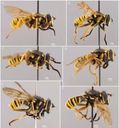
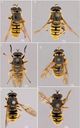
Medium-sized syrphid fly with -mimicking coloration. Tergite 2 displays two yellow bands: an interrupted band and a uninterrupted band along the posterior margin. Tergite 1 has an uninterrupted band along its posterior margin. calypter bears long yellow pile. Scutellum pruinose only on anterior third or less, with at least partial yellow pilosity. Sternites 2–4 are almost completely pruinose, each with a posteromedial triangular non-pruinose region that decreases in size on successive sternites. Surstyli elongated, more than three times longer than broad, with narrowest part approximately half the width of the base.
Distribution
United States
Similar Taxa
- Sphecomyia dyariSimilar congeneric in the S. pattonii group; distinguished by surstylus (narrowest part ~1/4 width of base vs. ~1/2 in S. hoguei)
- Sphecomyia vittataCongeneric mimic with similar overall appearance; belongs to the S. vittata group characterized by scutellar vittae, which S. hoguei lacks
More Details
Taxonomic history
Sphecomyia hoguei was described as a new (sp. n.) by Moran in 2019 as part of a comprehensive revision of the world Sphecomyia fauna. The revision established that Sphecomyia represents a monophyletic lineage within subtribe Criorhinina defined by specific morphological synapomorphies including a bare medial vitta extending ventrally from the oral margin, bare gena, bare katepimeron, and scutellum with at least margin densely .
Species group placement
S. hoguei belongs to the S. pattonii group, one of three species groups recognized in the . The S. pattonii group is characterized by the absence of scutellar vittae, distinguishing it from the S. vittata group.