
Temnostoma
Le Peletier & Audinet-Serville, 1828
Falsehorn Flies
Species Guides
8- Temnostoma alternans(Wasp-like Falsehorn)
- Temnostoma balyras(Yellow-haired Falsehorn)
- Temnostoma barberi(Bare-bellied Falsehorn)
- Temnostoma daochus(Yellow-spotted Falsehorn)
- Temnostoma excentrica(Black-spotted Falsehorn)
- Temnostoma obscurum(Hairy-winged Falsehorn)
- Temnostoma trifasciatum(Three-lined Falsehorn)
- Temnostoma venustum(black-banded falsehorn)
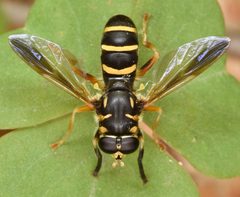
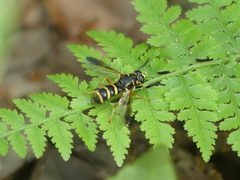
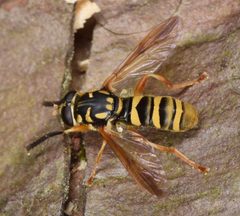
Temnostoma is a of hoverflies (Syrphidae) renowned for their sophisticated of . possess overall morphological resemblance to hymenopterans, including darkened wing margins that mimic the folded wings of vespid wasps at rest. A distinctive behavioral involves waving the forelegs in front of the to simulate wasp . The genus comprises approximately 25 described distributed across the Holarctic region, with larvae that are saproxylic—developing in wet, decaying wood where they feed on microorganisms.
Pronunciation
How to pronounce Temnostoma: /tɛmnoʊˈstoʊmə/
These audio files are automatically generated. While they are not always 100% accurate, they are a good starting point.
Identification
Distinguished from other syrphid by the combination of darkened wing margins and the distinctive of waving forelegs to mimic . From similar wasp-mimicking hoverflies like Sphecomyia: Temnostoma lacks the exceptionally long, thick antennae of that genus. From Helophilus: lacks the vertical thoracic stripes. From Chalcosyrphus: differs in wing margin pattern and lacks the wing-flicking behavior while running on surfaces. Identification to requires examination of male and female genitalia; North American specimens historically identified as T. vespiforme have been shown to represent distinct species based on genitalic .
Images
Appearance
Medium to large hoverflies with robust bodies adapted for mimicry. Wing margins darkened along the leading edge, creating the illusion of longitudinal wing folds characteristic of resting vespid wasps. Body coloration varies: some display perfect yellow-and-black banding patterns matching social wasps, while others exhibit darker, imperfect mimicry. relatively short compared to wasp models.
Habitat
Associated with woodland and forest edge environments. Larval is specifically wet, decaying wood of deciduous trees. frequent sunlit areas at woodland edges, forest openings, and vegetation near larval development sites.
Distribution
Holarctic distribution, occurring across North America, Europe, and Asia. Documented from Scandinavia (Denmark, Norway, Sweden), northwestern Balkans (Croatia, Bosnia and Herzegovina, Serbia), and North America including Vermont. Some with more restricted ranges: T. apiforme recently recorded from Croatia as the first Balkan Peninsula occurrence; T. meridionale newly documented in Bosnia and Herzegovina.
Diet
Larvae feed on microorganisms within wet, decaying wood. feeding habits not explicitly documented in sources.
Life Cycle
Larvae develop by boring into wet, decaying wood—classified as saproxylic. Specific details of -laying, , and not documented in available sources.
Behavior
perform remarkable behavioral mimicry: wave forelegs in front of the in a manner that precisely simulates the long of models. This compensates for the morphological limitation of short dipteran antennae. pattern described as lazy and zig-zagging, similar to yellowjackets searching for nest sites. Adults frequently observed basking on sunlit vegetation.
Ecological Role
Saproxylic hoverflies contributing to decomposition processes in forest through larval activity in decaying wood. pollination potential not documented. may reduce pressure, though specific interactions not recorded.
Human Relevance
Visually striking appearance may attract citizen scientist observation and documentation. No documented economic importance, pest status, or direct human health impacts. Presence indicates availability of suitable decaying wood , potentially useful as a habitat quality indicator for forest conservation.
Similar Taxa
- Sphecomyia vittataAnother syrphid mimic with similar size and yellowjacket-like appearance; distinguished by exceptionally long, thick that more closely match wasp models without requiring behavioral compensation
- HelophilusYellowjacket-mimicking syrphids with vertical yellow thoracic stripes; lack the darkened wing margins and foreleg-waving of Temnostoma
- ChalcosyrphusWood-associated syrphids with larvae in decaying wood; distinguished by wing-flicking while running on surfaces and different wing margin coloration
- TakaomyiaSister to Temnostoma; shares the plesiomorphic behavioral mimicry of foreleg -waving inherited from common ancestor
More Details
Evolution of Mimicry
Phylogenetic analysis indicates that behavioral mimicry (foreleg waving) is ancestral and shared with sister Takaomyia. Dark coloration (imperfect mimicry) represents the ancestral state within Temnostoma, with perfect mimicry evolving independently on two occasions. Northern Holarctic of some show secondary darkening and degradation of mimicry, suggesting ongoing evolutionary plasticity and selection pressure on mimicry-related traits.
Taxonomic Uncertainty
The T. vespiforme, originally described from Europe and long considered Holarctic, has been shown to represent a distinct . North American specimens differ in body coloration and genitalic , indicating that historical records require taxonomic revision.
Sources and further reading
- BugGuide
- Wikipedia
- GBIF taxonomy match
- iNaturalist taxon
- NCBI Taxonomy
- Catalogue of Life
- Bug Eric: Eight Illinois Wasp and Bee Mimics in Twenty Minutes
- On the distribution of Temnostoma vespiforme (Diptera, Syrphidae) in North America
- The evolution of wasp mimicry and biogeography in the genus Temnostoma (Diptera: Syrphidae)
- New records of the genus Temnostoma Le Peletier & Serville, 1828 (Diptera: Syrphidae) in the NW Balkans Novi nalazi roda Temnostoma Le Peletier & Serville, 1828 (Diptera: Syrphidae) na području sjeverozapadnog Balkana