
Chalcosyrphus
Curran, 1925
Leafwalkers
Species Guides
12- Chalcosyrphus anthreas(yellow-banded leafwalker)
- Chalcosyrphus chalybeus(violet leafwalker)
- Chalcosyrphus curvarius
- Chalcosyrphus inarmatus(Yellow-haired Leafwalker)
- Chalcosyrphus libo(Long-haired Leafwalker)
- Chalcosyrphus metallicus(Yellow-legged Leafwalker)
- Chalcosyrphus metallifer(Orange-horned Leafwalker)
- Chalcosyrphus nemorum(Dusky-banded Leafwalker)
- Chalcosyrphus piger(Short-haired Leafwalker)
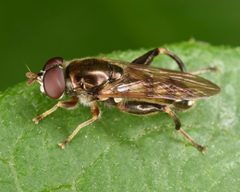
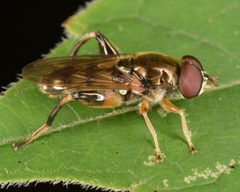
Chalcosyrphus is a of hoverflies ( Syrphidae) in the Eristalinae, commonly known as leafwalkers. are notable for mimicking and other hymenopterans, often displaying bright or metallic coloration. are structurally and behaviorally similar to the related genus Xylota but differ in larval . The genus occurs across Europe, Asia, and North America, with larvae being saproxylic feeders in rotten wood.
Pronunciation
How to pronounce Chalcosyrphus: /kælkəˈsɪrfəs/
These audio files are automatically generated. While they are not always 100% accurate, they are a good starting point.
Identification
resemble Xylota in structure and but differ in larval . Many mimic () or other hymenopterans; some species flick their wings like when moving on foliage or logs. The enlarged, spinose metafemora and curved tibiae are distinctive features not found in similar . Separation from Xylota requires examination of larval characters or detailed adult morphology.
Images
Habitat
Associated with damp, boggy and saproxylic environments. are found on foliage, logs, and in forested areas with decaying wood. In Poland, C. eunotus has been documented in beaver-influenced environments, suggesting an association with engineering activities that create suitable moist, decaying wood habitats.
Distribution
Widespread across Europe, Asia, and North America. Specific records include: Poland (Ojców National Park, Białowieża Primeval Forest, Toruń, Gdańsk, Łódź, Inowlódz), Denmark, Norway, Sweden, and Vermont (USA). The has approximately 22 in North America.
Diet
feed on pollen. Larvae are saprophages, feeding on decaying wood and possibly fermenting sap.
Life Cycle
Larvae develop in rotting wood (saproxylic), feeding as saprophages rather than . emerge and visit flowers or foliage surfaces for pollen feeding. Specific details are poorly documented for most .
Behavior
exhibit -mimicking , including wing-flicking while running on foliage or log surfaces. Some repeatedly return to and land on dead tree trunks when disturbed. Males have , suggesting visual mate location strategies. Adults rarely visit flowers, instead feeding on pollen grains from leaf surfaces.
Ecological Role
Saproxylic decomposer; larvae contribute to wood decay processes in forest . Association with beaver activity in some regions suggests potential ecosystem engineering interactions. may serve as through pollen consumption, though this role appears limited compared to other syrphid .
Human Relevance
Of interest to entomologists studying mimicry and saproxylic insect . Some are considered endangered in parts of their range (e.g., C. eunotus in Poland). The serves as an indicator of healthy forest with adequate dead wood .
Similar Taxa
- XylotaStructurally and behaviorally similar , but differs in larval . Xylota larvae also develop in rotting wood but have distinct morphological differences from Chalcosyrphus larvae.
- TemnostomaBoth are syrphid with -mimicking , but Temnostoma typically mimics mason wasps and has different wing patterns and leg structures.
- SomulaAnother syrphid with scoliid or yellowjacket mimics, but larger in size and with different abdominal color patterns.
More Details
Mimicry and coloration
Many exhibit mimicry of and other hymenopterans, with bright or metallic coloration serving as aposematic or mimetic signals. The all-black coloration of some species (e.g., C. chalybeus with steel blue highlights, C. piger with red markings) shows intrageneric variation in mimicry targets.
Taxonomic challenges
With 22 in North America alone, species-level identification is difficult without microscopic examination. The is closely allied to Xylota, requiring larval examination or detailed morphological study for definitive separation.
Conservation status
C. eunotus is considered one of the most endangered saproxylic hoverflies in Poland, with recent locality records suggesting potential range expansion linked to increasing beaver and associated creation.
Sources and further reading
- BugGuide
- Wikipedia
- GBIF taxonomy match
- iNaturalist taxon
- NCBI Taxonomy
- Catalogue of Life
- Bug Eric: Eight Illinois Wasp and Bee Mimics in Twenty Minutes
- Bug Eric: Beetle Bonanza
- Diptera | Beetles In The Bush | Page 5
- June | 2012 | Beetles In The Bush
- Archives | Beetles In The Bush
- Syrphidae | Beetles In The Bush
- Distribution and ecology of the saproxylic hoverfly Chalcosyrphus eunotus (Loew, 1873) (Diptera: Syrphidae) in Poland