
Xylota
Meigen, 1822
Leafwalkers and Forest Flies
Species Guides
6- Xylota angustiventris(Two-spotted Leafwalker)
- Xylota annulifera(Longspine Leafwalker)
- Xylota bicolor(Eastern Orange-tailed Leafwalker)
- Xylota flavitibia(Yellow-footed Leafwalker)
- Xylota quadrimaculata(Four-spotted Leafwalker)
- Xylota segnis(Orange-belted Leafwalker)
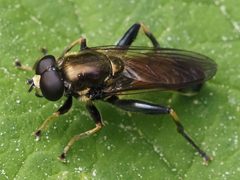
Xylota is a Holarctic of hoverflies ( Syrphidae) comprising over 100 described , with 12 species occurring in Europe. are characterized by their elongate body form and association with woodland . Unlike most syrphid flies, many Xylota species rarely visit flowers, instead feeding on pollen gathered from leaf surfaces. Larvae are saprophytic, developing in rotting wood of both broadleaved and coniferous trees.


Pronunciation
How to pronounce Xylota: //zaɪˈloʊtə//
These audio files are automatically generated. While they are not always 100% accurate, they are a good starting point.
Identification
Xylota can be distinguished from related Chalcosyrphus and Brachypalpoides by subtle morphological differences, though species-level identification is difficult and risky from photographs alone. Within the genus, species such as X. sylvarum and X. xanthocnema can be separated by characters including the coloration of the hind tibiae (dark in X. sylvarum). are typically large, black hoverflies with golden or yellowish markings; some species exhibit entirely black coloration without steel blue highlights or red abdominal markings.
Images
Habitat
are generally associated with woodland and woodland edges. Larvae inhabit rotting wood, including both broadleaved and coniferous tree material. The shows strong fidelity to forested environments where dead wood is available for larval development.
Distribution
Holarctic distribution, with over 100 described globally. In Europe, 12 species occur, with 7 species recorded from Britain. Abundant across the UK and continental Europe; widespread in England and Wales, scarcer in Scotland. Records also from North America including Vermont.
Seasonality
fly from May through October in temperate regions. Activity period varies by and locality.
Diet
feed on pollen, which they gather primarily from leaf surfaces rather than from flowers directly. They consume windblown pollen stuck to honeydew on foliage. Some do visit flowers occasionally. Larvae are saprophages, feeding on decaying wood material.
Life Cycle
Larvae develop in rotting tree material (broadleaved and coniferous wood). emerge and are active during the warmer months. The complete details including and pupal stages are not explicitly documented in available sources.
Behavior
are frequently observed running over the upper surfaces of leaves, a that gives rise to like "Leafwalkers." Many exhibit atypical feeding behavior for syrphid flies, avoiding flowers and instead harvesting pollen from foliage. Some species flick their wings while running on foliage or logs, behaviorally mimicking .
Ecological Role
Larvae contribute to wood decomposition as saprophages in forest . may serve as to a limited degree, though their primary ecological function appears to be as decomposer associates.
Similar Taxa
- ChalcosyrphusStructurally similar with related body form; distinguished by subtle morphological characters
- BrachypalpoidesClosely allied with similar overall appearance; requires detailed examination for separation
- TemnostomaAnother syrphid with -mimicking appearance and wing-flicking , but with different larval (develop in decaying plant matter submerged in water)
More Details
Genomic resources
The first -level assembly for Xylota was produced for X. sylvarum: 534.8 Mb genome, 11,993 protein-coding genes, 5 chromosomal pseudomolecules including X , 16.0 kb mitochondrial genome.
Taxonomic challenges
-level identification within Xylota has historically been difficult, and identification based on photographs is considered risky due to subtle diagnostic characters requiring microscopic examination.
Sources and further reading
- BugGuide
- Wikipedia
- GBIF taxonomy match
- iNaturalist taxon
- NCBI Taxonomy
- Catalogue of Life
- Bug Eric: Eight Illinois Wasp and Bee Mimics in Twenty Minutes
- Diptera | Beetles In The Bush | Page 5
- June | 2012 | Beetles In The Bush
- Eumastacidae | Beetles In The Bush
- The genome sequence of the Golden-tailed Leafwalker, Xylota sylvarum (Linnaeus, 1758).