
Xylota segnis
(Linnaeus, 1758)
Orange-belted Leafwalker, brown-toed forest fly, lazy wood fly
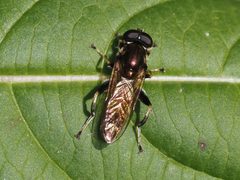
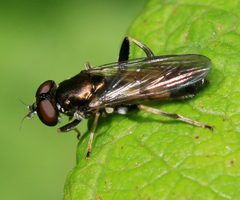
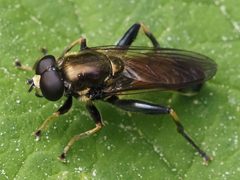
Xylota segnis is a common Palearctic and Nearctic hoverfly distinguished by its black with a prominent orange or yellowish-red patch on tergites 2 and 3. are notable for their sedentary , often resting motionless on leaves rather than actively flying. The is polyvoltine with up to three annually and has been observed from April through September. Larvae develop in decaying tree sap and have also been recorded from decaying human remains.
Pronunciation
How to pronounce Xylota segnis: //zaɪˈloʊtə ˈsɛɡnɪs//
These audio files are automatically generated. While they are not always 100% accurate, they are a good starting point.
Identification
Distinguished from similar Xylota by the combination of: (1) black with large orange-red patch restricted to tergites 2 and 3 with black apex on tergite 3, (2) yellow front and hind legs with dark , (3) greenish black with yellowish hairs, and (4) reddish . The male hind process is diagnostic for sex determination. Separation from Xylota flavitibia requires examination of leg coloration and abdominal pattern details.
Images
Habitat
Primarily inhabits low bushes in deciduous and mixed woodlands. frequently rest on leaf surfaces in shaded understory conditions. Larval centers on decaying tree sap flows and associated fermenting substrates in forest environments.
Distribution
Palearctic and Nearctic distribution. Present throughout Europe including Mediterranean regions, the Caucasus, and across Russia to the Russian Far East and Japan. In the Nearctic, occurs in southeastern Canada and northeastern United States. Additional records from the Azores (Faial, São Miguel, Santa Maria, Terceira) and Belgium (Flanders).
Seasonality
period extends from April to September. Polyvoltine with up to three per year in favorable conditions. most frequently encountered during late spring and summer months.
Diet
feed by grazing anemophilous pollen from leaf surfaces. Occasional flower visitation recorded including: Corylus avellana, Rubus idaeus, Euphorbia cyparissias, Aegopodium podagraria, Angelica sylvestris, Heracleum sphondylium, Cirsium arvense, and Crataegus . Adults also consume honeydew from aphids.
Host Associations
- Corylus avellana - nectar sourceflower visitation
- Rubus idaeus - nectar sourceflower visitation
- Euphorbia cyparissias - nectar sourceflower visitation
- Aegopodium podagraria - nectar sourceflower visitation
- Angelica sylvestris - nectar sourceflower visitation
- Heracleum sphondylium - nectar sourceflower visitation
- Cirsium arvense - nectar sourceflower visitation
- Crataegus - nectar sourceflower visitation
Life Cycle
Complete with , larval, pupal, and stages. Polyvoltine with up to three annually. Larvae develop in decaying tree sap; occurs in larval stage with in spring. Larvae have also been documented in decaying human remains. Adults emerge April through September depending on latitude and local conditions.
Behavior
Characteristically sedentary; rest motionless on leaves for extended periods and fly infrequently, earning the specific epithet 'segnis' (slipping or lazy). When disturbed, adults may return repeatedly to the same perch location. Males possess modified hind with long upcurved pointed processes of unknown behavioral function. Adults occasionally visit flowers but more commonly feed on pollen deposited on leaf surfaces.
Ecological Role
function as pollen consumers and potential incidental during occasional flower visits. Larvae contribute to decomposition processes in forest through saprotrophic feeding on decaying tree sap. The has forensic significance due to larval occurrence in human remains.
Human Relevance
Used as a biological indicator for woodland quality. Larval presence in decaying human remains has been documented, indicating potential forensic utility. are common subjects for hoverfly identification training due to widespread distribution and distinctive appearance. No economic significance as pest or beneficial documented.
Similar Taxa
- Xylota flavitibiaSimilar size and general appearance; distinguished by yellow tibiae on all legs versus dark in X. segnis, and subtle differences in abdominal color pattern
- Xylota sylvarumOverlapping woodland ; requires examination of leg coloration and abdominal markings for reliable separation
- Chalcosyrphus spp.Similar black coloration with possible abdominal markings and association with dead wood; distinguished by different wing venation and lack of orange-red abdominal patch
More Details
Etymology
The name Xylota derives from the rare Byzantine-Greek ξυλωτή (xsylōtē) meaning 'wooden'. The epithet segnis is Latin for 'slipping' or 'lazy', referencing the fly's habit of resting motionless on leaves. The vernacular translation 'lazy wood fly' captures both elements of the .
Male genitalia
The male genitalia were figured by Hippa (1968), providing diagnostic characters for identification within the .
Larval illustration
The larva was illustrated in color by Rotheray (1994), aiding identification of stages.