
Xylota angustiventris
Loew, 1866
Two-spotted Leafwalker
Xylota angustiventris is an uncommon syrphid fly found in northeastern North America. are medium-sized hover flies measuring 12.2–14.4 mm, predominantly black with two distinct yellow spots on the in males. The species belongs to the Xylota, whose larvae typically develop in decaying wood or tree holes where they feed on sap or decaying organic matter rather than being predatory. Adults are associated with flowers where they feed on nectar and pollen.
Pronunciation
How to pronounce Xylota angustiventris: //zaɪˈloʊtə ænˌɡʌstɪˈvɛntrɪs//
These audio files are automatically generated. While they are not always 100% accurate, they are a good starting point.
Identification
The two yellow abdominal spots in males distinguish this from other Xylota species. The combination of black body coloration with discrete yellow spotting, medium size (12–14 mm), and northeastern North American distribution helps separate it from . Final identification requires examination of male terminalia or other subtle morphological features.
Images
Appearance
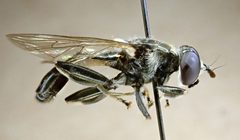
are 12.2–14.4 mm (0.48–0.57 in) in length. Body is largely black with two yellow spots on the in males. The overall form is typical of the Xylota: somewhat robust and compact rather than slender like many flower-visiting syrphids.
Habitat
are found in woodland and forest edge where flowers are available. Larval habitat is inferred from -level characteristics: decaying wood, tree holes, or under bark where sap flows or organic matter accumulates.
Distribution
Northeastern North America, including Canada and the United States. The is described as uncommon throughout its range.
Seasonality
activity period not explicitly documented; likely active during spring and summer when flowers are in bloom, based on -level patterns and adult flower-visiting .
Diet
feed on nectar and pollen from flowers. Larval diet unknown for this , but larvae of Xylota species are saprophagous, feeding on sap, decaying wood, or fermenting organic matter in tree holes and bark crevices rather than being predatory.
Life Cycle
Complete with , larva, pupa, and stages. Larvae develop in decaying wood or tree holes. Specific details of egg placement, larval instars, site, and time are unknown.
Behavior
exhibit typical syrphid of hovering near flowers and landing to feed on nectar and pollen. Males may use the yellow abdominal spots in visual signaling. Larvae are saprophagous in wood rather than predatory.
Ecological Role
contribute to pollination through flower visitation. Larvae function as decomposers in forest by processing decaying wood material and sap flows. The occupies a trophic position distinct from aphidophagous syrphids.
Human Relevance
No significant documented interactions with humans. Not known as a pest or beneficial in agriculture. Occasionally observed by entomologists and naturalists in northeastern forests.
Similar Taxa
- Xylota flavitibiaSimilar size and black coloration, but distinguished by yellow tibiae rather than abdominal spots; found in western North America
- Xylota segnisEuropean with similar general appearance; distinguished by distribution and subtle morphological differences in leg coloration
- Chalcosyrphus speciesSimilar black coloration and wood-associated larvae, but Chalcosyrphus males have contiguous () and often show metallic blue or red markings
Misconceptions
The 'Two-spotted Leafwalker' may suggest a leaf-dwelling habit, but the is not particularly associated with leaves; visit flowers and larvae inhabit wood. Despite being a syrphid fly, this species does not have -predatory larvae—the larvae are saprophagous in wood, a common misconception about hover flies.
More Details
Taxonomic History
Described by Hermann Loew in 1866. The has remained relatively obscure, with limited biological study due to its uncommon status.
Larval Biology Uncertainty
While larvae are explicitly stated as unknown for this , -level characteristics strongly suggest wood-inhabiting, saprophagous habits rather than the typical of many syrphids.