
Helophilus
Meigen, 1822
Marsh Flies, Tiger Hoverflies
Species Guides
9- Helophilus bottnicus(Gray-banded Marsh Fly)
- Helophilus fasciatus(Narrow-headed Marsh Fly)
- Helophilus groenlandicus(Black-margined Marsh Fly)
- Helophilus hybridus(hoverfly)
- Helophilus intentus(Yellow-legged Marsh Fly)
- Helophilus lapponicus(Yellow-margined Marsh Fly)
- Helophilus latifrons(Broad-headed Marsh Fly)
- Helophilus neoaffinis(Northwestern Marsh Fly)
- Helophilus obscurus(obscure marsh fly)
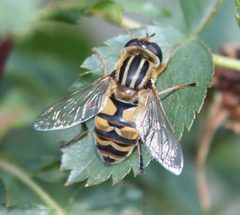
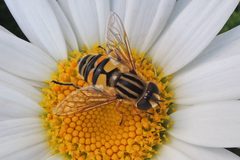
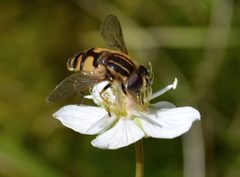
Helophilus is a of moderate to large hoverflies in the Syrphidae, commonly known as marsh flies or tiger hoverflies. are notable or mimics with distinctive lengthwise yellow stripes on the and transverse bands on the . Larvae are aquatic "rat-tailed maggots" that filter-feed on microorganisms in organic-rich water. The genus comprises two subgenera: Helophilus and Pilinasica (the latter containing New Zealand ).
Pronunciation
How to pronounce Helophilus: //hɛˈlɒfɪləs//
These audio files are automatically generated. While they are not always 100% accurate, they are a good starting point.
Identification
are distinguished from other hoverfly by the combination of longitudinal yellow stripes on the () and transverse abdominal banding. Most are yellow-black with large yellow-orange abdominal markings and an elongate pterostigma on the wing. Body length ranges 9–16.5 mm. Some species deviate: Helophilus hochstetteri is blue metallic, and H. cingulatus is black and white. The vertical thoracic stripes separate Helophilus from superficially similar genera like Eristalis (which lacks such striping) and from non-mimetic syrphids.
Images
Habitat
frequent sunny, flower-rich including meadows, woodland edges, and gardens. They prefer warm, wet places and are often observed sunbathing on fresh leaves. Larvae inhabit organic-rich standing water: ponds, ditches, rain gutters, and water gardens. They develop in nutrient-rich mud at the bottom, using a telescopic siphon to breathe at the water surface.
Distribution
Primary distribution in Europe, North America, Asia, and New Zealand. Recorded from Denmark, Norway, Sweden, and the United States (including Vermont). Sparse observations in Africa and South America. In New Zealand, occurs throughout the territory including smaller islands; five (H. antipodus, H. hochstetteri, H. seelandicus, H. cingulatus, H. campbelli) are placed in subgenus Pilinasica.
Seasonality
period predominantly summer. In Europe, active from March through October, with peak activity in warmer months.
Diet
feed on pollen and nectar, obtaining protein from pollen and energy from nectar. Females require pollen consumption for development. Larvae are filter-feeders, consuming bacteria and other microorganisms from decaying organic matter in aquatic .
Life Cycle
are laid in nutrient-rich, organic water. Hatching time is temperature-dependent. Larvae ("rat-tailed maggots") possess a highly elongated, telescopic siphon for breathing, adjustable to water depth. Mature larvae leave water to pupate in damp soil in oval chambers with hardened protective skin. are short-lived, surviving from a few days to a few weeks.
Behavior
are fast, direct fliers that rarely hover, moving decisively between flowers. When alarmed, they switch to zig-zag resembling / escape . During foraging, they make large-amplitude dorsoventral abdominal movements. Some (H. trivittatus, H. affinis) are migratory and capable of crossing considerable ocean stretches. Adults are sun-loving and frequently sunbathe.
Ecological Role
are , carrying pollen over longer distances than bees due to less restricted home ranges. Some migratory occur at high densities, potentially compensating for lower per-visit pollination . In New Zealand, species pollinate native plants including the orchid Dendrobium cunninghamii; H. hochstetteri acts as a synergistic pollinator for kiwifruit alongside honey bees. Larvae contribute to nutrient cycling in aquatic through filter-feeding on decay microorganisms.
Human Relevance
are beneficial as of crops and wild plants. H. hochstetteri provides pollination services for kiwifruit in New Zealand. Larvae may occur in water gardens and rain gutters, occasionally prompting curiosity or concern. Not considered pests.
Similar Taxa
- EristalisLarvae share aquatic filter-feeding habit and rat-tailed ; lack the distinctive longitudinal thoracic stripes of Helophilus.
- EristalinusLarvae ecologically similar in aquatic organic-rich ; differ in thoracic patterning.
- AnasimyiaLarvae occupy similar aquatic ; lack Helophilus-type thoracic striping.
- ParhelophilusClosely related with similar larval ; differ in thoracic pattern and abdominal markings.
Sources and further reading
- BugGuide
- Wikipedia
- GBIF taxonomy match
- iNaturalist taxon
- NCBI Taxonomy
- Catalogue of Life
- Spring is sprung… - Buglife Blog - Buglife
- Bug Eric: Grand Finale
- Bug Eric: City Nature Challenge 2023 Recap
- National Meadows Day 2023 in Scotland - Buglife Blog - Buglife
- Bug Eric: Fly Day Friday: Rat-tailed Maggots
- Bug Eric: Eight Illinois Wasp and Bee Mimics in Twenty Minutes
- Flight behaviour during foraging of the social waspVespula vulgaris(Hymenoptera: Vespidae) and four mimetic hoverflies (Diptera:Syrphidae)Sericomyia silentis,Myathropa florea,Helophilussp. andSyrphussp.