
Helophilus neoaffinis
Fluke, 1949
Northwestern Marsh Fly
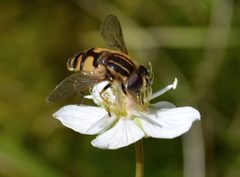
A syrphid fly in the Helophilus, recognized by iNaturalist as the Northwestern . As with other members of its genus, it likely exhibits yellowjacket mimicry with vertical yellow stripes on the . The larvae develop in decaying plant matter submerged in water, characteristic of the 'rat-tailed maggot' form found in aquatic or semi-aquatic .
Pronunciation
How to pronounce Helophilus neoaffinis: /hɛˈlɒfɪləs ˌniːoʊəˈfɪnɪs/
These audio files are automatically generated. While they are not always 100% accurate, they are a good starting point.
Identification
Members of the Helophilus can be identified by vertical yellow stripes on the . Specific identification of H. neoaffinis likely requires examination of subtle morphological features; the was described by Fluke in 1949 and appears to be less commonly documented than such as H. fasciatus or H. pendulus.
Images
Habitat
Aquatic and semi-aquatic environments; larvae develop in decaying plant matter that is submerged in water, including putrid and organic-rich standing water. are sun-loving and associated with open, sunny areas near larval .
Distribution
The specific distribution of H. neoaffinis is not well-documented in the provided sources. The 'Northwestern ' suggests a range in the northwestern region of North America, but this requires verification.
Diet
visit flowers for nectar and pollen. Larvae filter bacteria and other microbes from organic matter in aquatic .
Life Cycle
Complete . Larvae are aquatic 'rat-tailed maggots' with into an extensible breathing siphon that connects to the water surface. Larvae mature in decaying submerged vegetation, then seek dry land to pupate in a hard capsule.
Behavior
are sun-loving, consistent with the name Helophilus ('sun-lover'). Adults visit flowers. The likely exhibits -mimicry as observed in , though this is not explicitly documented for H. neoaffinis specifically.
Ecological Role
Larvae contribute to nutrient cycling in aquatic by processing decaying organic matter. may serve as when visiting flowers.
Similar Taxa
- Helophilus fasciatusAlso has vertical yellow thoracic stripes and similar aquatic larval ; distinguished by specific morphological features requiring close examination
- Helophilus pendulusShares yellowjacket-mimic appearance and aquatic larval development; known as the 'Tiger Hoverfly' in Europe and widely documented
- Eristalis tenaxAnother rat-tailed maggot producer with aquatic larvae, but lacks the distinct vertical thoracic stripes of Helophilus and has a different appearance ( mimic)
Sources and further reading
- BugGuide
- GBIF taxonomy match
- iNaturalist taxon
- Catalogue of Life
- Spring is sprung… - Buglife Blog - Buglife
- Bug Eric: Grand Finale
- Bug Eric: City Nature Challenge 2023 Recap
- National Meadows Day 2023 in Scotland - Buglife Blog - Buglife
- Bug Eric: Fly Day Friday: Rat-tailed Maggots
- Bug Eric: Eight Illinois Wasp and Bee Mimics in Twenty Minutes