
Helophilus intentus
Curran & Fluke, 1926
Yellow-legged Marsh Fly
Helophilus intentus is a of syrphid fly (flower fly) in the Syrphidae. It belongs to the Helophilus, whose members are commonly known as marsh flies due to their association with aquatic . The larvae develop in decaying plant matter submerged in water. are sun-loving and frequently observed visiting flowers for nectar and pollen.
Pronunciation
How to pronounce Helophilus intentus: /hɛˈlɒfɪləs ɪnˈtɛntəs/
These audio files are automatically generated. While they are not always 100% accurate, they are a good starting point.
Identification
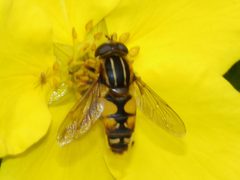
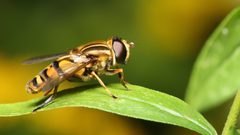
Members of the Helophilus can be recognized by vertical yellow stripes on the . The specific epithet 'intentus' and -level distinguishing features for H. intentus are not documented in available sources. The 'Yellow-legged ' suggests yellow leg coloration may be a diagnostic feature.
Images
Habitat
Aquatic and semi-aquatic environments. Larvae develop in decaying plant matter that is submerged in water. are associated with sunny, open areas near water sources.
Diet
visit flowers for nectar and pollen. Larvae filter bacteria and other microbes from organic matter in aquatic or saturated substrates.
Life Cycle
Complete with , larval, pupal, and stages. Larvae are aquatic or semi-aquatic, living in decaying submerged plant matter. Mature larvae seek dry land to pupate. The pupal capsule is hard and resembles a tiny mouse in shape.
Behavior
are sun-loving, consistent with the name Helophilus ('sun-loving'). Adults are active flower visitors. Larvae remain connected to the water surface via a breathing siphon.
Ecological Role
function as . Larvae contribute to decomposition of organic matter in aquatic . The serves as a mimic, likely of yellowjackets (Vespula spp.), providing protective coloration against .
Human Relevance
flies contribute to pollination of wildflowers and potentially crop plants. No documented pest status or economic impact. Like other syrphid flies, larvae may be encountered in water gardens or natural aquatic .
Similar Taxa
- Helophilus fasciatusAnother member of the Helophilus with similar yellow thoracic stripes and marsh-dwelling larvae; distinguished by specific pattern details and geographic distribution
- Helophilus pendulusEuropean with similar and ; known as the 'Tiger Hoverfly' and shares the yellow-striped pattern
- Eristalis tenaxAnother eristaline syrphid with aquatic rat-tailed maggot larvae and -mimic coloration, but lacks the vertical thoracic stripes of Helophilus
More Details
Taxonomic Note
Helophilus intentus was described by Curran & Fluke in 1926. The Catalogue of Life lists this name as a synonym, while GBIF treats it as an accepted . This discrepancy suggests taxonomic revision may be needed.
Larval Morphology
Based on -level characteristics, larvae likely possess the 'rat-tailed maggot' form typical of Eristalini, with an extensible breathing siphon connecting to the water surface.
Sources and further reading
- BugGuide
- Wikipedia
- GBIF taxonomy match
- iNaturalist taxon
- Catalogue of Life
- Spring is sprung… - Buglife Blog - Buglife
- Bug Eric: Grand Finale
- Bug Eric: City Nature Challenge 2023 Recap
- National Meadows Day 2023 in Scotland - Buglife Blog - Buglife
- Bug Eric: Fly Day Friday: Rat-tailed Maggots
- Bug Eric: Eight Illinois Wasp and Bee Mimics in Twenty Minutes