
Helophilus latifrons
Loew, 1863
Broad-headed Marsh Fly
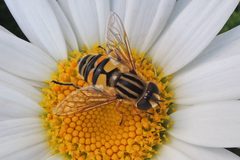
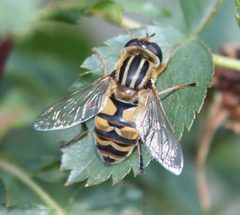
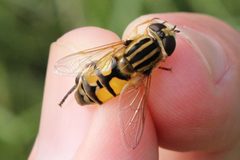
Helophilus latifrons, commonly known as the Broad-headed , is a of syrphid fly in the Syrphidae. are flower visitors that obtain nectar and pollen from blossoms. The larvae are aquatic and develop in decaying submerged vegetation, functioning as decomposers in wetland . The species occurs across much of North America including the United States, southern Canada, and mountainous regions of Mexico.
Pronunciation
How to pronounce Helophilus latifrons: /hɛˈlɒfɪləs læˈtɪfrɒnz/
These audio files are automatically generated. While they are not always 100% accurate, they are a good starting point.
Identification
Helophilus latifrons can be distinguished from similar Helophilus by its characteristically broad , as reflected in both its common and . Members of the Helophilus are recognized by vertical yellow stripes on the , which aid in their identification as probable yellowjacket mimics. The genus name Helophilus, meaning 'sun-loving,' reflects the of basking in sunlight. Definitive species-level identification requires careful examination and may need microscopic analysis.
Images
Habitat
Aquatic and semi-aquatic environments where larval development occurs in decaying plant matter submerged in water. frequent flowers in open, sunny areas near wetland margins.
Distribution
United States, lower Canada, and mountainous regions of Mexico.
Diet
feed on nectar and pollen from flowers. Larvae consume decaying submerged vegetation.
Life Cycle
Larvae are aquatic, developing in decaying plant matter submerged in water. The pupal stage occurs on dry land after the mature larva leaves the aquatic environment. emerge from the pupal case.
Behavior
are sun-loving and frequently observed basking. They are capable of hovering , remaining nearly motionless in the air. Adults commonly visit flowers for feeding. The exhibits mimicry of yellowjacket (Vespula spp.), likely as a defensive against .
Ecological Role
function as by visiting flowers for nectar and pollen. Larvae serve as decomposers in aquatic , breaking down decaying vegetation. The contributes to nutrient cycling in wetland .
Human Relevance
provide pollination services to wildflowers and potentially to agricultural crops. The is not known to be a pest or to cause direct harm to humans. Larvae may occasionally be observed in artificial water features such as rain gutters or container gardens.
Similar Taxa
- Helophilus fasciatusAnother North American Helophilus with similar yellow thoracic striping and aquatic larval ; distinguished by shape and other subtle morphological features
- Helophilus pendulusEuropean with similar and appearance; not native to North America but shares -level traits of yellow thoracic stripes and aquatic larvae
- Eristalis tenaxAnother syrphid with aquatic rat-tailed maggot larvae; distinguished by different coloration pattern and more pronounced mimicry
More Details
Taxonomic Note
Catalogue of Life lists Helophilus latifrons as an 'ambiguous synonym,' while GBIF treats it as an accepted . This discrepancy suggests some taxonomic uncertainty that may require further resolution.
Larval Morphology
Larvae of Helophilus , like other Eristalini, possess a respiratory siphon that functions as a breathing tube, connecting them to the water surface while they feed on decaying matter below. The length of this siphon varies among related .
Sources and further reading
- BugGuide
- Wikipedia
- GBIF taxonomy match
- iNaturalist taxon
- NCBI Taxonomy
- Catalogue of Life
- Spring is sprung… - Buglife Blog - Buglife
- Bug Eric: Grand Finale
- Bug Eric: City Nature Challenge 2023 Recap
- National Meadows Day 2023 in Scotland - Buglife Blog - Buglife
- Bug Eric: Fly Day Friday: Rat-tailed Maggots
- Bug Eric: Eight Illinois Wasp and Bee Mimics in Twenty Minutes