
Eristalinus
Rondani, 1845
Lagoon Flies
Species Guides
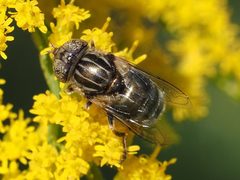
2- Eristalinus aeneus(Common Lagoon Fly)
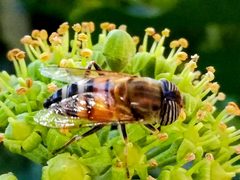
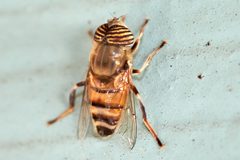
- Eristalinus taeniops(band-eyed drone fly)
Eristalinus is a of hoverflies ( Syrphidae) characterized by distinctive spotted or banded patterns in most . These stout, nimble fliers are distributed across Europe, Africa, Asia, and the Americas, with several species becoming widespread invasives outside their native ranges. The genus has undergone taxonomic revision, with molecular and morphological studies reorganizing former subgenera Eristalodes and Lathyrophthalmus into two primary clades. Species such as E. taeniops and E. aeneus are notable for their rapid global spread and potential as managed in agricultural systems.
Pronunciation
How to pronounce Eristalinus: /ɛ.rɪˈsta.lɪ.nəs/
These audio files are automatically generated. While they are not always 100% accurate, they are a good starting point.
Identification
Most Eristalinus are distinguished by prominent markings—spots or bands—though these may fade in preserved specimens. are generally stout-bodied compared to other hoverflies. The was historically divided into subgenera based on eye pattern (spotted vs. striped), but molecular studies have shown this character is not taxonomically reliable. Male genitalia and molecular data are now used for definitive species identification. E. taeniops specifically shows mimicry with contrasting striped eyes.
Images
Habitat
Aquatic and semi-aquatic environments including lagoons, ponds, slow-moving rivers, streams, and irrigation ditches. Larvae develop in putrid, organic-rich standing water, saturated manure, tree holes, bog mat pools, and rain gutters. frequent agricultural , natural vegetation, and urban green spaces. Several show preference for anthropized .
Distribution
Native to the Old World (Europe, Africa, Asia). Introduced and established in the Americas: United States, Argentina (at least 10 provinces), Chile, Paraguay, and other South American countries. E. taeniops has spread rapidly across South America via airports and seaports. Records exist from Belgium, Denmark, Norway, Sweden, and Vermont (USA).
Diet
Larvae are filter-feeders, consuming bacteria and microbes from organic matter in aquatic substrates. are feeding on floral nectar and pollen; E. aeneus shows floral constancy and visits multiple plant including mango and watermelon.
Life Cycle
Complete with , larval, pupal, and stages. Rat-tailed maggot larvae possess an extensible siphon for breathing at the water surface while feeding in low-oxygen substrates. Larvae seek dry land to pupate; pupal capsules are hard and mouse-shaped. E. arvorum time approximately 30 days. E. aeneus preadult development 22–27 days depending on larval medium; total preoviposition period 34–38 days.
Behavior
display bimodal daily activity with peaks in mid-morning and mid-afternoon, active across wide temperature (17.8–37.4°C), light (8.2–57.4 klux), and humidity (19.0–88.8%) ranges. Foraging includes nectar and pollen feeding, with longer visits for pollen (6.44 s) than nectar (5.51 s). Adults exhibit innate multimodal floral identification using olfactory cues combined with visual detection of radial symmetry and 500–700 nm wavelength reflection. Nimble capabilities exceed those of many other hoverfly .
Ecological Role
Important for crops and wild plants; E. aeneus effectively pollinates mango, watermelon, and other flowering plants. Larvae contribute to decomposition in aquatic organic substrates. Some are candidate managed pollinators for protected systems. Potential environmental .
Human Relevance
Used as managed in greenhouse production of mango and triploid watermelon, where they can increase yield 24–47% compared to low- releases. E. aeneus is a common research subject for studies of sensory , innate , and pollination . Some are ; E. taeniops has spread rapidly in South America with unknown impacts.
Similar Taxa
- EristalisBoth contain rat-tailed maggot larvae with extensible breathing siphons and share tribe Eristalini. Eristalis tenax (Drone Fly) is the most commonly encountered in this group. Eristalinus is distinguished by patterning and stouter body build.
- HelophilusShares aquatic larval and tribe Eristalini. Helophilus larvae typically have shorter siphons and different coloration patterns.
- SericomyiaLarvae inhabit bog mat pools; differ in and lack the distinctive markings of Eristalinus.
More Details
Taxonomic History
The was formerly divided into three clades (Eristalinus, Eristalodes, Lathyrophthalmus) based on . Recent molecular and male genitalia studies reorganized European into two clades: Eristalinus (+ Lathyrophthalmus) and Eristalodes, demonstrating that eye patterning is not phylogenetically informative.
Invasive Spread
E. taeniops, native to Africa, has become a successful global invader. First recorded in Argentina in multiple provinces and now confirmed in Paraguay and Chile. Spread appears facilitated by human transport via airports and seaports, with establishment in urban and anthropized preceding potential spread to natural .
Pollination Efficiency
E. aeneus shows high pollination effectiveness in controlled studies. At release densities of 30–45 individuals/m², it significantly increases pollen deposition and fruit yield in triploid watermelon compared to lower densities. The maintains activity across extreme environmental conditions, making it suitable for greenhouse management.
Larval Adaptations
The rat-tailed maggot represents a key to hypoxic aquatic . The telescoping siphon allows larvae to simultaneously access surface oxygen and feed at depth in organic-rich substrates. Different within Eristalini show siphon length variation correlated with habitat: long in Eristalis/Eristalinus (deep, putrid water), short in Chrysogaster (shallow pond edges).
Sources and further reading
- BugGuide
- Wikipedia
- GBIF taxonomy match
- iNaturalist taxon
- NCBI Taxonomy
- Catalogue of Life
- Lagoon Fly: Seeing Spots | Bug Squad
- Bug Eric: Fly Day Friday: Rat-tailed Maggots
- March | 2011 | Beetles In The Bush | Page 2
- Argentina | Beetles In The Bush | Page 11
- Diptera | Beetles In The Bush | Page 7
- Archives | Beetles In The Bush
- New records and distribution of the tiger fly Eristalinus (Eristalodes) taeniops (Wiedemann, 1818) (Diptera: Syrphidae) in Paraguay
- Morphological characteristics and biological cycle of the hoverfly Eristalinus arvorum (Fabricius, 1787) (Diptera, Syrphidae)
- Innate floral object identification in the generalist solitary hoverfly pollinator Eristalinus aeneus
- Eristalinus taeniops (Wiedemann, 1818) (Diptera: Syrphidae), an exotic flower fly rapidly spreading in South America: A review
- Redescription and Identification of Eristalinus quinquestriatus (Fabricius, 1794) and Melanostoma orientale (Wiedemann, 1824) Diptera: Syrphidae by DNA sequencing from the city Gorakhpur, Uttar Pradesh, India
- New records of the exotic Band-eyed Drone Fly, Eristalinus taeniops (Wiedemann, 1818) (Diptera, Syrphidae), in Argentina
- Age-stage two-sex life table analysis ofEristalinus aeneus(Diptera, Syrphidae) reared with two different larval media
- Activity and foraging behaviour of the hoverflyEristalinus aeneus(Scopoli, 1763) in protected cultivation of mango (Mangifera indicaL.)
- New records of Pseudoscaeva meridionalis (Fluke, 1951), Eristalinus (Eristalodes) taeniops (Wiedemann 1818), and Toxomerus politus (Say, 1823) (Diptera, Syrphidae) to Chile, with updated distributions for the New World according to citizen science
- Pollination Effectiveness of the Hoverfly Eristalinus aeneus (Scopoli, 1763) in Diploid and Triploid Associated Watermelon Crop