
Eristalinus taeniops
(Wiedemann, 1818)
band-eyed drone fly, stripe-eyed lagoon fly, tiger fly
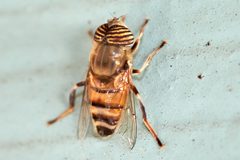
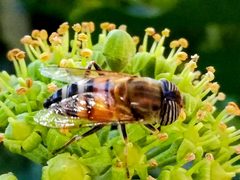
Eristalinus taeniops is a hoverfly ( Syrphidae) native to the Palearctic and Afrotropical regions that has become established as an across much of the world, including North and South America. are notable with distinctive banded featuring five vertical dark stripes, and they exhibit of bees and . The species is strongly associated with human-modified environments and has shown rapid geographic expansion in South America via airports and seaports.
Pronunciation
How to pronounce Eristalinus taeniops: //ɛrɪˈstæləˌnəs tʰaɪˈniˌɒps//
These audio files are automatically generated. While they are not always 100% accurate, they are a good starting point.
Identification
The five vertical dark stripes on the are diagnostic and immediately distinguish this from most other syrphid flies. The -like yellow and black coloration with metallic yellow-brown and reddish-yellow banded separates it from similar Eristalis species. The banded pattern differs from the spotted eyes of Eristalinus aeneus (lagoon fly).
Images
Appearance
reach 11–14 mm in length. The has a metallic yellow-brown coloration and is densely covered with yellow hairs. The scutellum is yellow-brown. The is reddish-yellow with transverse black bands. The are the most distinctive feature, displaying five distinct vertical dark stripes on a lighter background. Wings are transparent, usually yellowish-brown at the base, with that are brightly pale yellow. The overall coloration mimics bees and .
Habitat
Occurs in holly oak forests, forest clearings, maquis, riparian areas along rivers and streams, and coastal marshes. Strongly and associated with human-modified environments including urban areas, airports, and seaports. In South America, specimens have been captured exclusively within cities.
Distribution
Native to the Palearctic and Afrotropical regions. Established in Europe (Albania, Balearic Islands, Bulgaria, Canary Islands, Cyprus, France, Greece, Italy, Malta, North Macedonia, Poland, Portugal, Spain), North Africa, the Near East (Turkey, Lebanon, Israel, Syria), the Caucasus, eastern Afrotropical realm to South Africa, the (Nepal, northern India), northern Pakistan, and Iran. Introduced to North America (California, Florida) and South America, with confirmed records in Argentina (10 provinces including Buenos Aires, Córdoba), Brazil (Rio de Janeiro, Poços de Caldas, Curitiba, Nova Maringá, Goiás), Chile, Colombia, and Paraguay (Asunción, Hernandarias, San Lorenzo, Luque, Fernando de la Mora).
Seasonality
are active from April to October, with peak abundance from May to August.
Diet
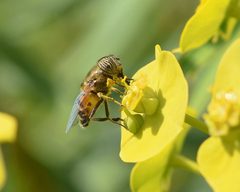
feed on nectar and pollen of yellow and white flowers, including Erica, Daphne, Senecio, Rosaceae , and Chenopodium quinoa.
Host Associations
- Chenopodium quinoa - flower visitationquinoa
Life Cycle
Larvae develop as rat-tailed maggots in mud, animal carcasses, and water contaminated by pig manure. The rat-tail is a telescopic breathing siphon that allows larvae to respire while submerged in decomposing organic matter.
Behavior
hover in front of flowers before landing to forage. Exhibits of bees and , likely reducing . Rapidly expanding geographic range in South America, with spread facilitated by human transportation infrastructure.
Ecological Role
of flowering plants. Potential competitive interactions with native syrphid in invaded regions, though specific impacts require further study.
Human Relevance
Considered a in agricultural contexts, including quinoa . association with human environments raises concerns about potential invasiveness, though specific negative impacts remain under evaluation. Attractive to photographers due to striking pattern.
Similar Taxa
- Eristalinus aeneusSimilar size and general appearance, but distinguished by spotted rather than banded
- Eristalis tenaxSimilar -mimic coloration, but lacks the distinctive five-striped pattern
- Milesia virginiensisAnother large -mimic syrphid, but with different wing venation and unbanded
More Details
Nomenclature
Originally described as Eristalis taeniops by Wiedemann in 1818; later transferred to Eristalinus. Sometimes placed in subgenus Eristalodes.
Research significance
Subject of neurobiological research on innate floral object identification, demonstrating how small encode multimodal sensory cues for foraging.
Sources and further reading
- BugGuide
- Wikipedia
- GBIF taxonomy match
- iNaturalist taxon
- NCBI Taxonomy
- Lagoon Fly: Seeing Spots | Bug Squad
- March | 2011 | Beetles In The Bush | Page 2
- Argentina | Beetles In The Bush | Page 11
- Diptera | Beetles In The Bush | Page 7
- Archives | Beetles In The Bush
- Syrphidae | Beetles In The Bush
- New records and distribution of the tiger fly Eristalinus (Eristalodes) taeniops (Wiedemann, 1818) (Diptera: Syrphidae) in Paraguay
- New records of the exotic Band-eyed Drone Fly, Eristalinus taeniops (Wiedemann, 1818) (Diptera, Syrphidae), in Argentina
- Eristalinus taeniops (Wiedemann, 1818) (Diptera: Syrphidae), an exotic flower fly rapidly spreading in South America: A review
- New records of Pseudoscaeva meridionalis (Fluke, 1951), Eristalinus (Eristalodes) taeniops (Wiedemann 1818), and Toxomerus politus (Say, 1823) (Diptera, Syrphidae) to Chile, with updated distributions for the New World according to citizen science