
Eristalinus aeneus
(Scopoli, 1763)
Common Lagoon Fly
Eristalinus aeneus is a hoverfly (Syrphidae) with subcosmopolitan distribution, commonly found in freshwater including coastal lagoons, ponds, and slow-moving rivers. are effective of crops including watermelon and mango, and have been evaluated as managed pollinators in protected agriculture. The exhibits distinctive patterned with black spots, metallic coloration, and rapid hovering . Larvae develop in aquatic or semi-aquatic environments with decaying organic matter, possessing a characteristic extensible breathing siphon.

Pronunciation
How to pronounce Eristalinus aeneus: /ˌɛrɪˈstælinəs ˈeɪniəs/
These audio files are automatically generated. While they are not always 100% accurate, they are a good starting point.
Identification
Distinguished from similar Eristalis by patterned with discrete black spots rather than uniform coloration. E. tenax has unpatterned eyes. E. taeniops has banded eyes rather than spotted pattern. Tergites 2 and 3 completely shiny in E. aeneus; other Eristalinus species may differ in abdominal patterning. Male eye contiguity and female eye pilosity diagnostic for sex determination.
Images
Appearance
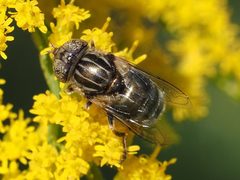
Wing length 6.5–9.25 mm. patterned with obvious black spots on metallic background. Tergites 2 and 3 completely shiny. Thoracic dorsum with faint greyish stripes (five strong grey stripes in Southern Europe). Male eyes meeting on ; female eyes bare on lower half. Hind tibiae with black ring after middle; with segments 2–4 darkened. Overall metallic bronze-green coloration.
Habitat
Freshwater : coastal lagoons, ponds, slow-moving rivers, streams, irrigation ditches. In northern range, confined to coastal sites with freshwater seepages and brackish rock pools; elsewhere in variety of freshwater habitats including association with animal and sewage farms. Anthropophilic in southern Europe.
Distribution
Subcosmopolitan. Recorded throughout Europe, United States, Mediterranean basin, and multiple continents. Present in Azores (Corvo, Flores, São Miguel, Santa Maria), Belgium (Flanders), and widely across Palearctic and Nearctic regions.
Seasonality
period April to October in temperate regions. Overwinters as .
Diet
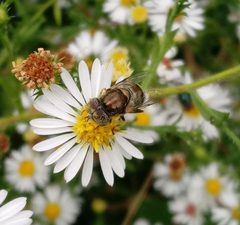
feed on nectar and pollen from diverse flowers including Aster, Berteroa incana, Cistus, Origanum, Salix repens, Taraxacum, and crop flowers such as watermelon and mango. Larvae filter bacteria and organic particles from decaying matter in aquatic ; can ingest particles 80–100 μm in size, larger than Eristalis tenax.
Life Cycle
to larva to pupa to . Larval stage has highest mortality. Preadult developmental time 22–27 days depending on rearing medium. Total preoviposition period 34–38 days. Adult maturation approximately 10–11 days. Mean time 39–46 days. Overwinters as adult. Larvae possess extensible breathing siphon connecting to water surface.
Behavior
Exhibits rapid, sustained hovering characteristic of Syrphidae. Bimodal daily activity pattern with peaks mid-morning and mid-afternoon. Foraging activity maintained across wide temperature (17.8–37.4°C), light (8.2–57.4 klux), and humidity (19.0–88.8%) ranges. Visits 36–46 flowers per 5 minutes on average. Nectar-feeding visits shorter (5.5 s) than pollen-feeding visits (6.4 s). No significant preference between pistillate and staminate flowers in some crops; visits flowers more than male flowers in mango. Innate floral identification using multimodal cues: radial symmetry combined with reflection in 500–700 nm wavelength range plus broad plant-based olfactory cues.
Ecological Role
of wild plants and crops including watermelon (Citrullus lanatus) and mango (Mangifera indica). Potential managed alternative to honey bees and bumble bees in protected . Bioindicator of water quality due to larval aquatic requirements. Contributes to decomposition through larval feeding on decaying organic matter.
Human Relevance
Evaluated and used as managed in greenhouse production of watermelon and mango, particularly for triploid seedless watermelon requiring cross-pollination. Improves fruit yield by 24–47% at appropriate release densities (30–45 individuals/m²). Artificial rearing protocols developed using brewery spent grain or soaked oat grains as larval media.
Similar Taxa
- Eristalis tenaxSimilar size and ; distinguished by unpatterned , smaller ingested particle size (70–80 μm vs 80–100 μm), and more restrictive mandibular lobes
- Eristalinus taeniopsSimilar patterning; distinguished by banded rather than spotted eye pattern, and different geographic origin (African native, more recently introduced to Americas)
- Eristalis arbustorumSimilar aquatic larval ; distinguished by smaller size and different abdominal patterning
Sources and further reading
- BugGuide
- Wikipedia
- GBIF taxonomy match
- iNaturalist taxon
- NCBI Taxonomy
- Encyrtid Holdings | Entomology Research Museum
- Learning the Insect Lingo While Working Abroad
- Nomenclatural changes in Phymatodes | Beetles In The Bush
- Bug Eric: Fly Day Friday: Rat-tailed Maggots
- March | 2011 | Beetles In The Bush | Page 2
- Argentina | Beetles In The Bush | Page 11
- Innate floral object identification in the generalist solitary hoverfly pollinator Eristalinus aeneus
- Pollination Effectiveness of the Hoverfly Eristalinus aeneus (Scopoli, 1763) in Diploid and Triploid Associated Watermelon Crop
- Age-stage two-sex life table analysis ofEristalinus aeneus(Diptera, Syrphidae) reared with two different larval media
- Activity and foraging behaviour of the hoverflyEristalinus aeneus(Scopoli, 1763) in protected cultivation of mango (Mangifera indicaL.)
- An in‐depth study of the larval head skeleton and the external feeding structures related with the ingestion of food particles by the eristaline flower flies Eristalis tenax and Eristalinus aeneus