
Eristalis arbustorum
(Linnaeus, 1758)
Eurasian Drone Fly, European Drone Fly
Eristalis arbustorum is a sexually dimorphic hoverfly in the Syrphidae. Females closely mimic small, dark mining bees (Andrenidae), while males exhibit less specific mimicry of and other yellow-black Hymenoptera. The species is abundant across the Northern Hemisphere and has been introduced to North America. are important that visit diverse flowering plants, while larvae are aquatic filter-feeders known as 'rat-tailed maggots' due to their elongated breathing siphon. The species is known to be migratory in Europe, with in sheltered locations such as cave entrances.
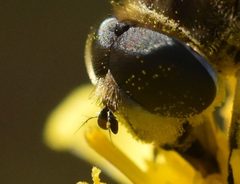
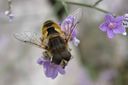
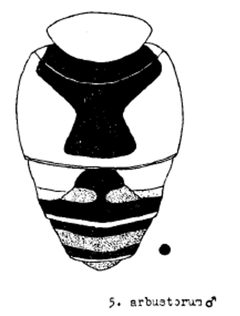
Pronunciation
How to pronounce Eristalis arbustorum: /e.rɪsˈtaː.lɪs aɹˈbʊs.təˌɹʌm/
These audio files are automatically generated. While they are not always 100% accurate, they are a good starting point.
Identification
Distinguished from E. abusiva by (E. abusiva has bare arista), less projecting mouth-edge, and shorter overall hair length. Separated from other Eristalis by combination of coloration, tibial markings, and arista structure. in color pattern assists identification: females appear as small dark bees, males as slender .
Images
Appearance
Wings 7–10 mm long. (antennal bristle) on at least basal half. entirely pale dusted, with shining black stripe visible in rubbed specimens. Hind pale only at tips. Second tibia with black coloration on top quarter. in abdominal coloration: females mimic small dark bees, males mimic with variable yellow-black patterning. Color pattern varies within sexes and is influenced by pupal rearing temperature.
Habitat
Wide range of wetlands including alluvial softwood forest, temperate coniferous forest, forest, taiga, and montane tundra. Also found in farmland, urban parks, and gardens. Larval : shallow, nutrient-rich standing water, cow , silage pits, and compost heaps. associated with flowers of low-growing plants and shrubs.
Distribution
Native to Palaearctic region including North Africa and extending to North India (Indomalayan realm). Introduced to North America near Toronto around 1885; now ubiquitous throughout much of the United States and Canada. Present on Atlantic islands including Azores (Flores, São Miguel, Santa Maria, Terceira).
Seasonality
active during warmer months. Migratory observed in Europe, with southward autumn movement to grounds around Mediterranean and beyond. Overwintering adults shelter in crannies around cave mouths and similar protected sites during winter months. Seasonal fluctuations in male color pattern frequencies due to temperature effects on pupal development.
Diet
feed on nectar for energy and pollen as protein source for development. Larvae are aquatic filter-feeders, consuming bacteria and other microbes from organic matter in water.
Life Cycle
Complete : , larva, pupa, . Larva aquatic, of 'long-tailed' or 'rat-tailed' type with elongated siphon for breathing at water surface. Larval development occurs in nutrient-rich standing water, , or decaying organic matter. occurs on dry land; pupal capsule hard and mouse-shaped. Developmental temperature influences adult coloration.
Behavior
Migratory in Europe, utilizing both (to escape hard winters) and residency strategies. exhibit hovering capability. individuals aggregate in sheltered microhabitats. in complements color dimorphism.
Ecological Role
pollination services for diverse flowering plants. Larval nutrient cycling in aquatic organic matter. of bees/ may influence learning and dynamics. Part of migratory insect contributing to nutrient transfer across landscapes.
Human Relevance
Important in agricultural and urban settings. Larvae occasionally found in compost and manure systems. Subject of research on mimicry, , and insect . Introduced in North America demonstrates human-mediated range expansion.
Similar Taxa
- Eristalis abusivaSimilar overall appearance; distinguished by bare (vs. in E. arbustorum), more projecting mouth-edge, and longer body hairs
- Eristalis tenaxCommon with similar drone fly ; larger size, different facial markings, and more distribution
- Eristalis pertinaxAnother Eristalis with overlapping range; differs in tibial coloration and facial pattern
Sources and further reading
- BugGuide
- Wikipedia
- GBIF taxonomy match
- iNaturalist taxon
- NCBI Taxonomy
- Catalogue of Life
- To Bee or Not to Bee | Bug Squad
- A friendlier type of drone: Common Drone Fly, Eristalis tenax — Bug of the Week
- Bug Eric: Fly Day Friday: Rat-tailed Maggots
- Insect Migration (Part 1) - Buglife Blog - Buglife
- Mudo Pryfed (Rhan 1) - Buglife Blog - Buglife
- Strathmore B-Lines: Surveying Grasslands and Pollinating Insects in the Strathmore Valley - Buglife Blog - Buglife
- Colour patterns of Syrphidae. III. Sexual dimorphism in Eristalis arbustorum