
Helophilus groenlandicus
(Fabricius, 1780)
Black-margined Marsh Fly
Helophilus groenlandicus, commonly known as the Black-margined , is a hoverfly in the Syrphidae. are flower visitors that obtain nectar and pollen. The occurs across the northern Holarctic region. Larval is not directly documented for this species, though related Helophilus species develop in wet decaying organic material with rat-tailed maggot .
Pronunciation
How to pronounce Helophilus groenlandicus: /hɛˈlɒfɪlɪs ɡrəʊnlændɪˈkʊs/
These audio files are automatically generated. While they are not always 100% accurate, they are a good starting point.
Identification
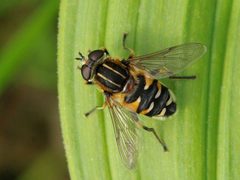
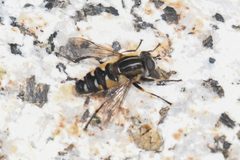
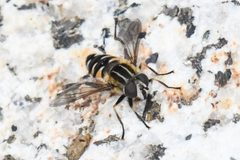
Vertical yellow stripes on the distinguish Helophilus from many other syrphid . Differentiation from other Helophilus species, particularly the widespread H. pendulus and H. fasciatus, requires examination of specific wing margin patterns and abdominal markings. The species name 'groenlandicus' and its northern distribution may aid in identification where ranges overlap with southern .
Images
Appearance
have vertical yellow stripes on the , a characteristic feature of the Helophilus. The 'Black-margined ' refers to dark marginal markings on the wings or body. Overall coloration includes black and yellow patterning consistent with yellowjacket mimicry. The exact wing and abdominal pattern distinguishing this from is not detailed in available sources.
Habitat
are found in association with flowers in various open . Based on -level , larval development likely occurs in aquatic or semi-aquatic environments with decaying organic matter, including pond margins, wet meadows, and other situations with standing water and decomposing vegetation.
Distribution
Northern Holarctic distribution including Baltic countries, northern Russia, Siberia, Greenland, and North America. In Great Britain, it is rarely recorded and restricted to Scotland. GBIF records confirm presence in Norway and Sweden.
Diet
feed on nectar and pollen from flowers. Larval diet is not documented for this ; related Helophilus species filter bacteria and microbes from decaying organic matter in aquatic environments.
Life Cycle
Complete with , larva, pupa, and stages. Larvae of the are 'rat-tailed maggots' with an extensible siphon for breathing at the water surface while feeding in submerged decaying matter. Specific details for H. groenlandicus are not documented. occurs on dry land after the mature larva leaves the aquatic .
Behavior
hover and visit flowers. Like other Helophilus , they are probably yellowjacket mimics in appearance and . The name 'Helophilus' ('sun-loving') reflects adult tendency to bask in sunny conditions.
Ecological Role
function as when visiting flowers. Larvae likely contribute to decomposition and nutrient cycling in aquatic . As a potential mimic, adults may benefit from avoidance through .
Human Relevance
are of wildflowers and potentially crops. No significant pest or beneficial status is documented. The is occasionally noted in entomological surveys and citizen science observations.
Similar Taxa
- Helophilus pendulusShares yellow thoracic stripes and general ; distinguished by wing margin patterns and more southerly, widespread distribution in Europe
- Helophilus fasciatusSimilar striped and marsh-dwelling habits; requires careful examination of abdominal pattern and facial markings for separation
- Eristalis tenaxAlso has rat-tailed maggot larvae and yellowjacket mimicry, but lacks the distinct vertical thoracic stripes of Helophilus
More Details
Larval uncertainty
The Wikipedia source explicitly states that larvae of H. groenlandicus are unknown, despite larvae of other Helophilus being well-documented as rat-tailed maggots in decaying aquatic vegetation.
Sources and further reading
- BugGuide
- Wikipedia
- GBIF taxonomy match
- iNaturalist taxon
- NCBI Taxonomy
- Spring is sprung… - Buglife Blog - Buglife
- Bug Eric: Grand Finale
- Bug Eric: City Nature Challenge 2023 Recap
- National Meadows Day 2023 in Scotland - Buglife Blog - Buglife
- Bug Eric: Fly Day Friday: Rat-tailed Maggots
- Bug Eric: Eight Illinois Wasp and Bee Mimics in Twenty Minutes