
Helophilus hybridus
Loew, 1846
hoverfly
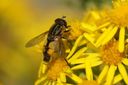
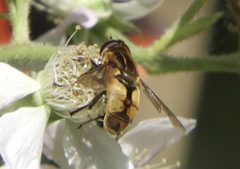
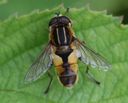
Helophilus hybridus is a Palearctic hoverfly in the Syrphidae. are medium-sized with distinctive yellow and black abdominal patterning. The species is associated with wetland across northern and central Europe, extending eastward through Russia to the Pacific coast. Larvae develop in aquatic or semi-aquatic environments with organic matter.
Pronunciation
How to pronounce Helophilus hybridus: /hɛˈlɒfɪləs hʌɪˈbrɪdəs/
These audio files are automatically generated. While they are not always 100% accurate, they are a good starting point.
Identification
Wing length 8.5–11.25 mm. 3 with yellow on top quarter or less. Tibiae 3 pale on basal quarter or less. Males have large yellow spots on tergite 2 that reach the hind margin over their full width. Distinguished from similar Helophilus by the extent and pattern of yellow markings on the legs and .
Images
Habitat
Wetlands including non-eutrophic pools in fen, poor fen, deciduous woodland, dune slacks, cutover valley bog, fen carr, and taiga.
Distribution
Palearctic: Fennoscandia south to North France, Ireland east through North and Central Europe (including the Alps) into Russia, continuing through the Russian Far East and Siberia to the Pacific coast, and Mongolia. Nearctic: Alaska to Nova Scotia and south to Utah.
Seasonality
period from early May to early September.
Diet
visit flowers for nectar and pollen. Documented flower records include white umbellifers, Calluna vulgaris, Cirsium, Convolvulus, Crataegus, Echium, Euphorbia, Limonium, Lycopus, Mentha aquatica, Menyanthes, Narthecium, Parnassia palustris, Plantago, Pulicaria, Rosa, Rubus, Salix repens, Salix, Senecio, Sorbus, Succisa, Taraxacum, and Valeriana.
Life Cycle
Larva aquatic or semi-aquatic; develops in organic-rich standing water or saturated substrates. Larva illustrated by Hartley (1961). occurs on dry land.
Ecological Role
function as . Larvae contribute to nutrient cycling in wetland through feeding on organic matter and microorganisms.
Similar Taxa
- Helophilus fasciatusSimilar yellow and black abdominal patterning, but differs in leg coloration and distribution (Nearctic with limited Palearctic overlap)
- Helophilus pendulusOverlapping and range; distinguished by differences in yellow markings on tergites and leg patterning
Sources and further reading
- BugGuide
- Wikipedia
- GBIF taxonomy match
- NCBI Taxonomy
- Catalogue of Life
- Bug Eric: Priocnemis minorata
- Spring is sprung… - Buglife Blog - Buglife
- Bug Eric: Grand Finale
- Bug Eric: City Nature Challenge 2023 Recap
- National Meadows Day 2023 in Scotland - Buglife Blog - Buglife
- Bug Eric: Fly Day Friday: Rat-tailed Maggots