
Trypodendron
Stephens, J.F., 1830
Species Guides
5- Trypodendron betulae(birch ambrosia beetle)
- Trypodendron domesticum(European hardwood ambrosia beetle)
- Trypodendron lineatum(striped ambrosia beetle)
- Trypodendron retusum
- Trypodendron scabricolle
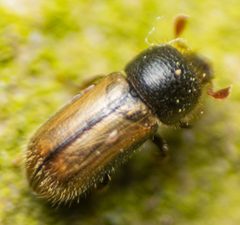
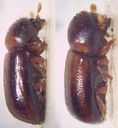
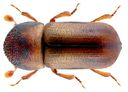
Trypodendron is a of ambrosia beetles in the Curculionidae, Scolytinae. in this genus are fungus-farmers that cultivate symbiotic fungi in galleries excavated within wood. Several species, including T. lineatum, T. domesticum, T. signatum, and T. laeve, are economically significant pests of timber. The genus is characterized by specialized -mediated and obligate nutritional mutualisms with specific fungal partners.
Pronunciation
How to pronounce Trypodendron: /traɪpoʊˈdɛndrɒn/
These audio files are automatically generated. While they are not always 100% accurate, they are a good starting point.
Identification
-level identification within Trypodendron requires careful examination of morphological characters and often benefits from molecular methods. T. lineatum (striped ) attacks conifers, while T. domesticum and T. signatum are hardwood pests. T. laeve, the least known species, also occurs on conifers. Real-time assays have been developed to distinguish T. lineatum from T. domesticum. Genetic analysis based on COI gene fragments provides reliable species determination regardless of sex.
Images
Habitat
Forested environments, particularly in association with standing or felled timber. T. lineatum occurs in coniferous forests, with documented occurrence from sea level to over 900 meters elevation. T. laeve has been found at elevations from 118 to 929 meters in mountain regions. hibernate in forest litter or duff, particularly at the base of trees where duff is deeper.
Distribution
Widespread across Europe, with documented occurrence in Poland, Romania (Carpathian Mountains), Germany (Black Forest), and Azerbaijan. T. lineatum has also been recorded in western North America. Distribution includes both native ranges and areas where have been introduced through international trade in timber.
Seasonality
activity peaks in spring (March-April), with mating activity increasing through late winter. beetles show rising reproductive activity from February onward. In temperate regions, and -seeking occurs primarily during spring months.
Diet
Obligate fungal mutualists. and larvae feed exclusively on ambrosia fungi cultivated within wood galleries. T. lineatum relies on Phialophoropsis ferruginea as its sole food source. The beetles transport fungal spores in specialized mycangia and inoculate gallery walls to establish fungal gardens.
Host Associations
- Pinus sylvestris - Preferred for T. laeve in Poland; conifer host for T. lineatum
- Picea abies - Conifer for T. lineatum and T. laeve; occurs at high elevations
- Quercus - Hardwood for T. domesticum
- Fagus - Hardwood
- Castanea - Hardwood
- Ulmus - Hardwood
Life Cycle
Development occurs within wood galleries where larvae feed on cultivated fungi. Newly emerged initially show low mating frequency. Adults undergo reproductive during winter, with hibernating in forest duff. Mating activity increases in spring prior to . Parents that have recently emerged from brood logs show negligible mating activity, while excavating parents experience reduced mating activity within two weeks of host invasion.
Behavior
Strong mediated by . Males produce lineatin as an aggregation pheromone, with peak production occurring 4-8 hours after attack. Beetles respond to host including ethanol and α-pinene; T. lineatum shows positive response to α-pinene while T. domesticum and T. signatum are repelled by this compound. Males are aggressive in mating behavior, mounting females without prolonged courtship. Multiple matings by both sexes occur. is not essential for mating. Pheromone trap interference has been documented at distances up to 40 meters.
Ecological Role
Primary decomposers of dead and dying wood through fungal . As ambrosia beetles, they specific fungal mutualists and create gallery systems that modify wood structure. Their activity contributes to nutrient cycling in forest , though this function transitions to economic damage when fresh timber or living trees are attacked.
Human Relevance
Significant economic pests of the lumber industry. Attack on freshly sawn timber and standing trees causes degradation of wood quality through staining and structural damage caused by fungal growth in galleries. T. lineatum, T. domesticum, and T. signatum are subject to monitoring and management in forestry and logging operations. International trade in timber facilitates potential range expansion. -based monitoring using lineatin, ethanol, and α-pinene is employed for detection and management.
Similar Taxa
- ScolytusBoth are wood-boring Scolytinae, but Trypodendron are ambrosia beetles that cultivate fungi while Scolytus are true bark beetles that feed directly on phloem
- IpsBoth are conifer-associated Scolytinae, but Ips are bark beetles with different gallery patterns and systems; Trypodendron show distinct response to lineatin
- HypothenemusFormerly classified in the same tribe (Cryphalini), now separated; Hypothenemus are generally smaller (around 1 mm), often inbreeding, and include seed-borers such as the
More Details
Genomic characteristics
T. lineatum possesses a streamlined (74.4-83.6 Mb) with low repetitive content (19.9%) and unusually short . Comparative reveals contractions in gene associated with plant digestion, detoxification, and , consistent with obligate fungal mutualism.
Pheromone ecology
lineatin is detected by highly expressed odorant receptor orthologs shared among Trypodendron . Dosage and blend composition significantly affect trap catch rates, with trap spacing effects documented at 10-40 meter distances.
Sources and further reading
- BugGuide
- GBIF taxonomy match
- iNaturalist taxon
- NCBI Taxonomy
- Catalogue of Life
- Bark Beetles With Identity Issues: Reclassifying the Cryphalini
- Trypodendron laeve Eggers w Polsce na tle wybranych aspektów morfologicznych i genetycznych drwalników (Trypodendron spp., Coleoptera, Curculionidae, Scolytinae)
- Real‐time PCR identification of the ambrosia beetles, Trypodendron domesticum (L.) and Trypodendron lineatum (Olivier) (Coleoptera: Scolytidae)
- Widespread Distribution of Trypodendron laeve in the Carpathian Mountains (Romania)
- Factors Influencing the Distribution of Overwintering Ambrosia Beetles, Trypodendron lineatum (Oliv.)
- SEXUAL BEHAVIOR AND SEASONAL MATING ACTIVITY OF TRYPODENDRON LINEATUM (COLEOPTERA: SCOLYTIDAE)
- Comparative genomics reveal signatures of ecological specialization in the striped ambrosia beetle Trypodendron lineatum
- Distribution of a bark beetle, Trypodendron lineatum, in a harvested landscape
- Dosage response of the ambrosia beetle Trypodendron lineatum (Oliver) (Coleoptera, Scolytidae) to semiochemicals
- RESPONSE BY THE STRIPED AMBROSIA BEETLE, TRYPODENDRON LINEATUM (OLIVIER), TO THE BARK BEETLE PHEROMONE, FRONTALIN
- SEX PHEROMONE OF TRYPODENDRON LINEATUM (COLEOPTERA: SCOLYTIDAE): PRODUCTION, BIO-ASSAY, AND PARTIAL ISOLATION
- Interference among pheromone traps for the ambrosia beetles Trypodendron spp.1
- Bioecological Peculiarities and Economical Significance of Scolytus intricatus (Ratzeburg, 1837) and Trypodendron lineatum (A. G. Olivier, 1800) Damaging to Forest Trees in the South Slopes of the Greater Caucasus (Azerbaijan)
- Highly Expressed Odorant Receptor Orthologs Detect the Aggregation Pheromone Lineatin in Trypodendron Ambrosia Beetles.