
Scolytus
Geoffroy, E.L., 1762
bark beetles, elm bark beetles
Species Guides
8- Scolytus mali(larger shothole borer)
- Scolytus multistriatus(European elm bark beetle)
- Scolytus muticus(hackberry engraver)
- Scolytus piceae(Spruce Engraver)
- Scolytus quadrispinosus(Hickory Bark Beetle)
- Scolytus rugulosus(shothole borer)
- Scolytus schevyrewi(Banded Elm Bark Beetle)
- Scolytus unispinosus(Douglas-fir engraver)
Scolytus is a of bark beetles in the Scolytinae, Curculionidae. Multiple within this genus are significant forest pests, particularly as of . The genus includes both European and North American species with documented roles in tree mortality. Some species exhibit chemically-mediated involving communication.
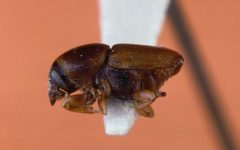
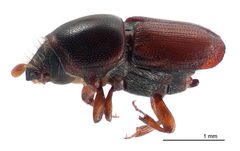
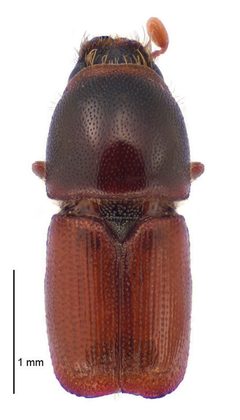
Pronunciation
How to pronounce Scolytus: //ˈskɒl.ɪ.təs//
These audio files are automatically generated. While they are not always 100% accurate, they are a good starting point.
Identification
-level identification within Scolytus requires examination of elytral declivity, pronotal shape, and male genitalia. The is distinguished from Hylurgopinus by antennal club structure and elytral punctation patterns. Scolytus scolytus is larger than S. multistriatus; of S. scolytus measure approximately 3.5–6.0 mm versus 1.5–2.5 mm for S. multistriatus. Species-specific keys for eastern North America have been published (Cognato 2010).
Images
Habitat
Associated with woody plants, primarily trees in the Ulmus (elms). occupy the inner bark and cambium layer of living, stressed, or recently dead trees. Specific microhabitat requirements vary by species; S. scolytus and S. multistriatus colonize elm bark, while S. fagi is associated with Fagus (beech), and S. rugulosus with Prunus and other stone fruits.
Distribution
Widespread across the Northern Hemisphere. Native European distribution includes multiple countries from Scandinavia to the Mediterranean. Introduced established in North America, particularly S. multistriatus and S. schevyrewi. GBIF records indicate presence in Denmark, Norway, Sweden, and the United States (Vermont). Specific range boundaries vary considerably among .
Diet
Phloem and cambium tissue of trees. Larvae feed on inner bark, creating characteristic gallery systems. of some feed on bark before reproducing.
Host Associations
- Ulmus - primary Multiple elm ; principal for S. scolytus, S. multistriatus, and S. schevyrewi
- Fagus - Documented for S. fagi
- Prunus - Documented for S. rugulosus
- Carya - Documented for S. quadrispinosus
- Larix - Documented for S. laricis
- Pseudotsuga - Documented for S. unispinosus
- Abies - Documented for S. ventralis
Behavior
of S. scolytus and S. multistriatus produce that attract conspecifics to trees; S. scolytus females have been observed to produce α-multistriatin, 4-methyl-3-heptanol, and α-cubebene. Males typically initiate gallery construction in bark, followed by female entry and mating. Mass attack can overcome tree defenses. Some exhibit activity patterns correlated with temperature and host volatiles.
Ecological Role
Primary consumers of phloem tissue; accelerate decomposition of dead and dying trees. As of Ophiostoma ulmi and O. novo-ulmi fungi, certain play a major role in , causing landscape- changes in forest composition. Native species contribute to natural disturbance regimes; disrupt stability.
Human Relevance
Major economic and ecological pest of elm trees in urban and forest settings. , vectored primarily by S. scolytus in Europe and by S. multistriatus in North America, has caused extensive mortality of Ulmus . Management includes removal of infested material, applications, and deployment of -based monitoring traps. Some species (e.g., S. rugulosus) affect orchard and ornamental trees.
Similar Taxa
- Hylurgopinus rufipesAlso in North America; distinguished by antennal club with three versus two in Scolytus, and different elytral striation patterns
- PteleobiusMorphologically similar bark beetle ; requires examination of pronotal and declivital characters for separation
- OrthotomicusOverlapping size range and ; distinguished by elytral declivity structure and antennal club
Sources and further reading
- BugGuide
- Wikipedia
- GBIF taxonomy match
- iNaturalist taxon
- NCBI Taxonomy
- Catalogue of Life
- Scolytus scolytus . [Distribution map].
- Volatiles associated with scolytus scolytus beetles on English elm
- Chemically-mediated Behavior in the Large Elm Bark Beetle, Scolytus scolytus
- Figure 2 from: Cognato A (2010) Notes on Scolytus fagi Walsh, 1867 with the designation of a neotype, distribution notes and a key to Scolytus Geoffroy of America east of the Mississippi River (Coleoptera, Curculionidae, Scolytinae, Scolytini). ZooKeys 56: 35-43. https://doi.org/10.3897/zookeys.56.516
- Ecology of the Dutch Elm Disease Vectors Scolytus laevis and S. Scolytus