
Trypodendron lineatum
(Olivier, 1800)
striped ambrosia beetle, two-striped timber beetle, conifer ambrosia beetle, spruce timber beetle
Trypodendron lineatum is a small ambrosia beetle (3.5 mm) in the Curculionidae with a Holarctic distribution. It is a major forest pest that cultivates symbiotic fungi in galleries excavated in conifer xylem. The exhibits a distinctive cycle with mass spring swarming triggered by temperatures above 16°C, followed by summer of new that overwinter before reaching sexual maturity. Unlike true bark beetles, T. lineatum feeds on cultivated fungi rather than wood tissue.
Pronunciation
How to pronounce Trypodendron lineatum: /trɪpoʊˈdɛndrən lɪˈniːətəm/
These audio files are automatically generated. While they are not always 100% accurate, they are a good starting point.
Identification
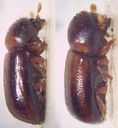
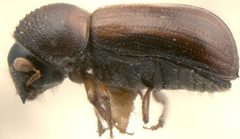
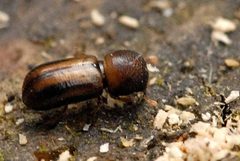
are distinguished by two lighter-colored longitudinal stripes on each dark brown to black , giving the its . Females average 3.5 mm in length by 1.5 mm in width, with a rounded and . Males are smaller, with a dished-out head and straight thorax. The overall body form is typical of ambrosia beetles—compact and adapted for gallery excavation. are white, translucent, and approximately 1.00 mm. Larvae are small, nondescript white .
Images
Habitat
Primarily coniferous forests, with strong preference for stressed, dying, or recently dead conifer trees. Has been recorded from four of deciduous trees (Alnus, Betula, Malus, Acer) but conifers are the principal . Colonizes winter-felled or naturally killed conifers in spring. Overwinters in forest litter or duff, particularly at the base of trees in deeper duff layers.
Distribution
Holarctic, including Europe, northern Asia, North Africa, and North America. Present in and temperate forest regions across this range.
Seasonality
Two distinct periods: a spectacular mass spring swarming flight when temperatures exceed 16°C (March–April in many regions), and a less conspicuous late-summer flight by new . All new brood adults must overwinter to reach sexual maturity. Daily flight activity peaks in mid-afternoon.
Diet
Obligate mutualistic relationship with the fungus Phialophoropsis ferruginea. cultivate fungal gardens in xylem galleries; larvae feed exclusively on fungal and wood fibers. The fungus metabolizes wood and provides nutrients, steroids, and vitamins to the larvae.
Life Cycle
cycle with reproductive . Females initiate galleries into sapwood, inoculating them with fungal spores transported in mycangia. Males follow females into galleries and assist in removing boring dust. Paired females produce approximately twice as many as unpaired females. Eggs are laid in individual sealed with boring dust. Larvae develop within galleries, feeding on cultivated fungi. New emerge sporadically throughout summer, undergo initial photopositive , then settle in forest margins to overwinter. Overwintering adults resume sexual activity in February, with full spring swarming by March–April.
Behavior
Strongly attracted to ethanol and conifer monoterpenes (especially α-pinene) emitted by stressed or dying trees. Females produce the lineatin, which attracts both sexes. Males produce a pheromone mask that reduces secondary attraction once they arrive in galleries. Mating occurs on log surfaces; males are aggressive, females passive, with no observable courtship. Multiple matings by both sexes occur. is not essential for mating. Males may mount mating couples and other males. Sexual activity declines markedly within 30–40 minutes of initial opposite-sex contact.
Ecological Role
Contributes to decomposition and nutrient cycling through of dead or dying wood. The obligate fungal mutualism represents a specialized form of external digestion that facilitates wood breakdown in forest .
Human Relevance
Major forest pest causing economic losses through wood staining and gallery formation that degrades commercial timber quality. Indirect losses occur through prejudice against pin-holed lumber. Monitored using traps baited with lineatin combined with ethanol and α-pinene. Management includes rapid processing of harvested or windthrown wood, timely debarking, and strategic trap deployment during seasons.
Similar Taxa
- Trypodendron domesticumSimilar conifer-associated ambrosia beetle in the same , distinguished by differences in gallery structure and preferences; T. lineatum has distinctive elytral striping not present in T. domesticum.
- Xyleborinus saxeseniiAnother small ambrosia beetle with similar , but T. lineatum is distinguished by its specific elytral pattern, spring swarming , and production of lineatin .
Sources and further reading
- BugGuide
- Wikipedia
- GBIF taxonomy match
- iNaturalist taxon
- NCBI Taxonomy
- Catalogue of Life
- Cerambycidae | Beetles In The Bush | Page 8
- Bark Beetles With Identity Issues: Reclassifying the Cryphalini
- Distribution of a bark beetle, Trypodendron lineatum, in a harvested landscape
- ASPECTS OF ORIENTATION BEHAVIOR IN THE AMBROSIA BEETLE TRYPODENDRON LINEATUM (OLIVIER)
- SEXUAL BEHAVIOR AND SEASONAL MATING ACTIVITY OF TRYPODENDRON LINEATUM (COLEOPTERA: SCOLYTIDAE)
- Comparative genomics reveal signatures of ecological specialization in the striped ambrosia beetle Trypodendron lineatum
- Factors Influencing the Distribution of Overwintering Ambrosia Beetles, Trypodendron lineatum (Oliv.)
- RESPONSE BY THE STRIPED AMBROSIA BEETLE, TRYPODENDRON LINEATUM (OLIVIER), TO THE BARK BEETLE PHEROMONE, FRONTALIN
- SEX PHEROMONE OF TRYPODENDRON LINEATUM (COLEOPTERA: SCOLYTIDAE): PRODUCTION, BIO-ASSAY, AND PARTIAL ISOLATION
- Pheromone mask produced by male Trypodendron lineatum (Coleoptera: Scolytidae)
- Dosage response of the ambrosia beetle Trypodendron lineatum (Oliver) (Coleoptera, Scolytidae) to semiochemicals
- THE EFFECT OF MATING AND THE PRESENCE OF THE MALE AMBROSIA BEETLE, TRYPODENDRON LINEATUM, ON "SECONDARY" ATTRACTION
- Bioecological Peculiarities and Economical Significance of Scolytus intricatus (Ratzeburg, 1837) and Trypodendron lineatum (A. G. Olivier, 1800) Damaging to Forest Trees in the South Slopes of the Greater Caucasus (Azerbaijan)
- Field Studies on Attack Flight and Log Selection by the Ambrosia Beetle Trypodendron lineatum (Oliv.) (Coleoptera: Scolytidae)