
Trypodendron domesticum
(Linnaeus, 1758)
European hardwood ambrosia beetle
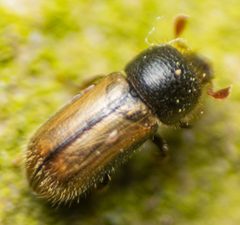
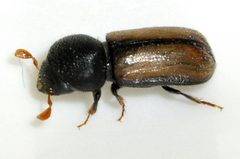
Trypodendron domesticum is a European ambrosia beetle in the Curculionidae. It is a wood-boring pest of hardwoods that has been introduced to North America. The is morphologically similar to the closely related T. lineatum, requiring molecular methods for reliable identification. It is one of four Trypodendron species documented in Europe.
Pronunciation
How to pronounce Trypodendron domesticum: /trɪpoʊˈdɛndrən dəˈmɛstɪkəm/
These audio files are automatically generated. While they are not always 100% accurate, they are a good starting point.
Identification
Morphologically similar to Trypodendron lineatum; reliable differentiation requires molecular identification using real-time assays targeting mitochondrial COI gene or nuclear ITS2 region sequences. The is tiny, comparable in size to other pygmy borers in the former Cryphalini group.
Images
Distribution
Native to Europe; present in North America as an introduced . Documented in Belgium and other European countries.
Diet
Feeds on ambrosia fungi cultivated in wood galleries; specific fungal associates not documented in available sources.
Behavior
Constructs galleries in wood to cultivate fungal gardens; exhibits ambrosia beetle lifestyle involving fungal farming.
Ecological Role
Contributes to wood decomposition through ambrosia beetle-fungus .
Human Relevance
Causes serious damage to lumber, reducing timber quality and value; targeted for management in logging and lumber industries. Molecular detection methods have been developed to enable rapid identification for pest control decision-making.
Similar Taxa
- Trypodendron lineatumMorphologically similar striped ambrosia beetle; requires molecular markers for reliable differentiation
- Trypodendron laeveCongeneric ambrosia beetle with overlapping European distribution
- Trypodendron signatumCongeneric occurring in same geographic region
Sources and further reading
- BugGuide
- Wikipedia
- GBIF taxonomy match
- iNaturalist taxon
- NCBI Taxonomy
- Catalogue of Life
- Bark Beetles With Identity Issues: Reclassifying the Cryphalini
- Real‐time PCR identification of the ambrosia beetles, Trypodendron domesticum (L.) and Trypodendron lineatum (Olivier) (Coleoptera: Scolytidae)
- Trypodendron laeve Eggers w Polsce na tle wybranych aspektów morfologicznych i genetycznych drwalników (Trypodendron spp., Coleoptera, Curculionidae, Scolytinae)