
Apamea
Ochsenheimer, 1816
Cutworm moths, Rustic shoulder-knot moths
Species Guides
55- Apamea acera
- Apamea albina
- Apamea alia(Fox Apamea)
- Apamea amputatrix(Yellow-headed Cutworm)
- Apamea antennata
- Apamea apamiformis(rice worm moth)
- Apamea atriclava
- Apamea atrosuffusa
- Apamea auranticolor
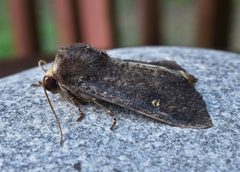
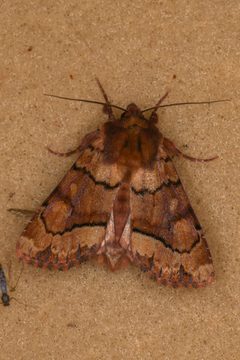
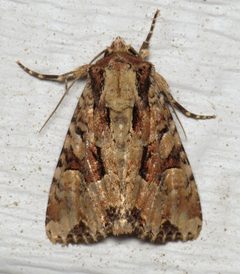
Apamea is a of in the Noctuidae, commonly known as cutworm moths or rustic shoulder-knot moths. The genus contains numerous that are typically medium-sized with cryptic, mottled forewings in shades of brown, gray, and ochre. Several species are significant agricultural pests, with larvae feeding on cereal crops and grasses. Species-level identification is notoriously difficult due to extensive individual variation and overlapping morphological features.
Pronunciation
How to pronounce Apamea: /əˈpeɪmiə/
These audio files are automatically generated. While they are not always 100% accurate, they are a good starting point.
Identification
-level identification within Apamea is exceptionally challenging and often requires examination of genitalia or molecular markers. Visual separation from similar relies on forewing pattern details, particularly the configuration of the and spots, the presence and shape of the claviform spot, and the course of the postmedian line. Some species show distinctive pale or dark patches at the forewing base (the 'shoulder-knot'). However, extensive individual variation and interspecific similarity mean that confident field identification to species is frequently impossible without voucher specimens and expert verification.
Images
Habitat
Diverse including grasslands, meadows, marshes, agricultural fields, woodlands, and coastal areas. Many associated with grassy or herbaceous vegetation. Several species are strongly tied to arable farmland and cereal .
Distribution
Holarctic distribution, with primary diversity in the Palearctic region. Widespread across Europe, Asia, and North America. Individual ranges vary: some are widespread and common (e.g., A. lithoxylaea in Britain), others are more restricted or local.
Seasonality
generally active from late spring through summer, typically May to August in temperate regions. Most have a single ; partial second generations may occur in favorable conditions. periods vary by species and latitude.
Diet
Larvae feed on grasses (Poaceae) and cereal crops including wheat and barley. Some feed internally on developing grain as well as externally on foliage. Specific associations vary among species.
Host Associations
- Poaceae - larval food plantGrasses are primary larval for most
- Triticum aestivum - larval food plantWheat; significant pest association for some
- Hordeum vulgare - larval food plantBarley; significant pest association for some
Life Cycle
Holometabolous development with complete . laid on plants, typically on flower of grasses or cereals. Larvae feed on foliage and/or grain; some are stem borers or feed internally on seeds. Larvae pupate in soil or concealed locations. Most species have one per year, with emerging the following season. stage typically the pupa or larva.
Behavior
; readily attracted to light. Many exhibit characteristic 'startle' response when disturbed, dropping to the ground and remaining motionless to rely on cryptic coloration. Some species have been documented with shifting , with periods advancing earlier in the season over recent decades.
Ecological Role
Herbivores in grassland and agricultural . Several are serious pests of cereal production, particularly in Russia and Kazakhstan, where they cause significant economic damage. Larval feeding reduces grain yield and quality. Subject to including autumn ploughing, application, and trapping.
Human Relevance
Several are significant agricultural pests of cereal crops, requiring monitoring and control measures. The is well-represented in biodiversity surveys and recording schemes. Some species have served as study organisms for climate change research due to documented phenological shifts.
Similar Taxa
- OligiaSimilar size, coloration, and forewing pattern; distinguished by genitalia and subtle differences in wing venation and pattern details
- MesoligiaOverlapping and preferences; separation requires careful examination of forewing pattern elements and often genitalia
- CalamagrostisFormerly included now placed in Calamagrostis; distinguished by forewing pattern and genitalic characters
More Details
Genomic resources
High-quality assemblies have been generated for multiple Apamea through the Darwin Tree of Life project, including A. anceps (615.8 Mb, 31 chromosomal pseudomolecules) and A. lithoxylaea (577.73 Mb and 521.26 Mb haplotypes, 32 chromosomal pseudomolecules). These resources support studies of , pest evolution, and phenological change.
Taxonomic challenges
The Apamea has undergone repeated taxonomic revision, with many formerly placed in related genera such as Calamagrostis and Hadenella. Current generic limits remain under study using molecular data.
Sources and further reading
- BugGuide
- Wikipedia
- GBIF taxonomy match
- iNaturalist taxon
- NCBI Taxonomy
- Catalogue of Life
- Bug Eric: National Moth Week Recap for Colorado Springs
- The genome sequence of the Light Arches, Apamea lithoxylaea (Denis & Schiffermüller), 1775 (Lepidoptera: Noctuidae).
- The genome sequence of the Large Nutmeg, Apamea anceps (Denis & Schiffermüller, 1775).
- First description of a male Melapheapamea Hoffman & Lohmander, 1968 from Turkey (Diplopoda, Polydesmida, Xystodesmidae).