
Apamea antennata
Smith, 1891
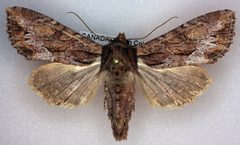
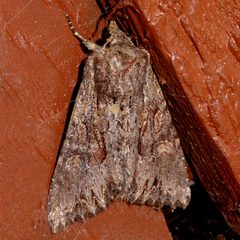
Apamea antennata is a noctuid widespread in the forests of western North America. have a wingspan of approximately 44 mm and fly during early and midsummer. The larval stage feeds on grasses. Two are recognized: the nominate A. a. antennata and A. a. purpurissata restricted to British Columbia.
Pronunciation
How to pronounce Apamea antennata: /əˈpeɪ.miə ænˈtɛnˌneɪ.tə/
These audio files are automatically generated. While they are not always 100% accurate, they are a good starting point.
Identification
Distinguished from other Apamea by a combination of geographic distribution (western North American forests), period (early to midsummer), and association with grass-feeding larvae. The A. a. purpurissata occurs in British Columbia and may show subtle morphological differences from the nominate subspecies. Specific diagnostic characters for separating A. antennata from other western Apamea species are not documented in available sources.
Images
Habitat
Forested environments in western North America. Specific forest type associations beyond general forest are not documented.
Distribution
Western North America. Specific range boundaries are not precisely documented, but the is described as widespread in western North American forests. The A. a. purpurissata is restricted to British Columbia.
Seasonality
period occurs in early and midsummer. Larval stage timing not specified.
Diet
Larvae feed on grasses. feeding habits are not documented.
Life Cycle
Complete with , larva, pupa, and stages. Larvae are grass-feeders. Specific details on site, stage, or time are not documented.
Behavior
are attracted to light. activity pattern inferred from characteristics but not explicitly documented for this .
Ecological Role
Larval herbivory on grasses contributes to nutrient cycling in forest . Specific ecological impacts or -prey relationships are not documented.
Human Relevance
Occasionally encountered at light traps by entomologists. No significant documented economic or agricultural impacts.
Similar Taxa
- Other Apamea speciesWestern North American Apamea share similar size, , and periods. A. antennata may be distinguished by the specific combination of forest habitat, midsummer flight, and grass-feeding larvae, though precise diagnostic characters require examination.
More Details
Sources and further reading
- BugGuide
- Wikipedia
- GBIF taxonomy match
- iNaturalist taxon
- NCBI Taxonomy
- Catalogue of Life
- Bug Eric: National Moth Week Recap for Colorado Springs
- Phocus on Phyllobrotica | Beetles In The Bush
- When is a locust borer not a locust borer? | Beetles In The Bush
- North America’s largest stag beetle | Beetles In The Bush