
Oligia
Hübner, 1821
Species Guides
12- Oligia bridghamii(Bridgham's Brocade)
- Oligia chlorostigma(Yellow-spotted Brocade)
- Oligia divesta(cutworm moth)
- Oligia egens(Neumoegen's Quaker)
- Oligia latruncula(Tawny Marbled Minor)
- Oligia minuscula(Small Brocade)
- Oligia modica(black-banded brocade)
- Oligia obtusa(obtuse sedge borer)
- Oligia rampartensis(cutworm moth)
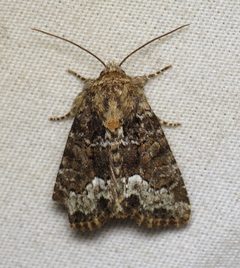
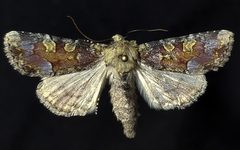
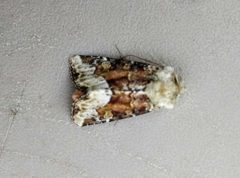
Oligia is a of noctuid comprising over 60 described distributed across Europe, the Americas, Africa, and Asia. Species are small to medium-sized moths typically associated with grassland . Several species are economically significant as pests of forage grasses, while others have served as models for studying melanism evolution. Species-level identification often requires genitalia examination due to morphological similarity among closely related .
Pronunciation
How to pronounce Oligia: /oʊˈlɪdʒiə/
These audio files are automatically generated. While they are not always 100% accurate, they are a good starting point.
Identification
-level identification within Oligia frequently requires examination of genitalia due to external morphological similarity among . For example, Oligia strigilis cannot be reliably distinguished from O. latruncula and O. versicolor without genital dissection. Some species exhibit straightforward identification: O. fasciuncula lacks frequent melanic forms and can be identified without genitalia examination. are generally small to medium-sized noctuid with compact bodies. Coloration varies among species, with some exhibiting reddish or orange-brown ground color with darker pattern elements.
Images
Habitat
Grasslands are the primary , with occupying a range of moisture conditions from dry to damp grassland. O. fasciuncula specifically inhabits damp grassland including wet woodland areas. Larval stages are concealed within grass stems or feed on grass leaves.
Distribution
Widespread across the Palearctic, with records from Europe east to Central Asia. Present in Britain and Ireland, though some show restricted ranges within Europe (O. fasciuncula occurs mostly in western Europe, not extending far north or south). Accidental introduction to North America has occurred, with O. strigilis establishing and spreading rapidly in the northeastern United States. Additional records from Africa and the Americas indicate broad geographic representation of the .
Seasonality
periods vary by . O. fasciuncula adults emerge in summer, mainly June and July. O. strigilis abundance and have been documented with declines of 76% in Britain since the 1970s.
Diet
Larvae feed on grasses. O. strigilis larvae feed within grass stems, moving between stems, with documented association with Dactylis glomerata (Cock's-foot Grass). O. fasciuncula larvae feed on leaves of Deschampsia cespitosa (Tufted Hairgrass) and Holcus lanatus (Yorkshire Fog), feeding nocturnally from late summer through winter, resuming in spring. feeding habits are not documented.
Host Associations
- Dactylis glomerata - larval food plantCock's-foot Grass; O. strigilis periodically becomes a pest of this in Germany and Romania
- Deschampsia cespitosa - larval food plantTufted Hairgrass; food plant for O. fasciuncula
- Holcus lanatus - larval food plantYorkshire Fog; food plant for O. fasciuncula
Life Cycle
Larvae of O. fasciuncula feed from late summer, overwinter, and resume feeding in spring, with emerging the following summer. O. strigilis larvae feed within grass stems, moving between stems. Chromosomal sex determination is ZZ/ZW, with assemblies showing 30 plus Z in O. strigilis and O. fasciuncula.
Behavior
Larvae of O. fasciuncula are feeders. of O. fasciuncula are attracted to light traps. Melanism patterns have been studied in O. strigilis and appear to have evolved independently in different geographic locations. O. fasciuncula lacks frequent melanic forms unlike some .
Ecological Role
Grass-feeding ; several function as potential pests of forage grasses. declines documented for some species (O. strigilis in Britain) may indicate sensitivity to environmental changes in grassland .
Human Relevance
O. strigilis periodically becomes a pest of Cock's-foot Grass in Germany and Romania, with potential economic impact on forage grass production. sequencing of O. strigilis and O. fasciuncula has contributed to lepidopteran genomic resources. Some serve as study organisms for melanism evolution.
Similar Taxa
- MesapameaFormer Oligia O. arbora and O. fractilinea reclassified to this ; external similarity may cause confusion
- NeoligiaFormer Oligia O. hausta and O. laevigata reclassified to this ; taxonomic history indicates morphological similarity
- FishiaFormer Oligia O. illocata reclassified to this
- XylomoiaFormer Oligia O. indirecta reclassified to this
- PlatypoliaFormer Oligia O. mactata reclassified to this
- AseptisFormer Oligia O. marina reclassified to this
More Details
Genomic Resources
-level assemblies are available for O. strigilis (626.1 Mb, 17,751 protein-coding genes) and O. fasciuncula (617.70 Mb, 17,994 protein-coding genes). Both have 31 chromosomal pseudomolecules (30 + Z ) and mitochondrial genomes of approximately 15.35 kb. Chromosomal assignment in O. fasciuncula was based on synteny to O. strigilis.
Population Trends
O. strigilis abundance has decreased by 76% in Britain since the 1970s, indicating significant decline in at least part of its range.