
Xylomoia
Staudinger, 1892
Species Guides
2- Xylomoia chagnoni(Reed Canary Grass Borer Moth)
- Xylomoia indirecta(Oblique Brocade Moth)
Xylomoia is a of in the Noctuidae, established by Staudinger in 1892. The genus contains at least seven recognized distributed across the Holarctic region, with the majority occurring in Europe and northern Asia. A 2024 integrative taxonomic review synonymized three species—X. strix, X. retinax, and X. stangelmaieri—as of X. strix based on morphological and genetic evidence. The genus belongs to the tribe Apameini within the Noctuinae.


Pronunciation
How to pronounce Xylomoia: /zaɪˈloʊ.mɔɪ.ə/
These audio files are automatically generated. While they are not always 100% accurate, they are a good starting point.
Identification
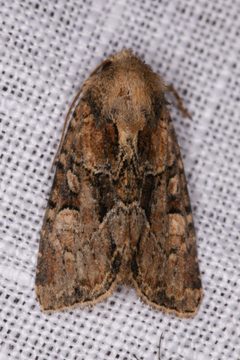
within Xylomoia are distinguished primarily by genitalia , particularly male phallus structures including the presence or absence of basal cornutus/spines and medial with cornutus. Wing coloration varies and is not considered a reliable diagnostic character; for example, X. retinax was originally distinguished by darker forewing coloration but this trait was found to be unstable. The of X. strix uniquely lacks phallus structures present in other Xylomoia species, though subsequent specimens show variability in these structures.
Images
Distribution
The occurs across the Palearctic and Nearctic regions. X. strix (including X. s. strix, X. s. stangelmaieri, and X. s. retinax) ranges from Finland and the Baltic states through Poland, Belarus, Ukraine, and European Russia west of the Volga-Ural region; the subspecies X. s. retinax extends eastward through Western Siberia to Irkutsk, Novosibirsk, Omsk, Chelyabinsk, Yaroslavl, and the Altai Republic; and X. s. stangelmaieri is restricted to the northern Adriatic coast near Venice, Italy. Records from Denmark, Sweden, Vermont (USA), and other US localities are documented.
Similar Taxa
More Details
Taxonomic Revision
A 2024 integrative review based on 59 genitalia slides and 40 barcodes concluded that X. strix, X. retinax, and X. stangelmaieri represent a single with three (X. s. strix, X. s. stangelmaieri stat. nov., X. s. retinax stat. nov.) rather than three separate species. Genetic distances between these were found to be low, and no stable morphological differences apart from wing coloration in X. retinax were identified.
Type Specimen Anomaly
The of X. strix uniquely lacks phallus structures (basal cornutus/spines and medial with cornutus) that are present in other Xylomoia . This absence was initially considered potentially significant but later specimens revealed variability in these structures, supporting status rather than species-level distinction.