
Apamea apamiformis
Guenée, 1852
rice worm moth, riceworm, wild rice worm
Apamea apamiformis is a noctuid known as the rice worm moth, a significant agricultural pest of wild rice in North America. exhibit with dark and light wing color forms, and are active from June to August. The has a specialized tightly linked to wild rice (Zizania spp.), with larvae developing inside florets and grain . It represents a notable economic concern in Minnesota and the Upper Midwest, where it is considered the most serious insect pest of cultivated wild rice.
Pronunciation
How to pronounce Apamea apamiformis: //əˈpeɪ.mi.ə əˌpeɪ.miˈfɔːr.mɪs//
These audio files are automatically generated. While they are not always 100% accurate, they are a good starting point.
Identification
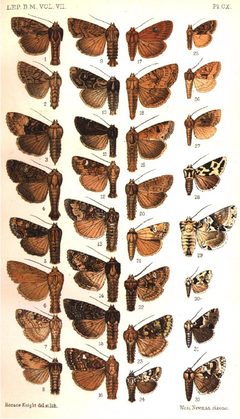
Distinguished from other Apamea by the white-scaled concave border of the spot on the forewing. The dimorphic coloration (dark and light forms) is a notable feature. In the Upper Midwest, larvae are identified by their presence within wild rice florets and grain , and their resemblance to rice grains. may be confused with other cutworm moths in the Apamea, which are notoriously difficult to separate based on appearance alone.
Images
Appearance
have a wingspan of approximately 39 mm (1.5 in). Forewings show two distinct color morphs: a dark form and a light form. The spot is dark with distinctive white along its concave border facing the outer wing margin. Hindwings and body coloration correspond to the forewing morph. Larvae are -like and may be mistaken for rice grains during harvest.
Habitat
Associated with wetlands and aquatic environments where wild rice (Zizania spp.) grows. are attracted to light and nectar sources, particularly common milkweed flowers. Larval is restricted to the flowering and stalks of wild rice plants.
Distribution
North America: primarily in the Upper Midwest and eastern Canada. Documented from Wisconsin, New York, Minnesota, Manitoba, and Saskatchewan. in Maryland are imperiled, Indiana critically imperiled, and New Jersey vulnerable.
Seasonality
active June to August, with timing varying by location. laying occurs late June/early July to early August. Larvae overwinter in soil or rice stalks from September through spring. occurs mid-spring with following.
Diet
feed on nectar, specifically observed on common milkweed (Asclepias syriaca) flowers. Larvae feed exclusively on wild rice (Zizania spp.): initially consuming the ovary of the floret, then maturing grain in flower from third instar onward.
Host Associations
- Zizania spp. - larval plantWild rice; laid in florets, larvae feed on ovary and maturing grain
- Asclepias syriaca - nectar sourceCommon milkweed
Life Cycle
laid in wild rice florets (late June–early August). Eggs hatch in 8–9 days. First–second instar larvae consume floret ovary, then balloon on silk threads to new florets. Third–sixth/seventh instars feed on maturing grain in flower . Late instars (September) burrow into soil or rice stalks to overwinter. Spring , feeding, and to eighth instar, followed by . emerge June–August.
Behavior
Newly hatched larvae produce silk threads for ballooning between wild rice florets. Late instar larvae construct shelters by boring into rice stalks or burying in soil. are and attracted to light.
Ecological Role
herbivore of wild rice. As a significant consumer of wild rice grain, it influences seed production and plant in both natural and cultivated stands. Serves as prey for in wetland .
Human Relevance
Major economic pest of cultivated wild rice in Minnesota and the Upper Midwest, considered the most serious insect pest of this crop. Larval reduces yield and grain quality. Larvae may be harvested with rice and mistaken for grain, affecting product quality. Conservation concern exists for peripheral (Maryland, Indiana, New Jersey).
Similar Taxa
- Other Apamea speciesCutworm moths in this are notoriously difficult to identify due to individual variation and overlapping ; A. apamiformis distinguished by spot pattern and association with wild rice
More Details
Conservation Status
Peripheral show declining status: imperiled in Maryland, critically imperiled in Indiana, vulnerable in New Jersey
Original Description
First described as Xylophasia apamiformis by Guenée in 1852, later transferred to Apamea