
Hypena
Schrank, 1802
Species Guides
28- Hypena abalienalis(white-lined hypena)
- Hypena appalachiensis(Appalachian Snout)
- Hypena atomaria(Speckled Snout)
- Hypena baltimoralis(Baltimore Hypena)
- Hypena bijugalis(Dimorphic Snout)
- Hypena californica(California cloverworm moth)
- Hypena deceptalis(Deceptive Snout)
- Hypena decorata(decorated hypena)
- Hypena degesalis
Hypena is a of in the Erebidae, first described by Franz von Paula Schrank in 1802. The genus comprises over 680 worldwide, predominantly distributed in tropical regions. Species in this genus are non-migratory and overwinter as pupae. Several species are economically significant agricultural pests, particularly the green cloverworm (Hypena scabra), which is a major defoliator of soybeans in the eastern United States. The genus also includes agents such as Hypena opulenta, introduced to North America to control swallow-worts.
Pronunciation
How to pronounce Hypena: /haɪˈpiːnə/
These audio files are automatically generated. While they are not always 100% accurate, they are a good starting point.
Identification
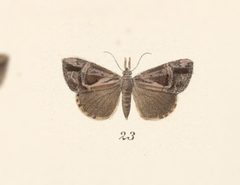
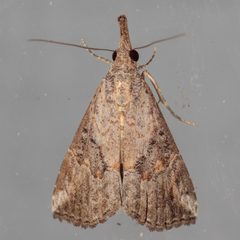
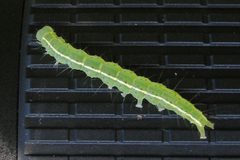
Hypena can be recognized by the combination of an acute frontal tuft, smoothly scaled with abdominal tufts, and forewings with an acute, depressed apex. Males have minutely ciliated . Larvae are distinguished by having three pairs of abdominal plus one terminal pair, pale green coloration with white lateral stripes, and vigorous wiggling when disturbed. -level identification often requires examination of genitalia or .
Images
Habitat
vary by . Agricultural pest species such as Hypena scabra occupy open habitats including soybean fields, clover and alfalfa stands, and weedy areas. The agent Hypena opulenta inhabits forest understory and grassland habitats dominated by its plant, the swallow-wort. Some species have been recorded from caves.
Distribution
The Hypena has a worldwide distribution with over 680 , predominantly in tropical regions. Documented occurrences include North America (eastern United States, Canada), South Korea, Japan, Taiwan, Hong Kong, Macau, India, and Eastern Europe (Ukraine, east to Afghanistan, south to Syria and Iran). Specific species distributions vary: Hypena scabra occurs east of the Rocky Mountains in North America; Hypena opulenta is native to Eastern Europe and has been introduced to Canada and the northeastern United States.
Seasonality
Activity patterns vary by and latitude. In temperate regions, are active from spring through fall with multiple per year. Hypena scabra has at least three generations annually in the eastern United States, with adults flying from March through October. Species in southern latitudes may have extended or year-round activity. occurs as pupae.
Diet
Larval feeding habits vary by . Hypena scabra larvae are feeders on herbaceous plants including clover, alfalfa, ragweed, strawberries, and raspberries. Hypena opulenta is a on Vincetoxicum species (swallow-worts). feeding habits are not well documented.
Host Associations
- Vincetoxicum rossicum - Primary for Hypena opulenta, swallow-wort
- Vincetoxicum nigrum - Secondary for Hypena opulenta
- Trifolium - Clover, for Hypena scabra
- Medicago sativa - Alfalfa, for Hypena scabra
- Ambrosia - Ragweed, for Hypena scabra
- Fragaria - Strawberry, for Hypena scabra
- Rubus - Raspberry, for Hypena scabra
Life Cycle
Development includes , larva, pupa, and stages. Females lay eggs singly on leaf undersides. Larvae progress through 4-7 instars depending on . occurs in soil or within folded leaves on the ground. The is characterized by as pupae. Some species exhibit facultative cued by ; for example, Hypena opulenta enters diapause when day length falls below approximately 15.5 hours. Multiple are possible in favorable conditions, with voltinism varying by latitude and species.
Behavior
are and attracted to ultraviolet light sources. They are non-migratory and almost never come to . Larvae exhibit characteristic vigorous wiggling and twisting when disturbed, a defensive . Some have been documented from cave , suggesting at least occasional use of such environments.
Ecological Role
in this occupy diverse ecological roles. Agricultural pest species such as Hypena scabra function as primary consumers in agroecosystems, with larvae causing significant defoliation of crops. Hypena opulenta serves as a agent, reducing of swallow-worts that dominate forest understories and displace native vegetation. The ecological role of most tropical species remains poorly documented.
Human Relevance
Several Hypena are significant agricultural pests. The green cloverworm (Hypena scabra) is a major defoliator of soybeans in the eastern United States, capable of causing substantial yield loss when are uncontrolled. It is considered one of the five most economically important caterpillar pests of soybean in the U.S. Hypena opulenta has been intentionally introduced to North America as a agent for swallow-worts, with releases approved in Canada (2013) and the United States (2017).
Similar Taxa
- Chrysodeixis includensSoybean looper is another major soybean defoliator with similar larval damage ; distinguished by having two pairs of abdominal versus three in Hypena, and different mandibular ridge patterns visible with magnification
- Anticarsia gemmatalisVelvetbean caterpillar is another key soybean pest with similar larval coloration; distinguished by having four pairs of abdominal versus three in Hypena, and more robust body with lengthwise stripes
- Trichoplusia niCabbage looper is a similar looper pest with looping locomotion; distinguished by mandibular ridges that extend to the edge versus truncated ridges in soybean looper, and different count
More Details
Taxonomic history
The formerly included now placed in Bomolocha, which have been synonymized. The genus is monophyletic based on morphological characters.
Research significance
Hypena is one of the most -rich in Erebidae with over 680 described species, yet the majority remain poorly studied. Most research focuses on the small number of agricultural pest species and the agent H. opulenta.
Collection methods
Specimens are most effectively collected using ultraviolet light traps, including bucket traps and blacklight sheets. do not respond to .
Sources and further reading
- BugGuide
- Wikipedia
- GBIF taxonomy match
- iNaturalist taxon
- NCBI Taxonomy
- Catalogue of Life
- Soybean Insects: Mid-to-Late Season Pests (V8 to Maturity) - AgriLife Extension Entomology
- green cloverworm (Hypena scabra) - Entomology Today
- A Revision of Soybean Caterpillar Pest Information for U.S. Soybean
- Bug Eric: National Moth Week 2024 Recap from Kansas City
- Bug Eric: Blacklighting Already?
- caterpillar pests of soybean - Entomology Today
- An updated list of the genus Hypena Schrank (Lepidoptera, Erebidae) from Korea with five additional records to the fauna.
- Foliage age affects pupal weight and development time, but not diapause induction in the biological control agent Hypena opulenta (Lepidoptera: Erebidae).