
Hypena abalienalis
Walker, 1859
white-lined hypena, white-lined bomolocha moth, white-lined snout
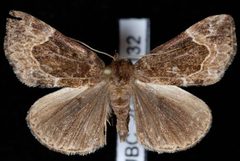
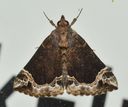
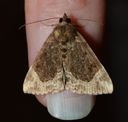
Hypena abalienalis, commonly known as the white-lined hypena or white-lined bomolocha , is a small to medium-sized moth in the Erebidae. First described by Francis Walker in 1859, this occurs across eastern North America from southern Canada through the northern United States. are active primarily from spring through mid-summer, with multiple per year. The species is distinguished by characteristic wing markings and is frequently attracted to artificial light sources.
Pronunciation
How to pronounce Hypena abalienalis: /hɪˈpiːnə ˌæbəˌliːnəˈlɪs/
These audio files are automatically generated. While they are not always 100% accurate, they are a good starting point.
Identification
The white-lined hypena can be distinguished from similar Hypena by the presence of well-defined pale longitudinal lines on the forewings, particularly a prominent white or cream-colored line running lengthwise. The species lacks the more complex spotted or blotched patterns seen in some . The snout-like projection of the labial palps is more pronounced than in many related . Confusion is most likely with other eastern Hypena species such as H. bijugalis or H. humuli, which differ in forewing pattern details and geographic distribution in areas of overlap.
Images
Appearance
have a wingspan of 25–33 mm. Forewings are relatively broad with a somewhat triangular outline when at rest. The refers to pale longitudinal lines on the forewings, which contrast against darker ground coloration. Hindwings are paler and more uniform. The body is moderately stout with a tufted or snout-like projection formed by elongated labial palps, typical of the Hypena. Overall coloration ranges from brown to grayish-brown with variable pattern intensity.
Habitat
Occurs in a variety of open and semi-open including deciduous woodlands, forest edges, meadows, and suburban areas. are frequently encountered near artificial light sources in residential settings. Larval habitat requirements are poorly documented but likely include herbaceous vegetation and low-growing plants in open habitats.
Distribution
Eastern North America from southern Canada (Manitoba, Saskatchewan, Ontario, Quebec, and the Maritimes) southward through the eastern United States to northern Florida and westward to eastern Texas. The western limits of the range extend through the Great Plains states, with records from Minnesota, Iowa, Missouri, Kansas, Oklahoma, and Texas.
Seasonality
are active from April through August in most of the range. At least two occur per year throughout the distribution, with peak activity varying by latitude. Earlier periods occur in southern portions of the range, with activity beginning in March in the Deep South and extending into September in some years.
Life Cycle
Development includes , larva, pupa, and stages. Multiple per year are documented, with at least two complete cycles in most of the range. stage is not explicitly documented in available sources but likely occurs as pupa or late-instar larva based on patterns in related . Detailed descriptions of stages and plant relationships are lacking in the accessible literature.
Behavior
are and strongly attracted to artificial light sources, frequently appearing at porch lights and blacklight setups. They are active fliers and readily come to illuminated sheets. Daytime resting posture involves holding wings flat or slightly tented over the body. Males and females are both attracted to light, with no documented differences in between sexes.
Ecological Role
likely function as of flowering plants, though specific plant associations are undocumented. Larval feeding habits are unknown, but related Hypena include both herbivores and on particular plant . The species serves as prey for nocturnal including bats, birds, and predatory arthropods.
Human Relevance
No significant economic importance. The is occasionally encountered by homeowners due to its attraction to porch lights but does not damage structures or stored products. It is of interest to enthusiasts and participants in citizen science projects such as National Moth Week and iNaturalist, where it is among the more frequently photographed eastern North American moths.
Similar Taxa
- Hypena scabraSimilar size and general appearance, but H. scabra has more uniform forewing coloration without distinct longitudinal white lines; also differs in larval associations and has more southerly distribution with year-round activity in Gulf Coast regions
- Hypena bijugalisOverlapping range in eastern North America; distinguished by more complex forewing pattern with additional dark spots and bands rather than clean longitudinal lines
- Hypena humuliSimilar snout-like palps but occurs more in northern and western portions of the range; forewing pattern differs in having more diffuse markings and less contrast between lines and ground color
More Details
Taxonomic History
Originally described in the Noctuidae, this was transferred to Erebidae following molecular phylogenetic studies that reorganized the higher classification of Noctuoidea. Some older references and databases may still list it under Noctuidae.
Common Name Usage
The 'white-lined bomolocha ' reflects an older classification where the Hypena was placed in the Bomolochidae or as a Bomolochinae; this name persists in some regional usage but is less common than 'white-lined hypena'.
Sources and further reading
- BugGuide
- Wikipedia
- GBIF taxonomy match
- iNaturalist taxon
- NCBI Taxonomy
- Soybean Insects: Mid-to-Late Season Pests (V8 to Maturity) - AgriLife Extension Entomology
- green cloverworm (Hypena scabra) - Entomology Today
- A Revision of Soybean Caterpillar Pest Information for U.S. Soybean
- Bug Eric: National Moth Week 2024 Recap from Kansas City
- Bug Eric: Blacklighting Already?
- caterpillar pests of soybean - Entomology Today