
Hypena humuli
Harris, 1841
Hop Looper, Hop Vine Moth, Hop Vine Snout
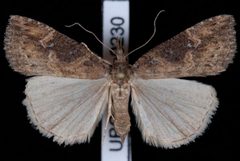
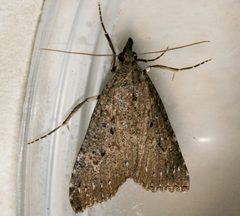
Hypena humuli, commonly known as the hop looper or hop vine , is a moth in the Erebidae. First described by Thaddeus William Harris in 1841, it has a broad distribution across North America from coast to coast in Canada south to Florida and Arkansas in the east and California in the west. The species is an emerging agricultural pest of hops (Humulus lupulus), with larvae feeding on hop foliage. It has been studied for its and natural enemy associations in Washington State hop yards.
Pronunciation
How to pronounce Hypena humuli: //hɪˈpiːnə ˈhjuːmjʊlaɪ//
These audio files are automatically generated. While they are not always 100% accurate, they are a good starting point.
Identification
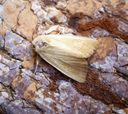
can be distinguished from similar Hypena by geographic occurrence and association with hop plants. The larva has fourteen legs and a distinctive greenish-white, semi-transparent appearance with slight striping and dotted patterning. The yellowish mouth with black-tipped jaws is a notable larval feature. Similar to other snout moths in resting posture with triangular wing arrangement.
Images
Habitat
Agricultural hop yards (Humulus lupulus ). Also found in areas with wild hops and related plants including nettles (Laportea , Urtica species) and wood nettle.
Distribution
North America: coast to coast in Canada; south in the eastern United States to Florida and Arkansas; west to California. Absent from south-central United States. In Canada, absent from Newfoundland and Labrador, Prince Edward Island, and the far north. Present in Alberta, Manitoba, and Saskatchewan.
Seasonality
fly year-round in southern and western portions of range. In the northeastern United States, active from April to November. Two per year in northern and eastern areas.
Diet
Larvae feed on hop foliage (Humulus lupulus), Laportea , nettle (Urtica species), and wood nettle.
Host Associations
- Humulus lupulus - larval food plantPrimary in agricultural settings; emerging pest of cultivated hops
- Laportea - larval food plantWild plants
- Urtica - larval food plantNettle used as food source
Life Cycle
Two per year in northern and eastern portions of range. Larvae appear early June and continue through late August. stage not explicitly documented in available sources.
Behavior
Larvae are foliage feeders on plants. are and attracted to light.
Ecological Role
Herbivore in natural ; agricultural pest in hop . Subject to by natural enemies including and in managed agricultural systems.
Human Relevance
Emerging pest of commercial hop production in the United States, particularly in Washington State and potentially in northeastern hop-growing regions. Yield losses have been documented in association with hop looper . Subject to research focusing on .
Similar Taxa
- Hypena scabraGreen cloverworm moth; similar and appearance but associated with clover, alfalfa, and soybean rather than hops. More abundant in open east of the Rocky Mountains.
More Details
Pest Status
Hypena humuli has emerged as a significant pest of hops in Washington State, USA, where it has been the subject of research on and . The was historically known from eastern North America but has expanded its pest status in western hop-growing regions.
Natural Enemies
Research in Washington State hop yards has documented and associated with hop looper , though specific were not identified in available sources. Natural enemy populations may contribute to in managed systems.
Sources and further reading
- BugGuide
- Wikipedia
- GBIF taxonomy match
- iNaturalist taxon
- NCBI Taxonomy
- Catalogue of Life
- Soybean Insects: Mid-to-Late Season Pests (V8 to Maturity) - AgriLife Extension Entomology
- A Revision of Soybean Caterpillar Pest Information for U.S. Soybean
- Bug Eric: National Moth Week 2024 Recap from Kansas City
- Bug Eric: Blacklighting Already?
- A New Pest Management Resource for Hop Farmers in the Northeastern U.S.
- caterpillar pests of soybean - Entomology Today
- Phenology and impact of natural enemies associated with the hop looper (Hypena humuli) in Washington State, USA
- Biology, phenology and control ofHypena humuli(Lepidoptera: Noctuidae), an emerging pest of hops (Humulus lupulus) (Cannabaceae) in the USA