
Hypena scabra
(Fabricius, 1798)
Green Cloverworm Moth, Black Snout, Green Cloverworm
Hypena scabra, commonly known as the green cloverworm or black snout, is a moth in the Erebidae. It is an abundant across much of North America east of the Rocky Mountains, with multiple per year. The larvae are significant agricultural pests, particularly of soybeans and other legumes, though they feed on a wide variety of plants. are active from early spring through late fall, or year-round in warmer regions.
Pronunciation
How to pronounce Hypena scabra: //hɪˈpiːnə ˈskæbrə//
These audio files are automatically generated. While they are not always 100% accurate, they are a good starting point.
Identification
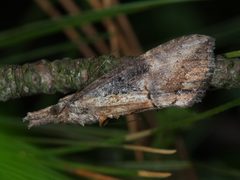
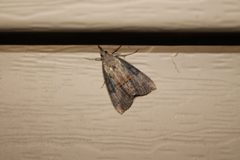
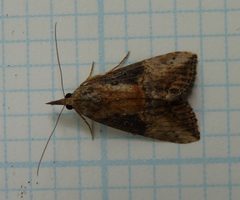
can be distinguished from similar Hypena and other owlet moths by the triangular wing posture at rest and the prominent snout-like labial palps. Larvae are identified by the combination of pale green color, two white lateral stripes, three pairs of abdominal plus anal prolegs, and characteristic vigorous wiggling when handled. This proleg count (3+1) separates green cloverworm larvae from soybean loopers (2+1) and velvetbean caterpillars (4+1).
Images
Habitat
Found in a variety of mostly open including agricultural fields, meadows, roadsides, and disturbed areas. Associated with plants in the pea (Fabaceae) and other herbaceous vegetation. Overwinters in the Gulf Coast region where host plants remain available year-round.
Distribution
Native to North America, ranging from Canada (Alberta, Manitoba, Saskatchewan, Quebec) south through the eastern and central United States to Florida and Texas. Introduced to Great Britain via American soybean shipments. Most abundant east of the Rocky Mountains.
Seasonality
are active from March to November in most of the range, with year-round activity in warmer southern regions. Multiple occur annually—at least three generations per year in Kansas, with later generations typically causing the most severe crop damage. Peak abundance in summer months.
Diet
Larvae are feeders with documented including clover (Trifolium), alfalfa (Medicago sativa), ragweed (Ambrosia), strawberries (Fragaria), raspberries (Rubus), soybeans (Glycine max), and various other legumes. Also reported on maples (Acer), cherries (Prunus), hackberries (Celtis), and elms (Ulmus). are not known to feed.
Host Associations
- Trifolium - larval food plantclover
- Medicago sativa - larval food plantalfalfa
- Glycine max - larval food plantsoybean, major agricultural pest
- Ambrosia - larval food plantragweed
- Fragaria - larval food plantstrawberry
- Rubus - larval food plantraspberry
- Acer - larval food plantmaple
- Prunus - larval food plantcherry
- Celtis - larval food planthackberry
- Ulmus - larval food plantelm
Life Cycle
Complete with , larva, pupa, and stages. Larvae progress through six to seven instars. Multiple per year; occurs as larvae or pupae in the southern part of the range, with adults migrating northward in spring. In the Gulf Coast region, active year-round with continuous breeding.
Behavior
are and attracted to light. When at rest, adults hold wings in a distinctive triangular posture. Larvae feed on leaf tissue and characteristically wiggle or drop from plants when disturbed. Larvae are typically found on the underside of leaves.
Ecological Role
Larvae function as herbivores, consuming leaf tissue of numerous plant . In natural , they likely contribute to nutrient cycling and serve as prey for and . In agricultural systems, they can reach densities and cause significant defoliation. The fungus rileyi has been observed infecting larvae, potentially regulating .
Human Relevance
Significant agricultural pest, particularly of soybeans in the eastern and central United States. Economic damage occurs through defoliation, with research indicating soybeans can tolerate no more than 20% defoliation without substantial yield loss during reproductive stages. Relatively easy to control with . The has been introduced to Great Britain through international trade, though not established as a pest there.
Similar Taxa
- Anticarsia gemmatalisVelvetbean caterpillar larvae are similar in size, color, and (vigorous wiggling), but have four pairs of abdominal rather than three, and are lighter in color with a diagonal black line across the wings.
- Chrysodeixis includensSoybean looper larvae have only two pairs of abdominal , causing a more pronounced looping gait; lack ridges extending to the edge.
- Trichoplusia niCabbage looper larvae have two pairs of abdominal and with ridges extending fully to the edge.
More Details
Agricultural Management
The Early Soybean Production System (ESPS)—planting early-maturing varieties in April—can reduce damage by allowing harvest before late-season caterpillar peak. Research has identified some soybean varieties with partial resistance to defoliation, though these are not widely planted due to lower yields.
Sources and further reading
- BugGuide
- Wikipedia
- GBIF taxonomy match
- iNaturalist taxon
- NCBI Taxonomy
- Catalogue of Life
- Soybean Insects: Mid-to-Late Season Pests (V8 to Maturity) - AgriLife Extension Entomology
- A Revision of Soybean Caterpillar Pest Information for U.S. Soybean
- Bug Eric: National Moth Week 2024 Recap from Kansas City
- Bug Eric: Blacklighting Already?
- The World’s Largest Tiger Beetle | Beetles In The Bush
- Not all Florida tiger beetles are rare | Beetles In The Bush