
Hypena bijugalis
Walker, 1859
Dimorphic Snout, Dimorphic Bomolocha, Dimorphic Hypena, Toothed Snout-Moth
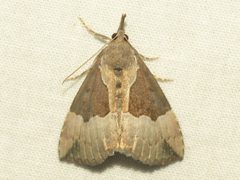
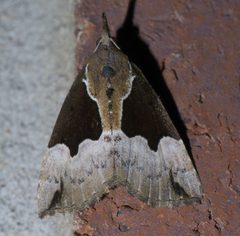
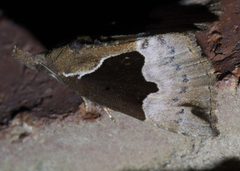
Hypena bijugalis, commonly known as the Dimorphic Snout, is a in the Erebidae, Hypeninae. It occurs across southern Canada from Nova Scotia to Vancouver Island, and throughout the United States to Florida. The species exhibits , with distinct differences in appearance between males and females. It is a species attracted to light sources.
Pronunciation
How to pronounce Hypena bijugalis: /haɪˈpiːnə baɪˌdʒuːˈɡælɪs/
These audio files are automatically generated. While they are not always 100% accurate, they are a good starting point.
Identification
The name "bijugalis" refers to its dimorphic nature, with males and females showing different coloration or pattern. As a member of the Hypena, it possesses the characteristic elongated labial palps that project forward like a snout, a trait common to snout moths. Specific identification features distinguishing it from other Hypena species are not documented in available sources.
Images
Distribution
Found from Nova Scotia across southern Canada to Vancouver Island, south throughout the United States to Florida. Distribution records confirm presence in Alberta, Manitoba, and Saskatchewan in Canada, and Vermont in the United States.
Behavior
; has been observed at artificial light sources including UV lights and porch lights. Like other , navigates using celestial cues and becomes disoriented by artificial lighting, resulting in spiraling toward light sources.
Similar Taxa
- Hypena scabraBoth are members of Hypena with snout-like labial palps, but H. scabra (Green Cloverworm) is a significant agricultural pest of soybeans and other legumes, whereas H. bijugalis has no documented economic impact.
More Details
Sources and further reading
- BugGuide
- GBIF taxonomy match
- iNaturalist taxon
- NCBI Taxonomy
- Catalogue of Life
- Soybean Insects: Mid-to-Late Season Pests (V8 to Maturity) - AgriLife Extension Entomology
- green cloverworm (Hypena scabra) - Entomology Today
- A Revision of Soybean Caterpillar Pest Information for U.S. Soybean
- Bug Eric: National Moth Week 2024 Recap from Kansas City
- Bug Eric: Blacklighting Already?
- caterpillar pests of soybean - Entomology Today