
Hypena baltimoralis
Guenée, 1854
Baltimore Hypena, Baltimore Bomolocha
A of the Erebidae, described by Guenée in 1854. fly from April to October with multiple per year, more numerous in southern portions of its range. The is strongly associated with deciduous forests and maple-feeding larvae.
Pronunciation
How to pronounce Hypena baltimoralis: /haɪˈpiːnə bɔːltɪˈmɔːrəlɪs/
These audio files are automatically generated. While they are not always 100% accurate, they are a good starting point.
Identification
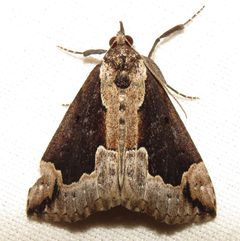
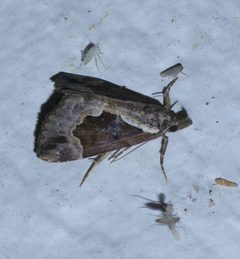
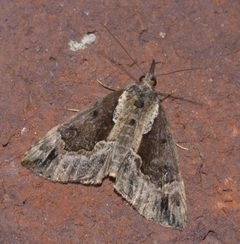
The triangular resting posture with concealed hindwings is characteristic of the Hypena. Distinguished from by the large dark forewing patch that extends approximately three-quarters of wing length without touching the inner margin, combined with the diagonal dark lines from wing corners. The grayish-brown ground color with variable female lightness separates it from darker or more uniformly patterned Hypena .
Images
Habitat
Deciduous forests and adjacent edge . Most commonly encountered in or near forested areas with maple presence.
Distribution
Eastern United States, ranging west to Wisconsin and Missouri, south to Florida and Texas.
Seasonality
active April to October; timing varies by latitude. At least two in New England, with additional generations southward.
Diet
Larvae feed on maple (Acer), primarily red maple (A. rubrum) and silver maple (A. saccharinum). feeding habits not documented.
Host Associations
- Acer rubrum - larval food plantred maple
- Acer saccharinum - larval food plantsilver maple
Life Cycle
Multiple per year; at least two in northern portions of range, more in south. stage not explicitly documented in sources. Larval development on maple foliage.
Behavior
are and attracted to light. Rest with distinctive triangular posture, forewings overlapping to conceal hindwings.
Ecological Role
Larval herbivore on maple foliage; contributes to nutrient cycling in deciduous forest . Specific ecological interactions beyond herbivory not documented.
Human Relevance
Not documented as an agricultural or forestry pest. Occasionally encountered by enthusiasts at light sources.
Similar Taxa
- Hypena scabraSimilar triangular resting posture and grayish coloration, but H. scabra larvae feed on herbaceous plants (clover, alfalfa, ragweed) rather than maple, and lack the distinctive large dark forewing patch with diagonal corner lines of H. baltimoralis
- Other Hypena speciesMany share the triangular resting posture; H. baltimoralis is distinguished by the specific pattern of the large dark forewing patch not reaching the inner margin and the presence of diagonal dark lines from wing corners
More Details
Sources and further reading
- BugGuide
- Wikipedia
- GBIF taxonomy match
- iNaturalist taxon
- NCBI Taxonomy
- Catalogue of Life
- Soybean Insects: Mid-to-Late Season Pests (V8 to Maturity) - AgriLife Extension Entomology
- green cloverworm (Hypena scabra) - Entomology Today
- A Revision of Soybean Caterpillar Pest Information for U.S. Soybean
- Bug Eric: National Moth Week 2024 Recap from Kansas City
- Bug Eric: Blacklighting Already?
- caterpillar pests of soybean - Entomology Today