
Idia
litter moths, American idia moths
Species Guides
18- Idia aemula(Common Idia)
- Idia americalis(American Idia)
- Idia concisa(American Idia Moth)
- Idia denticulalis(Toothed Idia Moth)
- Idia diminuendis(Orange-spotted Idia Moth)
- Idia forbesii(Forbes' Idia Moth)
- Idia gopheri(Gopher Tortoise Moth)
- Idia immaculalis(Immaculate Idia Moth)
- Idia julia(Julia's Idia Moth)
Idia is a of litter moths in the Erebidae, Herminiinae. These are primarily and are commonly attracted to light sources. The genus includes the well-known American Idia Moth (Idia americalis) and related . Members of this genus are found across North America and are frequently documented in citizen science projects such as iNaturalist.
Pronunciation
How to pronounce Idia: /ˈɪdiə/
These audio files are automatically generated. While they are not always 100% accurate, they are a good starting point.
Identification
Distinguished from similar herminiine by the combination of: forewing with complete transverse lines including a distinct antemedial line, postmedial line, and subterminal line; spot usually present and well-defined; hindwing pale with minimal patterning. Differs from Zanclognatha in having more complete forewing lines and less angled wing margins. Separated from Palpita by smaller size and lack of wing scaling. Genitalia examination often required for definitive -level identification.
Images
Appearance
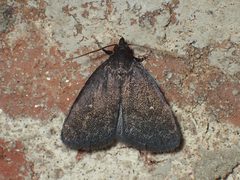
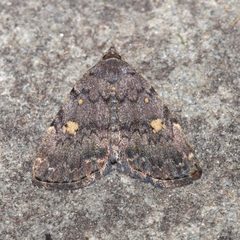
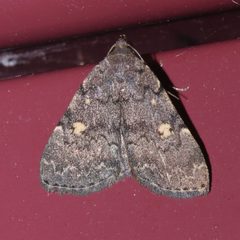
Medium-sized with wingspans typically ranging from 20-35 mm. Forewings usually display muted earth tones—gray, brown, or buff—with intricate dark transverse lines and often a distinct spot. Hindwings are generally paler than forewings, often whitish or pale gray with subtle markings. Body is stout and densely scaled. are (thread-like) in both sexes. Some show in wing pattern intensity.
Habitat
Deciduous and mixed woodlands, forest edges, riparian corridors, suburban areas with tree cover, and parks. frequently found near ground-level vegetation and leaf litter. Larvae occur in decaying plant matter.
Distribution
Primarily Nearctic; widespread across North America from southern Canada through the United States, with highest diversity in eastern and central regions. Some extend into Mexico.
Seasonality
active primarily from late spring through early autumn, with peak activity in summer months. Multiple per year in southern portions of range; single or partial second generation in northern areas.
Diet
Larvae feed on decaying plant material, including dead leaves, rotting wood, and other detritus. One has been documented feeding on lichens. do not feed.
Life Cycle
Complete . laid on or near larval food sources. Larvae are , developing through several instars in decaying organic matter. occurs in silk cocoon within leaf litter or soil. stage varies by and latitude—may be larval or pupal.
Behavior
; strongly attracted to artificial light sources and frequently collected at blacklights. Adults rest with wings folded tent-like over body during day, often on tree trunks or vertical surfaces where cryptic coloration provides camouflage. Some documented at flowers or sugar baits.
Ecological Role
Larvae function as decomposers, contributing to nutrient cycling in forest by breaking down dead plant material. serve as prey for including bats, birds, and predatory arthropods.
Human Relevance
Occasional minor nuisance at outdoor lighting. Frequently documented by citizen scientists and enthusiasts. The American Idia Moth (Idia americalis) is one of the more commonly encountered at light traps in eastern North America. No economic significance as pests.
Similar Taxa
- ZanclognathaSimilar herminiine with angled wing margins and often more reduced forewing lines; distinguished by wing shape and line completeness
- PalpitaLarger size with , often white or pale wings and more pointed wing apices; different preferences
- BleptinaOverlapping size range but typically with more uniform forewing coloration and less distinct transverse lines
More Details
Taxonomic Note
The Idia was historically placed in Noctuidae but was reassigned to Erebidae following molecular phylogenetic studies. The Herminiinae, to which Idia belongs, is commonly referred to as the 'litter moths' due to larval habits.
Documentation
The is well-represented in citizen science databases, with over 83,000 observations on iNaturalist as of 2024, facilitating studies of distribution and .