
Sympiesis
Förster, 1856
Species Guides
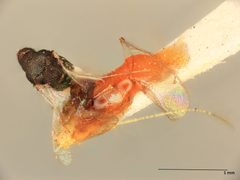
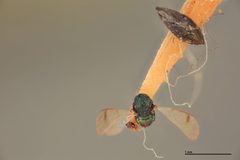
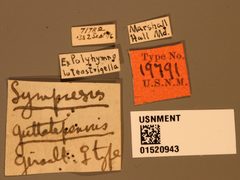
5Sympiesis is a of small in the Eulophidae. are primarily ectoparasitoids of lepidopteran larvae, particularly leaf-mining in the family Gracillariidae, though some species attack other caterpillar groups including Hesperiidae (skippers) and Hyblaeidae. Several species have been studied for their potential as agents of agricultural pests. The genus has been documented from North America, Europe, and South Asia.
Pronunciation
How to pronounce Sympiesis: /sɪmˈpiːsɪs/
These audio files are automatically generated. While they are not always 100% accurate, they are a good starting point.
Identification
Small , typically 2–4 mm in body length. Members of the can be distinguished from other Eulophinae by combinations of antennal segment proportions, presence or absence of malar , mesoscutal patterns, and wing setation. Specific identification requires examination of funicle segment proportions, propodeal structure, and ovipositor .
Images
Habitat
Agricultural including apple orchards, citrus groves, and teak plantations; also forest edges and areas where plants of lepidopteran prey occur.
Distribution
North America (Connecticut, California, Alberta, British Columbia), Europe, and South Asia (India: Uttarakhand, Kerala, Assam; China: Beijing).
Host Associations
- Gracillariidae - primary leaf-mining larvae; most frequently documented
- Hesperiidae - primary caterpillars
- Hyblaeidae - primary teak defoliator Hyblaea puera
Life Cycle
Females oviposit on or near larvae. Development occurs as ectoparasitoid on caterpillars, with of from host remains. Some are solitary, others gregarious depending on host size.
Behavior
females locate using mechano- and . In apple orchards, female abundance decreases with increasing distance from forest edges, suggesting edge-mediated or host-finding .
Ecological Role
Primary regulating of leaf-mining and defoliating lepidopteran larvae. Contributes to natural in orchard and forest .
Human Relevance
Several investigated as agents for agricultural pests: S. marylandensis for apple blotch leafminer (Phyllonorycter crataegella), S. hyblaeae for teak defoliator (Hyblaea puera), and S. striatipes for citrus leafminer (Phyllocnistis citrella). Susceptible to orchard , which can disrupt biological control services.
Similar Taxa
- Chrysocharisalso Eulophinae of leaf-mining Lepidoptera; distinguished by antennal structure and wing venation
- ElasmusEulophidae of Lepidoptera; typically smaller with reduced wing venation
- TetrastichusEulophinae with similar ; differs in tarsal structure and antennal formula
Sources and further reading
- BugGuide
- GBIF taxonomy match
- iNaturalist taxon
- NCBI Taxonomy
- Catalogue of Life
- Sympiesis xanthostoma
- Gracillariid Hosts of Sympiesis marylandensis (Hymenoptera: Eulophidae) in New England
- A New Species of Sympiesis Förster, 1856 (Hymenoptera: Eulophinae) Parasitizing Lepidopteran Pest Feeding on Dioscorea bulbifera in Almora, Uttarakhand, India
- Mechano- and Chemoreceptors and Their Possible Role in Host Location Behavior of Sympiesis sericeicornis (Hymenoptera: Eulophidae)
- Toxicity of insecticides to the citrus leafminer, Phyllocnistis citrella, and its parasitoids, Chrysocharis pentheus and Sympiesis striatipes (Hymenoptera: Eulophidae)
- Model for the Temperature-dependent Emergence of Overwintering Phyllonorycter crataegella (Clemens) (Lepidoptera: Gracillariidae), and its Parasitoid, Sympiesis marylandensis Girault (Hymenoptera: Eulophidae)
- Seasonal Development, Flight Activity, and Density of Sympiesis marylandensis (Hymenoptera: Eulophidae), a Parasitoid of Leaf- Mining Phyllonorycter spp. (Lepidoptera: Gracillariidae), in Connecticut Apple Orchards and Forests
- Comparative Toxicity of Orchard Insecticides to the Apple Blotch Leafminer, Phyllonorycter crataegella (Lepidoptera: Gracillariidae), and its Eulophid Parasitoid, Sympiesis marylandensis (Hymenoptera: Eulophidae)
- Reproduction, Development, Longevity, and Host Mortality of Sympiesis marylandensis (Hymenoptera: Eulophidae), a Parasitoid of Spotted Tentiform Leafminer (Lepidoptera: Gracillariidae), in the Laboratory
- Sympiesis notata (Hymenoptera: Chalcidoidea: Eulophidae), a gregarious parasitoid of Hesperiidae (Lepidoptera), and some records of other Chalcidoidea associated with skipper butterflies in the Western Palaearctic
- SPATIAL DISTRIBUTION OFSYMPIESIS MARYLANDENSISGIRAULT (HYMENOPTERA: EULOPHIDAE) IN APPLE ORCHARDS INFESTED BY ITS HOST, THE APPLE BLOTCH LEAFMINER,PHYLLONORYCTER CRATAEGELLA(CLEMENS) (LEPIDOPTERA: GRACILLARIIDAE)
- A new species of Sympiesis (Hymenoptera: Eulophidae) parasitic on the teak defoliator Hyblaea puera (Lepidoptera: Hyblaeidae) in India