
Phyllonorycter crataegella
(Clemens, 1859)
Apple Blotch Leafminer Moth
Phyllonorycter crataegella is a microlepidopteran in the Gracillariidae, commonly known as the apple blotch leafminer . It is a significant pest of apple orchards in northeastern North America, where larvae create blotch mines in leaves. The exhibits a primarily activity pattern with sex-specific timing: males fly intensely in the morning for mating, while females fly in the afternoon and evening for oviposition. It has three per year in its core range, with emerging in spring triggered by accumulated above 5°C.
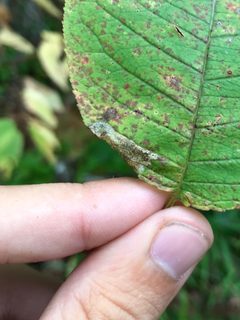
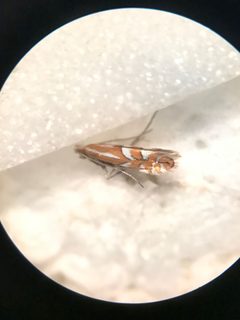
Pronunciation
How to pronounce Phyllonorycter crataegella: //ˌfɪloʊˈnɔːrɪktər ˌkrætəˈdʒɛlə//
These audio files are automatically generated. While they are not always 100% accurate, they are a good starting point.
Identification
Extremely small size (5.5–6 mm wingspan) distinguishes it from larger . As a Phyllonorycter , it can be separated from other Gracillariidae by typical genus-level . Specific species-level identification requires examination of genitalia or molecular methods; it is closely related to and potentially confused with P. blancardella, another apple-feeding leafminer. The and association with apple (Malus) and hawthorn (Crataegus) plants provides ecological context for identification.
Images
Appearance
Very small with wingspan of 5.5–6 mm. are typical of the Phyllonorycter in overall form. Specific coloration and pattern details are not well-documented in available sources.
Habitat
Commercial apple orchards in northeastern North America. Within orchards, aggregate in the inner half of the tree . moths rest primarily on the lower third of tree trunks, especially below 1.5 m height; first and second generation moths rest on leaves. Proximity to forest edges influences abundance and rates.
Distribution
North America: Canada (Nova Scotia, Québec, Ontario, New Brunswick, Manitoba); United States (Kentucky, Massachusetts, Michigan, Missouri, New Hampshire, New Jersey, New York, Ohio, Pennsylvania, Virginia, West Virginia, Wisconsin, California, Maine, Vermont, Oregon, Arkansas, Connecticut, Illinois). Core distribution in northeastern apple-growing regions.
Seasonality
Three per year in northeastern North America. generation emerge in spring based on accumulated above 5°C. First generation (second ) and second generation (third flight) follow sequentially through summer. Adult activity is primarily with midday inactivity.
Diet
Larvae are leaf miners that feed internally on leaf tissue, creating blotch mines. Specific larval feeding creates characteristic damage patterns in plant leaves.
Host Associations
- Amelanchier canadensis - larval serviceberry
- Aronia spp. - larval chokeberry
- Crataegus mollis - larval hawthorn; specific epithet crataegella refers to this
- Cydonia japonica - larval Japanese quince
- Cydonia oblonga - larval quince
- Malus coronaria - larval sweet crabapple
- Malus domestica - larval cultivated apple; primary economic
- Malus pumila - larval paradise apple
- Malus sieboldii - larval Siebold's crabapple
- Malus sylvestris - larval European crabapple
- Photinia spp. - larval
- Prunus americana - larval American plum
- Prunus avium - larval sweet cherry
- Prunus domestica - larval European plum
- Prunus pennsylvanica - larval pin cherry
- Prunus persica - larval peach
- Prunus serotina - larval black cherry
- Prunus virginiana - larval chokecherry
- Pyrus communis - larval common pear
- Pyrus coronaria - larval
- Sorbus americana - larval American mountain-ash
- Sorbus aucuparia - larval European rowan
- Sympiesis marylandensis - eulophid ; major natural enemy
Life Cycle
Three per year: (1) generation with emerging in spring, (2) first generation, and (3) second generation. Overwintering occurs as adults. Spring is temperature-dependent, triggered by accumulated above 5°C. Males emerge before females (protandry). Larvae mine leaves of plants; occurs within the mine or in soil.
Behavior
Primarily with distinct activity pattern: intense morning (almost exclusively males) associated with mating; lesser afternoon-to-dusk flight (predominantly females) associated with oviposition; midday inactivity. aggregate in inner of trees. moths perch on lower tree trunks; summer generation moths perch on leaves. are attracted to light at night, though this is not their primary activity period.
Ecological Role
Herbivore and pest of apple orchards; leaf mining damage reduces photosynthetic capacity and can affect fruit production. for Sympiesis marylandensis, which provides natural . Part of orchard including other parasitoids and . Spatial distribution within orchards affects rates, with edge effects influencing both and parasitoid abundance.
Human Relevance
Significant economic pest of apple (Malus domestica) in northeastern North American orchards. Leaf mining damage reduces tree vigor and fruit quality. Subject to programs and applications, which must balance control with preservation of natural enemies like Sympiesis marylandensis. Orchard management practices at forest edges can negatively impact by affecting distribution.
Similar Taxa
- Phyllonorycter blancardellaAnother tentiform leafminer in same attacking apple; occurs sympatrically in northeastern orchards; requires genitalia examination or molecular methods for definitive separation
- Other Phyllonorycter spp.Many congeneric are morphologically similar microlepidopterans; identification to species level typically requires specialized taxonomic expertise
More Details
Temperature-dependent phenology
Spring of is modeled using accumulated above 5°C, allowing prediction of periods for management timing.
Sex-specific spatial and temporal patterns
Males and females differ in both timing (morning vs. afternoon ) and distribution (female abundance decreases with distance from forest, while male distribution is more uniform).
Historical basionym
Originally described as Lithocolletis crataegella by Clemens in 1859 before transfer to Phyllonorycter.
Sources and further reading
- BugGuide
- Wikipedia
- GBIF taxonomy match
- iNaturalist taxon
- NCBI Taxonomy
- Catalogue of Life
- Bug Eric: My Personal National Moth Week, 2017
- Bug Eric: September 2017
- DIURNAL BEHAVIOR OF THE APPLE BLOTCH LEAFMINER MOTH, PHYLLONORYCTER CRATAEGELLA (LEPIDOPTERA: GRACILLARIIDAE)
- Model for the Temperature-dependent Emergence of Overwintering Phyllonorycter crataegella (Clemens) (Lepidoptera: Gracillariidae), and its Parasitoid, Sympiesis marylandensis Girault (Hymenoptera: Eulophidae)
- Comparative Toxicity of Orchard Insecticides to the Apple Blotch Leafminer, Phyllonorycter crataegella (Lepidoptera: Gracillariidae), and its Eulophid Parasitoid, Sympiesis marylandensis (Hymenoptera: Eulophidae)
- Within-Tree Distribution of Phyllonorycter blancardella (F.) and P. crataegella (Clemens) (Lepidoptera: Gracillariidae) and Associated Levels of Parasitism in Commercial Apple Orchards
- Biology and Impact of Parasitoids of <i>Phyllonorycter blancardella</i> and <i>P. crataegella</i> (Lepidoptera: Gracillariidae) in Northeastern North American Apple Orchards
- SPATIAL DISTRIBUTION OFSYMPIESIS MARYLANDENSISGIRAULT (HYMENOPTERA: EULOPHIDAE) IN APPLE ORCHARDS INFESTED BY ITS HOST, THE APPLE BLOTCH LEAFMINER,PHYLLONORYCTER CRATAEGELLA(CLEMENS) (LEPIDOPTERA: GRACILLARIIDAE)