
Lithocolletinae
Stainton, 1854
leaf-miner moths
Genus Guides
8- Anarsioses
- Cameraria
- Chrysaster
- Cremastobombycia
- Leucanthiza
- Macrosaccus
- Phyllonorycter(Leaf blotch miner moths)
- Porphyrosela
Lithocolletinae is a of small leaf-mining within Gracillariidae, containing over 540 across eleven . The subfamily is distributed worldwide with highest diversity in temperate regions, particularly the Palearctic and Nearctic realms. Larvae are predominantly leaf miners, with most species feeding on plants in Fabaceae, Fagaceae, Betulaceae, Rosaceae, and Salicaceae. Many species are monophagous, known from only a single plant. The genus Phyllonorycter dominates with approximately 400 species.
Pronunciation
How to pronounce Lithocolletinae: //ˌlɪθəkəˈlɛtɪniː//
These audio files are automatically generated. While they are not always 100% accurate, they are a good starting point.
Identification
distribution patterns on leaf mines are used to distinguish : frass may be scattered, deposited neatly along leaf , gathered at feeding areas and knit into piles with silk threads, or spun into the cocoon. Cameraria species typically form flat mines on upper leaf surfaces, while most Phyllonorycter species form underside tentiform mines, though exceptions exist.
Images
Appearance
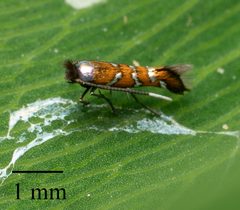
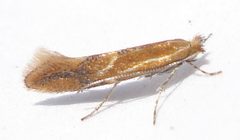
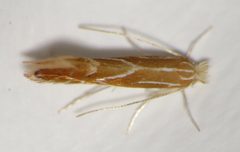
are small with wingspans under 10 millimeters. Forewings are often colorful, displaying orange or red-brown shades with white or silvery streaks and a metallic, shiny ground color.
Distribution
Worldwide distribution with concentration in temperate regions. Approximately half of are native to the , over 100 occur in the , 66 in the Afrotropical realm (mainly southern Africa), and species occur in the Neotropical region including Brazil and Uruguay.
Diet
Larvae feed as leaf miners on leaves of at least 870 plant in 36 . Many feed on Fabaceae; five are restricted to this family. Other important host families include Fagaceae, Betulaceae, Rosaceae, and Salicaceae.
Host Associations
- Fabaceae - primary for many ; five restricted to this family
- Fagaceae -
- Betulaceae -
- Rosaceae -
- Salicaceae -
- Malvaceae -
- Cistaceae - for Triberta
- Juglandaceae -
Life Cycle
Larvae develop through five instars. Early instars are typically flat and legless with lacerating-sucking mouthparts, feeding on sap. Later instars become cylindrical with developed legs, round , and chewing mouthparts, consuming leaf tissue. Some complete development in approximately 16 days at 25°C.
Behavior
Larvae are leaf miners, feeding internally within leaves and producing characteristic blotch or tentiform mines. Most larvae remain unexposed during development. Some larvae produce galls on plants. are very small and difficult to detect in the field.
Ecological Role
Leaf-mining herbivores that create tissue damage on plant leaves. Serve as hosts for including Chrysocharis walleyi (Eulophidae).
Human Relevance
Some are agricultural or horticultural pests. Cameraria ohridella is a significant pest of horse chestnut (Aesculus hippocastanum). Phyllonorycter blancardella feeds on apples (Malus spp.). Cremastobombycia lantanella attacks (Lantana camara).
Similar Taxa
- Other Gracillariidae subfamiliesLithocolletinae distinguished by leaf-mining habit and specific mine ; molecular analysis shows distinctiveness from other gracillariid lineages
- Phyllonorycter vs. CamerariaOnce treated as single Lithocolletis; now separated based on mine position (upper vs. lower leaf surface) and , though some were historically misplaced between these genera
Sources and further reading
- BugGuide
- Wikipedia
- iNaturalist taxon
- NCBI Taxonomy
- Catalogue of Life
- Systematics, revisionary taxonomy, and biodiversity of Afrotropical Lithocolletinae (Lepidoptera: Gracillariidae)
- Morphology and biology of Porphyrosela minuta Clarke 1953 (Lepidoptera: Gracillariidae, Lithocolletinae) in Uruguay
- A new species of Macrosaccus (Lepidoptera: Gracillariidae: Lithocolletinae) from Arizona, USA
- Systematics, phylogeny and biology of a new genus of Lithocolletinae (Lepidoptera: Gracillariidae) associated with Cistaceae
- Description of Porphyrosela arachisella sp. nov. (Lepidoptera: Gracillariidae), the first report of Lithocolletinae for Brazil
- Wrong side of the leaf: assigning some Lithocolletinae species (Lepidoptera: Gracillariidae) to their proper genera
- Description of <i>Hyloconis longivalvata</i> Li, sp. n., with notes on its biology (Lepidoptera: Gracillariidae, Lithocolletinae)
- A review of the ecological grouping of species of the genus Phyllonorycter Hübner, [1822] (Lepidoptera, Gracillariidae: Lithocolletinae), associated with fagaceae
- Leaf-mining moths of the genus Phyllonorycter Hübner<br>(Lepidoptera: Gracillariidae: Lithocolletinae) associated with Malvaceae in China, with descriptions of one new species
- Leaf-mining moths of the genus Phyllonorycter Hübner (Lepidoptera: Gracillariidae: Lithocolletinae) associated with Juglandaceae in China, with descriptions of two new species and one newly recorded species
- Cremastobombyciasocoromaensis sp. nov., the first South American representative of the micromoth genus Cremastobombycia Braun (Lepidoptera, Gracillariidae, Lithocolletinae).