
Chrysaster
Kumata, 1961
Species Guides
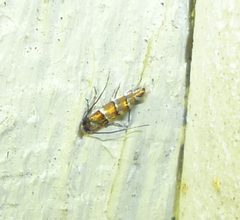
2Chrysaster is a of small leaf-mining in the Gracillariidae, established by Kumata in 1961. The genus contains two described : C. hagicola, described from Japan, and C. ostensackenella, a North American species that has become in East Asia and Europe. Members of this genus are specialized miners of Fabaceae leaves, with C. ostensackenella specifically associated with Robinia pseudoacacia. The invasive spread of C. ostensackenella has been documented through genetic analysis, revealing multiple introduction and establishing in China, South Korea, Japan, Italy, and Russia.
Pronunciation
How to pronounce Chrysaster: //kɹɪˈsæstər//
These audio files are automatically generated. While they are not always 100% accurate, they are a good starting point.
Identification
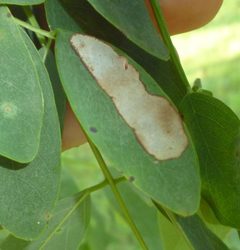
Identification to requires examination of forewing pattern and male genitalia. For C. ostensackenella, leaf mine characteristics provide field diagnostic features: yellowish blotch mines on the upper leaf surface, typically beginning with a short tunnel (1.5–2 mm) before expanding to a blotch, with relatively smooth edges and position near but not strictly associated with the main . These mines occupy 10–30% of the leaf compound area. Mines can be distinguished from other gracillariids on Robinia by the short initial tunnel and upper surface location. C. hagicola is distinguished by genitalia and distribution (Japan).
Images
Habitat
Associated with plantings and natural stands of Fabaceae, particularly Robinia pseudoacacia. In the invaded range in Russia, found in arboreta and tree plantings including the Mountain-Taiga Station arboretum in Gornotaejnoe village, Gornotaejnoe village plantings, and Khorol village area in Primorsky Krai. suitability is determined by plant presence rather than specific environmental conditions.
Distribution
The has a disjunct distribution corresponding to its two . C. hagicola occurs in Japan. C. ostensackenella is native to North America (USA and Canada) and has been introduced to East Asia (China first recorded 2015, South Korea 2017, Japan 2021), Europe (Italy 2022), and Russia (Primorsky Krai 2022). Further spread is expected in regions with widespread Robinia pseudoacacia plantings.
Seasonality
In Primorsky Krai, observed in July. Possibly two per year in this region, though this remains uncertain based on available observations. In China, up to four generations may occur depending on climate conditions.
Diet
Specialized leaf-mining on Fabaceae. C. ostensackenella feeds on Robinia pseudoacacia leaves, with larvae mining between leaf surfaces. C. hagicola associations are not documented in the provided sources.
Host Associations
- Robinia pseudoacacia - confirmed for C. ostensackenella
Life Cycle
are laid near the main or between main and secondary veins. Larvae create mines beginning as short tunnels (1.5–2 mm) that widen into blotches. Late instar larvae create semicircular cuts in the upper to exit the mine. occurs in a white, tough cocoon: on the lower leaf surface along secondary veins in the Russian Far East, but inside the mine in North America. Under laboratory conditions (24°C, 45% humidity), pupal development takes up to six days.
Behavior
occurs via wind currents as aerial plankton and through human-mediated transport. stages can be transported with plants for planting. location differs between geographic ranges: outside the mine in the Russian Far East versus inside the mine in North America. Each leaf mine contains a single larva.
Ecological Role
C. ostensackenella functions as a foliar pest in invaded ranges, causing leaf discoloration, browning, drying, and premature leaf fall on Robinia pseudoacacia. The is considered an pest threatening ornamental and planted black locust stands. No information is available for ecological roles of C. hagicola in its native range.
Human Relevance
C. ostensackenella is an emerging pest of economic and ornamental concern due to damage to Robinia pseudoacacia, a widely planted tree for timber, erosion control, and ornamental purposes. The has spread through international plant trade and natural , with potential for further introduction to the Southern Hemisphere where black locust has been established. No human relevance is documented for C. hagicola.
Similar Taxa
- Other Gracillariidae on RobiniaLeaf mines of C. ostensackenella can be distinguished by the short initial tunnel, upper surface location, relatively smooth edges, and position near but not strictly on the main ; other may have different mine morphologies or .
- Macrosaccus robiniellaAnother gracillariid on Robinia pseudoacacia; distinguished by mine characteristics and location.
More Details
Invasion genetics
Phylogeographic analysis of C. ostensackenella revealed 10 haplotypes among 21 specimens with intraspecific genetic diversity of 3.29%. A shared haplotype between Japan and North Carolina suggests direct USA-to-East Asia invasion, while a shared haplotype between Japan and the Russian Far East indicates likely spread from Hokkaido to Primorsky Krai.
Pupation plasticity
The difference in location between North America (inside mine) and the Russian Far East (outside mine in cocoon on lower surface) represents geographic variation in , possibly due to environmental conditions, pressure, or founder effects in the invaded range.