
Macrosaccus robiniella
(Clemens, 1859)
Black Locust Leafminer
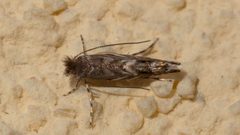
A small leaf-mining in the Gracillariidae, native to North America and in Europe since 1983. have a wingspan of 5.5–6.5 mm. Larvae are highly specialized miners of black locust (Robinia) leaves, producing distinctive blotch mines. Recent research has documented unexpected behavioral plasticity, with larvae capable of producing four distinct mine types that vary in position and appearance.
Pronunciation
How to pronounce Macrosaccus robiniella: /ˌmakroʊˈsækəs ˌroʊbɪniˈɛlə/
These audio files are automatically generated. While they are not always 100% accurate, they are a good starting point.
Identification
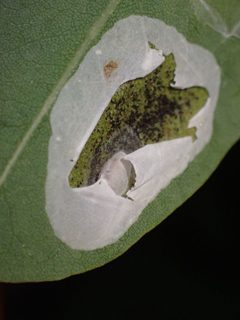
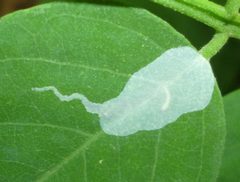
Distinguished from by association with Robinia and characteristic leaf mine . The mine begins as an elongate serpentine track that enlarges to an elongate-oval, whitish blotch, typically on one side of the midrib and usually on the lower leaflet surface; later instars cause slight tentiform folding due to silk deposition. In Europe, mines may be confused with those of Parectopa robiniella (upper-side blotch above midrib) or Obolodiplosis robiniae (edge blotch causing downward folding), though recent findings show M. robiniella itself can produce mimetic mine types resembling these species.
Images
Habitat
Forested areas and forest edges; open areas with Robinia pseudoacacia trees. In Europe, thrives in where black locust has been introduced and naturalized.
Distribution
Native to North America, widely distributed across the continent. in Europe: first reported near Basel, Switzerland in 1983, subsequently documented in France, Germany, northern Italy (1988), Austria (1989), Slovakia (1992), Hungary (mid-1990s), Slovenia (1994), Croatia (2001), and Russia (Voronezh region).
Seasonality
Two to three per year in temperate regions. Second generation most numerous, with mature mines present in October.
Diet
Larvae feed on leaf tissue of Robinia pseudoacacia, Robinia viscosa, and Robinia hispida. Early instars are sap-feeders; later instars are tissue-feeders.
Host Associations
- Robinia pseudoacacia - primary black locust
- Robinia viscosa -
- Robinia hispida -
Life Cycle
Five larval instars. Early instars are sap-feeders with strongly depressed bodies and reduced chaetotaxy. Later instars are tissue-feeders with cylindrical bodies. occurs within the leaf mine. Two to three per year.
Behavior
Larvae exhibit behavioral plasticity in leaf-mining, producing four distinct mine types: (1) common lower-side blotch on leaflet half; (2) upper-side blotch on leaflet half; (3) upper-side blotch above midrib (resembling Parectopa robiniella damage); (4) narrow blotch at leaf edge causing strong downward folding (resembling Obolodiplosis robiniae damage). Unusual mine types (3 and 4) may provide enemy-free space by mimicking damage of other herbivores, reducing attack rates. Can share leaflets with Parectopa robiniella.
Ecological Role
Herbivore and on black locust. pest capable of causing heavy (>50% leaf damage in dense ). Potential competitor for trophic with Parectopa robiniella. Reduced in novel mine types suggests exploitation of enemy-free space as a survival strategy supporting high population densities.
Human Relevance
pest of black locust, a tree planted for timber, erosion control, and ornamental purposes. Heavy reduce aesthetic value and potentially tree vigor. No known economic impact on crops; distinct from M. morrisella, which has been reported on soybean.
Similar Taxa
- Parectopa robiniellaAlso in Europe on Robinia; produces upper-side blotch mines above midrib. M. robiniella mine type 3 mimics this , but P. robiniella mines are typically more tentiform.
- Macrosaccus morrisellaCongeneric ; distinguished by range (Fabaceae including soybean and hog peanut, not primarily Robinia) and geographic focus of recent agricultural concern in North America.
- Obolodiplosis robiniaeGall midge producing edge mines with downward folding; M. robiniella mine type 4 mimics this damage.
Sources and further reading
- BugGuide
- Wikipedia
- GBIF taxonomy match
- iNaturalist taxon
- NCBI Taxonomy
- Catalogue of Life
- Macrosaccus morrisella adult - Entomology Today
- Macrosaccus morrisella soybean damage - Entomology Today
- Macrosaccus morrisella larva on soybean leaf - Entomology Today
- Leaf-Mining Moth May Be New Pest of Soybean
- macrosaccus-morrisella-adult-socialmedia - Entomology Today
- Joseph Moisan-De Serres Archives - Entomology Today
- THE FIRST FINDING OF MACROSACCUS ROBINIELLA (CLEMENS, 1859) AND OBOLODIPLOSIS ROBINIAE HALDEMAN, 1847 NEAR VORONEZH
- Leaf Mine Types and Associated Parasitism in the Invasive Tree Insect Pest Macrosaccus robiniella (Lepidoptera: Gracillariidae)