
Parectopa robiniella
Clemens, 1863
Locust Digitate Leafminer, Locust Digitate Leafminer Moth
Parectopa robiniella is a small gracillariid native to North America that has become in Europe. First detected in Italy in 1970, it has since spread to at least ten European countries including Ukraine, where it was first recorded in 2003. The is a whose larvae feed on Robinia species, particularly the black locust (Robinia pseudoacacia). Its spread has been facilitated by global warming and the widespread planting of its tree.
Pronunciation
How to pronounce Parectopa robiniella: /pæˈrɛktoʊpə roʊˌbɪniˈɛlə/
These audio files are automatically generated. While they are not always 100% accurate, they are a good starting point.
Identification
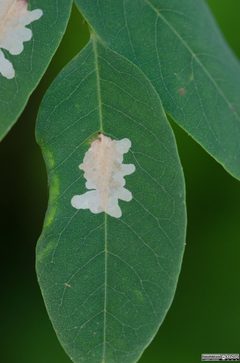
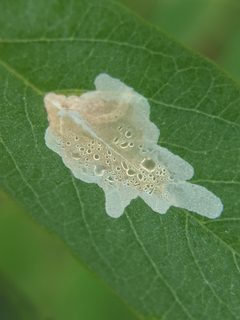
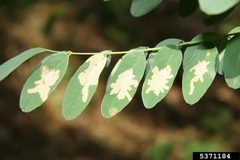
The is extremely small (5 mm wingspan) and difficult to identify without microscopic examination or genitalia dissection. The larval mines are more readily identifiable: they form a narrow blotch at the leaf edge, causing strong downward folding of the leaflet. This mine type resembles damage caused by the gall midge Obolodiplosis robiniae. Mines can be distinguished from those of the related Macrosaccus robiniella, which typically occupies one half of a leaflet on the lower surface, and from Phyllonorycter robiniella, which produces tentiform mines.
Images
Habitat
Urban and semi-urban environments, forest plantations, and artificial afforestation areas where trees occur. In Europe, it is strongly associated with planted black locust stands and street trees.
Distribution
Native to North America. in Europe: Italy (first recorded 1970), France, Germany, Slovenia, Croatia, Austria, Serbia, Slovakia, Romania, Ukraine (first recorded 2003), and Hungary. Predicted to continue expanding northward into Nordic countries, Estonia, the British Isles, and further into Russia.
Seasonality
Two to three per year in Hungary; two generations per year reported in Romania. periods not explicitly documented but likely synchronized with leaf availability.
Diet
Larvae feed as leaf miners on Robinia , specifically Robinia pseudoacacia (black locust). The mining activity occurs in the leaf mesophyll tissue.
Host Associations
- Robinia pseudoacacia - primary Black locust; sole documented in Europe
- Robinia - -level Native North American not specified in available sources
Life Cycle
Complete with two to three annually in parts of its European range. Larval stage is the feeding and damaging phase, occurring as a within Robinia leaves. likely occurs within the mine or in leaf litter, though specific details are not documented in available sources.
Behavior
Larval mining produces a characteristic narrow blotch mine at the leaf edge that causes strong downward folding of the leaflet. This mine position and differs from congeneric and confamilial miners on the same .
Ecological Role
Herbivore inducing significant defensive physiological responses in plants, including elevated peroxidase activity and altered chlorophyll fluorescence parameters. Heavy cause substantial leaf damage and reduce photosynthetic in black locust. The has been identified as the largest phytophagous invasion on Robinia pseudoacacia in Ukraine.
Human Relevance
Recognized as a significant economic pest of black locust, a strategically important tree for afforestation, landscaping, and apiculture in Europe. Causes serious damage to ornamental and plantation trees. Its spread is used as a biological indicator of climate change effects, with distribution modeling showing strong correlation with temperature-related variables. Plant defense responses to this species have been proposed as biomarkers for pest influence.
Similar Taxa
- Macrosaccus robiniellaAlso a gracillariid on Robinia; produces blotch mines on leaflet halves rather than edge mines, though M. robiniella has been observed forming mine type 4 that resembles P. robiniella damage
- Phyllonorycter robiniellaConfamilial on same ; produces tentiform mines on underside of leaves rather than edge-folding blotch mines
- Obolodiplosis robiniaeGall midge (Diptera: Cecidomyiidae) producing similar leaf edge damage; mine type 4 of M. robiniella was noted to resemble this ' damage pattern
More Details
Invasion Dynamics
The ' European expansion has been extensively modeled using Bayesian additive regression trees (BART). Temperature-related variables are the strongest predictors of its distribution, explaining its rapid spread coincident with rising mean temperatures. suitability alone does not improve distribution models, indicating thermal constraints are more limiting than host availability.
Plant Physiological Impact
triggers measurable changes in plant biochemistry: 3.8-fold increase in peroxidase activity in young trees, 24.6% increase in older trees, and significant alterations in chlorophyll fluorescence induction parameters indicating impaired .
Sources and further reading
- BugGuide
- Wikipedia
- GBIF taxonomy match
- iNaturalist taxon
- NCBI Taxonomy
- Catalogue of Life
- Monitoring the Attack by Parectopa Robiniella and Phyllonorycter Robiniella on Trees From the City of Tg. Secuiesc
- Peroxidase activity and isoenzyme composition in Robinia pseudoacacia L. leaves under the influence of Parectopa robiniella Clemens, 1863
- The Spread of the Invasive Locust Digitate Leafminer Parectopa robiniella Clemens, 1863 (Lepidoptera: Gracillariidae) in Europe, with Special Reference to Ukraine
- Impact of invasive species Parectopa robiniella (Gracillariidae) on fluorescence parameters of Robinia pseudoacacia in the conditions of the steppe zone of Ukraine
- Leaf Mine Types and Associated Parasitism in the Invasive Tree Insect Pest Macrosaccus robiniella (Lepidoptera: Gracillariidae)