
Ornixolinae
Kuznetzov & Baryshnikova, 2001
Genus Guides
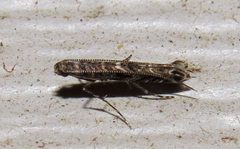
7Ornixolinae is a of leaf-mining micromoths within Gracillariidae, established in 2001. Members are characterized by specialized genital structures including hindwings with small frenular bristles along the in both sexes, a flap on VIII in males, and a sclerotized semicircular female antevaginalis. The subfamily contains approximately 30 distributed globally, with notable radiations in Australia, Hawaii, and Asia. Larvae are endophytic leaf miners that create diagnostic mine forms including serpentine, linear, and blotch patterns.
Pronunciation
How to pronounce Ornixolinae: /ɔrˌnɪksoʊˈlaɪniː/
These audio files are automatically generated. While they are not always 100% accurate, they are a good starting point.
Identification
Ornixolinae can be distinguished from related Gracillariidae by genital : hindwings bear small frenular bristles along the in both sexes; males possess a flap extending from the margin of VIII; females have a sclerotized semicircular antevaginalis. These traits separate Ornixolinae from Acrocercopinae and Gracillariinae, though some Australian previously assigned to Ornixolinae have been reclassified to these subfamilies based on molecular and morphological evidence.
Images
Habitat
Members occupy diverse terrestrial where plants occur. Hawaiian inhabit montane and subalpine native forests from 400–1800 m elevation. Australian species occur across varied including forests and woodlands. Habitat specificity is primarily determined by host plant distribution rather than .
Distribution
Global distribution with documented occurrences in Australia, China, Korea, Hawaii (USA), and Chile. Australian fauna has been extensively revised, with new distribution records for Diphtheroptila oxyloga and Stomphastis labyrinthica, and Liocrobyla and Polydema. Hawaiian Philodoria is . Genus Chileoptilia occurs in Chile.
Diet
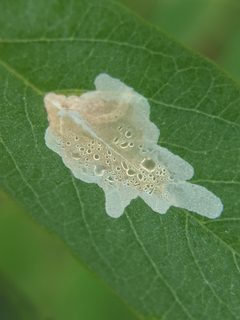
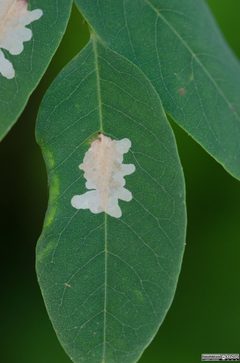
Larvae are obligate leaf miners, feeding endophytically on leaf mesophyll between epidermal layers. Feeding creates visible mines that may be serpentine, linear, or blotch-shaped depending on .
Host Associations
- Myrsine lanaiensis - larval Hawaiian ; of Philodoria kauaulaensis
- Myrsine lessertiana - larval Hawaiian ; of Philodoria kauaulaensis and P. kolea
- Myrsine sandwicensis - larval Hawaiian ; of Philodoria kauaulaensis
- Indigofera - larval of Liocrobyla indigofera in China
- Pueraria montana var. lobata - larval of Liocrobyla lobata in China
- Lespedeza bicolor - larval of Liocrobyla desmodiella in China
- Acacia dealbata - larval of Polysoma in Australia
- Acacia melanoxylon - larval of Polysoma in Australia
- Acacia pycnantha - larval of Polysoma in Australia
- Breynia cernua - larval of Diphtheroptila in Australia
- Breynia oblongifolia - larval of Diphtheroptila and Epicephala in Australia
- Glochidion philippicum - larval of Diphtheroptila and Epicephala in Australia
- Macaranga involucrata - larval of Polydema in Australia
- Mallotus polyadenos - larval of Polydema in Australia
- Drypetes deplanchei - larval New plant record for Gracillariidae in Australia
Life Cycle
Complete with , larval, pupal, and stages. Larvae develop within leaf mines; occurs in cocoons. Hawaiian Philodoria have been reared in laboratory at 20±5°C under 13–16L:8–12D . Specific developmental durations not documented.
Behavior
Larval mining creates diagnostic mine forms that vary among : serpentine mines, linear mines, and blotch mines. Philodoria kolea specifically utilizes leaves of seedlings while use leaves of larger plants. Sympatric species may partition resources by mine type and plant size class.
Ecological Role
Phytophagous insects dependent on specific plants; contribute to localized diversity of . Hawaiian are threatened by host plant endangerment and loss. Some species may serve as indicators of native plant community health.
Similar Taxa
- AcrocercopinaeSome Australian previously assigned to Ornixolinae reclassified to Acrocercopinae based on molecular, morphological, and bionomic evidence; distinguished by different genital structure and mine
- GracillariinaeSome Australian previously assigned to Ornixolinae reclassified to Gracillariinae based on holistic phylogenetic analyses; distinguished by larval and
Sources and further reading
- BugGuide
- Wikipedia
- iNaturalist taxon
- NCBI Taxonomy
- Catalogue of Life
- Hawaiian Philodoria (Lepidoptera, Gracillariidae, Ornixolinae) leaf mining moths on Myrsine (Primulaceae): two new species and biological data
- Taxonomic study of the leafmining genus Liocrobyla Meyrick, 1916 from China (Lepidoptera, Gracillariidae, Ornixolinae) with a description of one new species
- Diversity of Australian Ornixolinae (Lepidoptera: Gracillariidae) with taxonomic and nomenclatural acts within the related taxa (Acrocercopinae and Gracillariinae) based on the evidence of museomics, bionomics, and mitogenomics
- Review of the genus Liocrobyla (Lepidoptera, Gracillariidae, Ornixolinae) from Korea, with description of one newly-recorded species.