
Phyllonorycter
Hübner, 1822
Leaf blotch miner moths
Species Guides
55- Phyllonorycter aeriferella
- Phyllonorycter albanotella(Marginal Tentiform Oak Leafminer)
- Phyllonorycter apparella(Aspen Leaf Blotch Miner)
- Phyllonorycter arbutusella
- Phyllonorycter argentifimbriella
- Phyllonorycter argentinotella(Golden Elm Leafminer)
- Phyllonorycter auronitens
- Phyllonorycter basistrigella
- Phyllonorycter bataviella
Phyllonorycter is a large of micro- in the Gracillariidae, comprising approximately 400 with worldwide distribution concentrated in temperate regions. The genus is characterized by leaf-mining larvae that create distinctive blotch or tentiform mines on plant foliage. are small, typically 3–5 mm in length, with narrow wings often marked with pale or metallic patterns. Many species are economically significant as pests of fruit trees, poplars, and other woody plants, while others serve as hosts for diverse hymenopterous .
Pronunciation
How to pronounce Phyllonorycter: /ˌfɪl.oʊ.nəˈrɪk.tər/
These audio files are automatically generated. While they are not always 100% accurate, they are a good starting point.
Identification
Distinguished from other Gracillariidae by the combination of narrow, forewings with metallic or pale patterning, and symmetrical male genitalia (except in now transferred to other ). Larval mines are diagnostic: upper- or lower-surface blotch mines with silken webbing that causes the leaf to tent outward (tentiform mines). Distinguished from the related genus Macrosaccus by genitalic and larval characters; from Cameraria by mine structure and wing venation details. Species-level identification requires examination of genitalia or due to morphological similarity among many species.
Images
Appearance
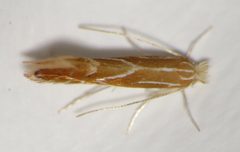
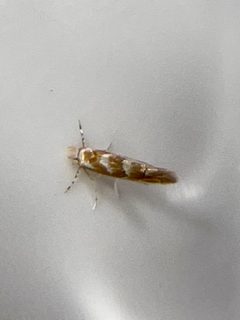
Small with wingspan typically 6–10 mm. Forewings narrow, , often with contrasting pale or golden markings on a darker ground color; many exhibit metallic golden, , or silvery iridescence. Hindwings narrow and fringed. Body slender; with smooth, forward-projecting palps. Male genitalia symmetrical in most species, a diagnostic feature distinguishing the from closely related such as Anarsioses. Larvae are minute, flattened, and adapted for life inside leaf mines.
Habitat
Primarily associated with deciduous woody plants and shrubs. Larvae develop in leaves of trees and shrubs in forests, woodlands, orchards, and urban plantings. occur in the vicinity of larval host plants. Some thrive in anthropogenic environments such as city parks and agricultural settings.
Distribution
Worldwide, with approximately 400 described . Temperate regions harbor the greatest diversity: about 257 species in the Palaearctic, 81 in the Nearctic. Tropical representation is limited: 36 species in Indo-Australia, 13 in the Neotropics, and 22 in the Afrotropical region (with 27 additional Afrotropical species described in 2012). Documented from Europe, Asia, North America, and other regions.
Seasonality
Multivoltine in temperate regions, with two or more per year. periods vary by and latitude; typically active from spring through autumn. occurs as pupae in leaf mines or as mated young females in some species.
Diet
Larvae are leaf miners feeding on mesophyll tissue of plant leaves. Specific host associations vary by : many specialize on single host or , including Populus (poplars), Corylus (hazel), Malus (apple), Tilia (linden), and various other woody Rosaceae, Salicaceae, Betulaceae, and Fagaceae. do not feed.
Host Associations
- Populus - larval P. populifoliella and other
- Corylus - larval P. coryli, P. nicellii
- Malus - larval P. blancardella, P. crataegella in orchards
- Tilia - larval P. issikii
Life Cycle
Complete . laid on plant leaves. Larvae hatch and mine into leaf tissue, creating blotch or tentiform mines; development occurs entirely within the mine. occurs within the mine or in a silken cocoon on the leaf surface. emerge to mate and oviposit. time varies from a few weeks to months depending on temperature and ; multiple generations per year typical in temperate climates.
Behavior
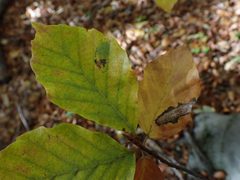
Larvae are endophagous leaf miners, feeding between upper and lower leaf . Mining activity creates visible blotch mines that expand as larvae grow; silk deposition causes leaf tissue to pucker or tent. are or , attracted to light. Some exhibit with rapid local increases in .
Ecological Role
Leaf miners that reduce photosynthetic capacity of plants; significant as pests during . Serve as hosts for diverse hymenopterous , particularly Eulophidae and Braconidae, contributing to natural . Parasitoid complexes can include 10–15+ , with some parasitoids specialized on Phyllonorycter species.
Human Relevance
Several are economically important pests. Phyllonorycter blancardella () and P. crataegella are significant pests of apple orchards in North America. P. populifoliella causes on poplars in urban plantings, as documented in St. Petersburg. P. issikii is an pest of linden in Europe. Management includes applications and using . Some species have developed insecticide resistance.
Similar Taxa
- MacrosaccusFormerly included now transferred to this ; distinguished by genitalic and associations (primarily leguminous plants)
- CamerariaAlso Gracillariidae with leaf-mining larvae; distinguished by mine structure (more linear or serpentine in early instars) and wing venation details
- AnarsiosesRecently erected for P. aberrans; distinguished by asymmetrical male genitalia and different larval
More Details
Taxonomic instability
The has undergone significant taxonomic revision. Several North American formerly placed in Phyllonorycter were transferred to the genus Macrosaccus in 2011. Phyllonorycter aberrans was removed to the new genus Anarsioses in 2019 based on morphological and molecular data. Species-level remains challenging due to morphological similarity.
Research significance
The serves as a model system for studying - interactions, resistance evolution, and invasion . The P. blancardella was among the first insects documented to develop in orchards.
Sources and further reading
- BugGuide
- Wikipedia
- GBIF taxonomy match
- iNaturalist taxon
- NCBI Taxonomy
- Catalogue of Life
- Bug Eric: My Personal National Moth Week, 2017
- Bug Eric: September 2017
- The second outbreak of the poplar leafminer Phyllonorycter populifoliella in St. Petersburg
- Distribution and Bionomies of the Leaf-miner Moth Phyllonorycter trifoliella (Lepidoptera: Gracillariidae)
- Hymenopterous parasitoids associated with Phyllonorycter coryli (Nic.) and Phyllonorycter nicellii (Stt.) on hazel in Poland
- Conservation of <i>Pholetesor ornigis</i> (Hymenoptera: Braconidae), a Parasitoid of <i>Phyllonorycter blancardella</i> (Lepidoptera: Gracillariidae) in Ontario
- Eulophidae (hymenoptera) parasitoids of Phyllonorycter apparella and phyllonorycter populifoliella (Lepidoptera, Gracillariidae), pests of Populus tremula and populus nigra in Ul’yanovsk province, Russia
- Management of Insecticide Resistance in <i>Phyllonorycter</i> spp. (Lepidoptera: Gracillariidae) and Effects on Their Parasitoids
- Anarsioses, a new generic name for Phyllonorycter aberrans (Braun) (Lepidoptera: Gracillariidae)
- Biology and Impact of Parasitoids of <i>Phyllonorycter blancardella</i> and <i>P. crataegella</i> (Lepidoptera: Gracillariidae) in Northeastern North American Apple Orchards
- Phyllonorycter issikii . [Distribution map].