
Macrosaccus
Davis & De Prins, 2011
Species Guides
5- Macrosaccus coursetiae
- Macrosaccus morrisella(hog peanut moth)
- Macrosaccus neomexicanus
- Macrosaccus robiniella(Black Locust Leafminer)
- Macrosaccus uhlerella
Macrosaccus is a of leaf-mining in the Gracillariidae, established by Davis & De Prins in 2011. The genus currently contains six recognized , all of which are leaf miners on Fabaceae (legume family) plants. The generic name derives from Greek μακρο- (long) and σάκκος (bag), referring to the elongate saccus in male genitalia. Several species have become economically significant as agricultural pests, particularly M. morrisella, which recently expanded from native forest legumes to soybean.
Pronunciation
How to pronounce Macrosaccus: /ˌmæ.kroʊˈsækəs/
These audio files are automatically generated. While they are not always 100% accurate, they are a good starting point.
Identification
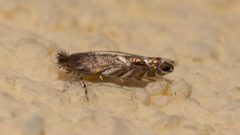
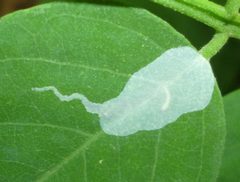
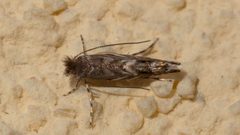
The is distinguished from related gracillariid genera by the elongate saccus in male genitalia, the characteristic from which the genus name derives. -level identification requires examination of genitalia and mine . are tiny (6-7 mm in M. morrisella). Larvae are hypermetamorphic, with distinct sap-feeding and tissue-feeding instar morphologies. Leaf mines are typically blotch-type or tentiform, appearing on the lower leaf surface.
Images
Habitat
occupy forest understories with native Fabaceae , and in some cases agricultural landscapes. M. morrisella occurs in forest understories with American hogpeanut and slickseed fuzzybean, and has recently colonized soybean fields. Higher in soybean occur at field edges adjacent to wooded areas.
Distribution
Native to North America. M. morrisella documented in eastern North America; recently reported from Quebec, Canada and Minnesota, USA in soybean. M. coursetiae described from Arizona, USA. M. robiniella, native to North America, is in Europe (first documented 1983), now present in Slovenia, Croatia, and Russia (Voronezh region).
Diet
All known are leaf miners on Fabaceae (legume ). Larvae feed internally on leaf tissue, creating blotch or tentiform mines.
Host Associations
- Fabaceae (legume family) - larval plant All specialize on Fabaceae; specific vary by species
Life Cycle
Hypermetamorphic development with distinct larval instar forms. M. morrisella has five instars: early instars are sap-feeding with specialized mouthparts, later instars are tissue-feeding. occurs inside the leaf mine. Development from to in M. morrisella requires 425 above 8.96°C lower threshold, enabling multiple per growing season.
Behavior
Larvae are endophytic leaf miners, feeding entirely within leaf tissue. oviposit on plant leaves. M. morrisella shows flexible host plant use without genetic differentiation between on different hosts, suggesting dietary plasticity rather than host race formation. M. robiniella produces multiple mine types (lower-side blotch, upper-side blotch, midrib blotch, edge blotch with leaf folding), potentially creating enemy-free space.
Ecological Role
Native herbivores on forest legumes; some have become agricultural pests. M. morrisella has expanded from native to soybean, a major agricultural crop. M. robiniella is in Europe, causing significant damage to black locust (Robinia pseudoacacia). are associated with these leaf miners, including Chrysocharis walleyi (Eulophidae) reared from M. coursetiae mines.
Human Relevance
M. morrisella has emerged as a potential pest of soybean in North America, with heavy (>10 mines per leaflet) documented in Quebec. M. robiniella is an established pest of black locust in Europe. Research is ongoing to assess economic impacts, develop monitoring protocols, and identify in soybean cultivars.
Similar Taxa
- PhyllonorycterBoth are in Gracillariidae and produce tentiform leaf mines; distinguished by male genitalia structure and associations
- Parectopa robiniellaBoth are gracillariid leaf miners on Fabaceae; M. robiniella mines may resemble P. robiniella damage, requiring careful identification
- CamerariaRelated gracillariid leaf miners with similar mine types; distinguished by genitalia and larval
More Details
Etymology
The generic name derives from ancient Greek μακρο- (makro-, meaning long) and σάκκος (sakkos, meaning bag), referring to the elongate saccus in the male genitalia.
Species diversity
Six currently recognized: M. coursetiae (Arizona, on Coursetia glandulosa), M. gliricidius, M. morrisella (widespread, on multiple Fabaceae including soybean), M. neomexicanus, M. robiniella ( in Europe, on black locust), and M. uhlerella.
Genomic resources
A 245 Mb assembly exists for M. morrisella with 96.33% BUSCO completeness and N50 of 9 Mb. genomic studies found no genetic structure correlated with geography or plant, with weighted FST of 0.0058.
Sources and further reading
- BugGuide
- Wikipedia
- GBIF taxonomy match
- iNaturalist taxon
- NCBI Taxonomy
- Catalogue of Life
- Macrosaccus morrisella adult - Entomology Today
- Macrosaccus morrisella soybean damage - Entomology Today
- Macrosaccus morrisella larva on soybean leaf - Entomology Today
- Leaf-Mining Moth May Be New Pest of Soybean
- macrosaccus-morrisella-adult-socialmedia - Entomology Today
- Joseph Moisan-De Serres Archives - Entomology Today
- A new species of Macrosaccus (Lepidoptera: Gracillariidae: Lithocolletinae) from Arizona, USA
- Instar and sex determination for Macrosaccus morrisella (Lepidoptera: Gracillariidae)
- The genome sequence and genomic diversity of soybean tentiform leafminer (Macrosaccus morrisella)
- THE FIRST FINDING OF MACROSACCUS ROBINIELLA (CLEMENS, 1859) AND OBOLODIPLOSIS ROBINIAE HALDEMAN, 1847 NEAR VORONEZH
- First Reports of Macrosaccus morrisella (Lepidoptera: Gracillariidae) Feeding on Soybean, Glycine max (Fabales: Fabaceae)
- Systematics and biology of the new genus Macrosaccus with descriptions of two new species (Lepidoptera, Gracillariidae)
- Legume host range and soybean host plant resistance for soybean tentiform leafminer, Macrosaccus morrisella (Lepidoptera: Gracillariidae)
- Leaf Mine Types and Associated Parasitism in the Invasive Tree Insect Pest Macrosaccus robiniella (Lepidoptera: Gracillariidae)
- Figures 41–44 from: Davis D, De Prins J (2011) Systematics and biology of the new genus Macrosaccus with descriptions of two new species (Lepidoptera, Gracillariidae). ZooKeys 98: 29-82. https://doi.org/10.3897/zookeys.98.925
- Figures 28–31 from: Davis D, De Prins J (2011) Systematics and biology of the new genus Macrosaccus with descriptions of two new species (Lepidoptera, Gracillariidae). ZooKeys 98: 29-82. https://doi.org/10.3897/zookeys.98.925
- Figures 2–9 from: Davis D, De Prins J (2011) Systematics and biology of the new genus Macrosaccus with descriptions of two new species (Lepidoptera, Gracillariidae). ZooKeys 98: 29-82. https://doi.org/10.3897/zookeys.98.925
- Figures 10–12 from: Davis D, De Prins J (2011) Systematics and biology of the new genus Macrosaccus with descriptions of two new species (Lepidoptera, Gracillariidae). ZooKeys 98: 29-82. https://doi.org/10.3897/zookeys.98.925
- Figures 13–17 from: Davis D, De Prins J (2011) Systematics and biology of the new genus Macrosaccus with descriptions of two new species (Lepidoptera, Gracillariidae). ZooKeys 98: 29-82. https://doi.org/10.3897/zookeys.98.925
- Figures 18–22 from: Davis D, De Prins J (2011) Systematics and biology of the new genus Macrosaccus with descriptions of two new species (Lepidoptera, Gracillariidae). ZooKeys 98: 29-82. https://doi.org/10.3897/zookeys.98.925
- Figures 23–27 from: Davis D, De Prins J (2011) Systematics and biology of the new genus Macrosaccus with descriptions of two new species (Lepidoptera, Gracillariidae). ZooKeys 98: 29-82. https://doi.org/10.3897/zookeys.98.925