
Macrosaccus morrisella
(Fitch, 1859)
hog peanut moth, soybean tentiform leafminer
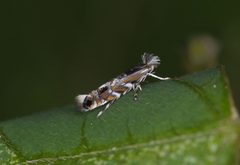
Macrosaccus morrisella is a small leaf-mining in the Gracillariidae, native to North America. Historically associated with native legumes including American hogpeanut and slickseed fuzzybean, it has recently expanded its range to include soybean, with first reports from Quebec in 2016 and Minnesota in 2021. The is notable for its hypermetamorphic larvae that produce distinctive serpentine-to-blotch-to-tentiform leaf mines, and its as a potential agricultural pest of a major commodity crop.
Pronunciation
How to pronounce Macrosaccus morrisella: /mæ.ˈkɹoʊ.sæk.əs ˌmɔɹ.ɪˈsɛl.ə/
These audio files are automatically generated. While they are not always 100% accurate, they are a good starting point.
Identification
Distinguished from other soybean leaf miners by its minute size ( 6–7 mm, larvae 4.7 mm) compared to leaf miners. The mine progression is diagnostic: beginning as an elongate serpentine track on the leaflet underside, enlarging to an elongate-oval whitish blotch, and finally becoming strongly tentiform. White-colored blotch-type mines on the lower leaf surface are readily detectable. Adults must be identified by genitalia dissection or molecular methods for definitive identification; visual identification is challenging due to small size.
Images
Habitat
Native occur in forest understories where legumes grow. In agricultural settings, are higher at field edges adjacent to wooded areas, suggesting spillover from native . Laboratory colonies maintained at 25±2°C with 16-hour photophase on potted soybean plants at V1–V2 growth stage.
Distribution
Native to North America, documented from Manitoba, Ontario, and Quebec south and west to Texas and Colorado. Recent expansion to soybean documented in Quebec, Canada (2016) and Minnesota, USA (2021), with sampled from Brooten, St. Paul, and Rochester, Minnesota.
Seasonality
Development from to requires 425 above 8.96°C, enabling multiple per growing season. Specific adult periods are not documented.
Diet
Obligate leaf-miner on Fabaceae. Native : American hogpeanut (Amphicarpaea bracteata) and slickseed fuzzybean (Strophostyles leiosperma). Recently expanded to cultivated soybean (Glycine max). Larvae feed internally within leaf tissue.
Host Associations
- Amphicarpaea bracteata - native American hogpeanut, forest understory legume
- Strophostyles leiosperma - native slickseed fuzzybean
- Glycine max - agricultural soybean; first reported 2016 (Quebec), 2021 (Minnesota)
Life Cycle
to development requires 425 above lower threshold of 8.96°C. Larvae are hypermetamorphic with distinct sap-feeding and tissue-feeding instars. Mine progression follows three stages: serpentine track → blotch → tentiform. occurs inside the mine. Adults oviposit on soybean leaves; laboratory rearing uses 48–72 hour oviposition periods on young plants.
Behavior
Larvae feed internally between leaf epidermal layers, creating mines that reduce of infested leaves. emerge from pupae within mines. Field sampling indicates higher abundance at field edges near wooded areas. of 18 individuals from three Minnesota locations found no genetic structure correlated with geography or plant (weighted FST 0.0058), suggesting a large population with flexible dietary preferences.
Ecological Role
Native oligophagous legume-feeding insect that has adapted to soybean as a new , representing a case of host range expansion in response to agricultural landscape change. As a , it reduces photosynthetic capacity of infested foliage. The serves as an example of how native herbivores can transition to crop pests without genetic differentiation or host-associated structure.
Human Relevance
Emerging agricultural pest of soybean, a major global vegetable oil and protein crop. Heavy exceeding 10 mines per leaflet have been observed in Quebec, though economic impact remains unquantified. A profile in the Journal of alerts growers to monitoring and identification. Management practices are under development pending assessment of geographic extent and potential crop damage.
Similar Taxa
- Various small beetles (Coleoptera)Other insects mine soybean leaves in North America, but M. morrisella is distinguished by being a (Lepidoptera) rather than , with substantially smaller body size.
- Other GracillariidaeMany gracillariids produce similar tentiform mines; definitive identification requires examination of genitalia or molecular methods.
More Details
Genome
assembled at 245 Mb with N50 of 9 Mb and 96.33% BUSCO completeness. genomic analysis found no evidence of -associated genetic differentiation.
Research Priority
Next steps identified by researchers include assessing potential impacts to soybean production, determining geographic extent of , and understanding in agroecosystems to inform management practices.
Sources and further reading
- BugGuide
- Wikipedia
- GBIF taxonomy match
- iNaturalist taxon
- NCBI Taxonomy
- Catalogue of Life
- Macrosaccus morrisella adult - Entomology Today
- Macrosaccus morrisella soybean damage - Entomology Today
- Macrosaccus morrisella larva on soybean leaf - Entomology Today
- Leaf-Mining Moth May Be New Pest of Soybean
- Joseph Moisan-De Serres Archives - Entomology Today
- macrosaccus-morrisella-adult-socialmedia - Entomology Today
- The genome sequence and genomic diversity of soybean tentiform leafminer (Macrosaccus morrisella).