
Macrosaccus uhlerella
(Fitch, 1859)
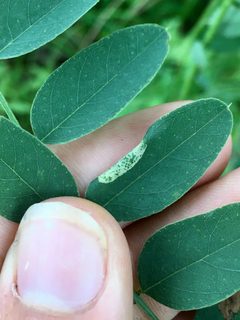
Macrosaccus uhlerella is a small leaf-mining in the Gracillariidae. It is known from five U.S. states: Illinois, Missouri, New York, Colorado, and Texas. The larvae feed on leguminous plants, creating distinctive blotch mines on the undersides of leaves. This has been documented mining leaves of Amorpha and Robinia species.
Pronunciation
How to pronounce Macrosaccus uhlerella: /ˌmækrəʊˈsækəs ˌʌɫəˈrɛlə/
These audio files are automatically generated. While they are not always 100% accurate, they are a good starting point.
Identification
Distinguished from other Macrosaccus by geographic range and plant associations. The leaf mines—elongate-oval, whitish blotches on the underside of leaflets, becoming tentiform and causing slight curling of the leaf edge—are characteristic. Final identification requires examination of genitalia or molecular analysis. Similar species include Macrosaccus morrisella, which has been reported on soybean and differs in host use and distribution (Canada, Minnesota).
Images
Appearance
are minute with a wingspan of 6–6.5 mm. As a member of Gracillariidae, they possess narrow, wings typical of microlepidoptera. Coloration details are not well documented in available sources.
Habitat
Associated with supporting its leguminous plants, including Amorpha fruticosa and Robinia . Specific habitat types are not well documented beyond presence in areas where host plants occur.
Distribution
United States: Illinois, Missouri, New York, Colorado, and Texas. No Canadian records documented for this .
Diet
Larvae feed on Amorpha (including Amorpha fruticosa) and Robinia species (Fabaceae). They are leaf miners, feeding internally within leaf tissue.
Host Associations
- Amorpha fruticosa - plantLarval food plant; leaf mining documented
- Amorpha - plant-level association
- Robinia - plant-level association
Life Cycle
Larvae mine leaves, creating an elongate-oval, whitish blotch on the underside of the leaflet, usually near the edge. The mine becomes tentiform as it matures, causing slight curling of the leaf edge. presumably occurs within the mine or in leaf litter, though specific details are not documented.
Behavior
Larvae are endophagous leaf miners, feeding between the upper and lower leaf . The mining creates visible blotch mines that may serve as a defensive .
Ecological Role
As a , larvae consume photosynthetic tissue and may influence plant . Specific ecological impacts are not quantified. The functions as a herbivore on native legumes.
Human Relevance
Not known to be an agricultural pest. Unlike the congeneric Macrosaccus morrisella, which has been reported infesting soybean, M. uhlerella has no documented association with cultivated crops. Its plants are primarily native .
Similar Taxa
- Macrosaccus morrisellaSimilar size, appearance, and leaf-mining habit. Distinguished by documented range expansion to soybean (Glycine max), geographic distribution including Canada and Minnesota, and potentially different requiring genital dissection for confirmation.
More Details
Taxonomic Note
Macrosaccus uhlerella was described by Fitch in 1859. The Macrosaccus was formerly included in Phyllonorycter but has been recognized as distinct based on morphological and molecular data.
Source Quality
Most information derives from a single Wikipedia entry and limited primary literature. plant and mine details are well-supported; other aspects remain undocumented.
Sources and further reading
- BugGuide
- Wikipedia
- GBIF taxonomy match
- iNaturalist taxon
- NCBI Taxonomy
- Catalogue of Life
- Macrosaccus morrisella adult - Entomology Today
- Macrosaccus morrisella soybean damage - Entomology Today
- Macrosaccus morrisella larva on soybean leaf - Entomology Today
- Leaf-Mining Moth May Be New Pest of Soybean
- macrosaccus-morrisella-adult-socialmedia - Entomology Today
- Joseph Moisan-De Serres Archives - Entomology Today