
Chrysaster ostensackenella
(Fitch, 1859)
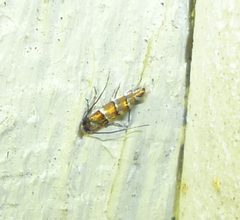
A small leaf-mining in the Gracillariidae, native to eastern North America and recently established as an pest in East Asia, Europe, and Russia. have a wingspan of approximately 4–5 mm. Larvae feed exclusively on Robinia , creating distinctive blotch mines on leaves. The species has spread rapidly through human-mediated transport of plants and is expected to expand further in regions where black locust is planted.
Pronunciation
How to pronounce Chrysaster ostensackenella: /ˈkɹɪsæstər oʊstɛnˌsækəˈnɛlə/
These audio files are automatically generated. While they are not always 100% accurate, they are a good starting point.
Identification
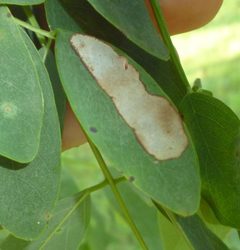
Distinguished from other Gracillariidae by forewing pattern and male genitalia; leaf mines are diagnostic—yellowish blotch mines on upper leaf surface with short initial tunnel (1.5–2 mm) following secondary . deposited in dotted central line in tunnel portion, scattered as black grains in blotch with highest concentration centrally. occurs outside the mine on lower leaf surface in white cocoon (in Russian ; North American populations pupate inside mine).
Images
Habitat
Arboreta, tree plantings, and urban landscapes where Robinia occur; in invaded range, found in ornamental plantings of black locust (Robinia pseudoacacia). Native range includes deciduous forests and urban areas with trees.
Distribution
Native to eastern North America: Canada (Ontario, Québec, Nova Scotia) and United States (Illinois, Kentucky, New York, Maine, Maryland, Michigan, Vermont, Arizona, Massachusetts, North Carolina, Connecticut, Tennessee, Virginia). range: China (2015), South Korea (2017), Japan (2021), Italy (2022), and Russia (Primorsky Krai, 2022). Expected further spread in East Asia and Europe due to widespread black locust planting.
Seasonality
Likely two per year in Primorsky Krai; up to four generations reported in China. active in July in Russian Far East; seasonal timing varies across range.
Diet
Larvae feed on leaves of Robinia (Fabaceae), specifically Robinia pseudoacacia, R. hispida, R. neomexicana, and R. viscosa. Leaf-mining larvae consume leaf tissue between upper and lower .
Host Associations
- Robinia pseudoacacia - primary Black locust; main supporting spread
- Robinia hispida -
- Robinia neomexicana -
- Robinia viscosa -
Life Cycle
laid near main or between main and secondary vein. Early instar creates short tunnel (1.5–2 mm) following secondary vein, then widens into blotch mine. Larva yellow-greenish, up to 4 mm; single larva per mine. Late instar creates semicircular cut in upper for escape. occurs outside mine on lower leaf surface in white tough cocoon along secondary vein (Russian ); North American populations pupate inside mine. Pupal development up to 6 days at 24°C and 45% humidity.
Behavior
Oviposition occurs near leaf . deposition pattern distinctive: dotted central line in tunnel, scattered black grains in blotch. disperse via wind currents as air plankton or hitchhike on human transport; stages transported with plants for planting.
Ecological Role
Herbivore and pest; causes leaf discoloration, browning, drying, and premature leaf fall. During , causes significant damage to ornamental woody plants. No known native or associations documented in invaded range.
Human Relevance
pest of ornamental and forestry plantings of black locust. Economic impact on urban landscaping and Robinia . Spread facilitated by international trade in plants. Genetic studies used to trace invasion routes and inform management.
Similar Taxa
- Other Gracillariidae on RobiniaSimilar leaf-mining habit; distinguished by mine (blotch mine with short initial tunnel, pattern) and site
- Phyllonorycter robiniellaAlso mines Robinia leaves; distinguished by mine shape, pattern, and