Hyblaea puera
(Cramer, 1777)
teak defoliator
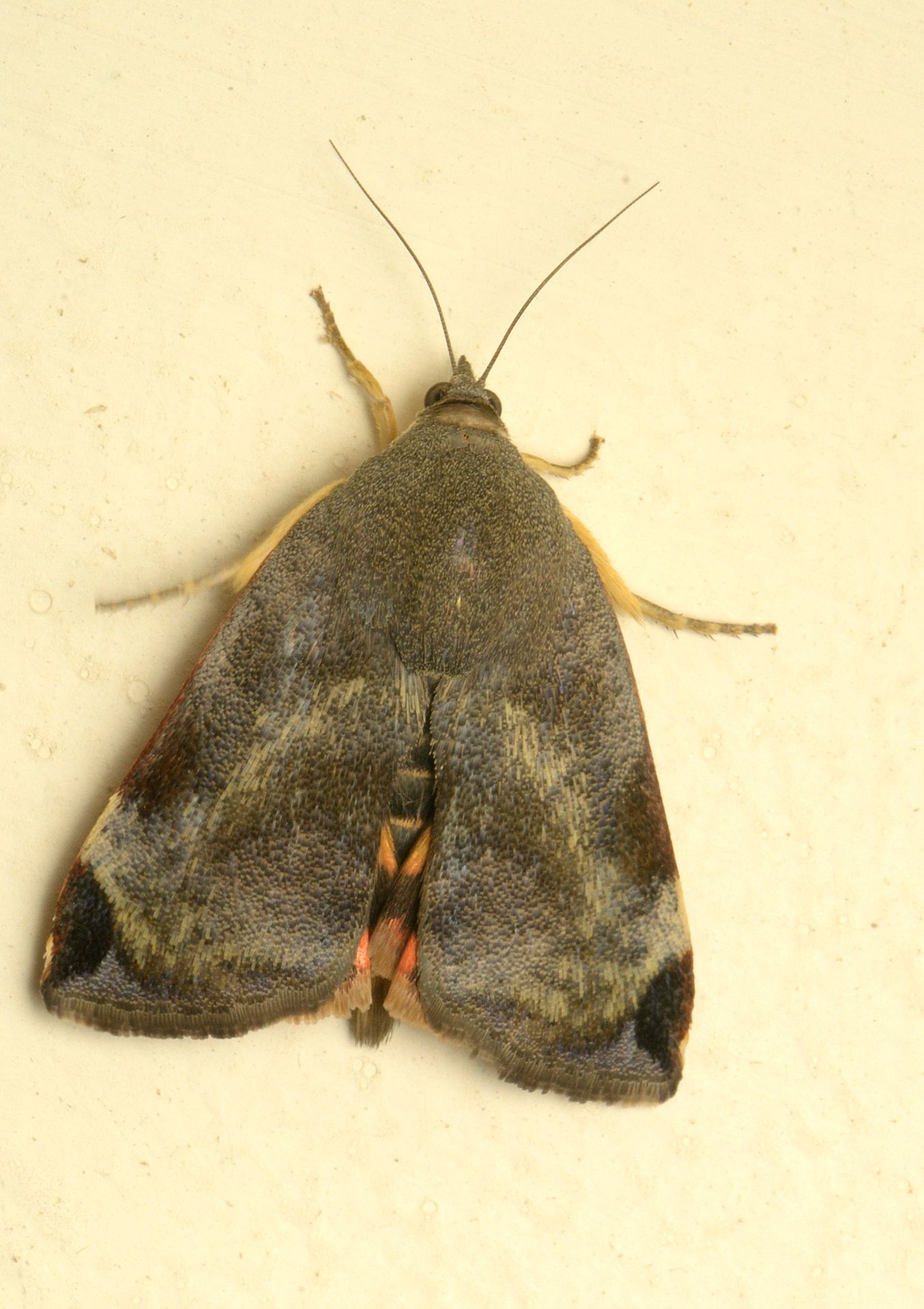
A small (wingspan 3–4 cm) and major defoliator of teak and mangrove across tropical Asia. have greyish-brown forewings that conceal brightly colored black and orange-yellow hindwings at rest. The undergoes dramatic , with densities shifting from levels to proportions seasonally. It has expanded beyond its native South and Southeast Asian range to Central America, Africa, and Australia, and has recently emerged as a serious pest of mangroves in India and China.
Pronunciation
How to pronounce Hyblaea puera: /hɪˈbleɪ.a ˈpjʊ.rə/
These audio files are automatically generated. While they are not always 100% accurate, they are a good starting point.
Identification
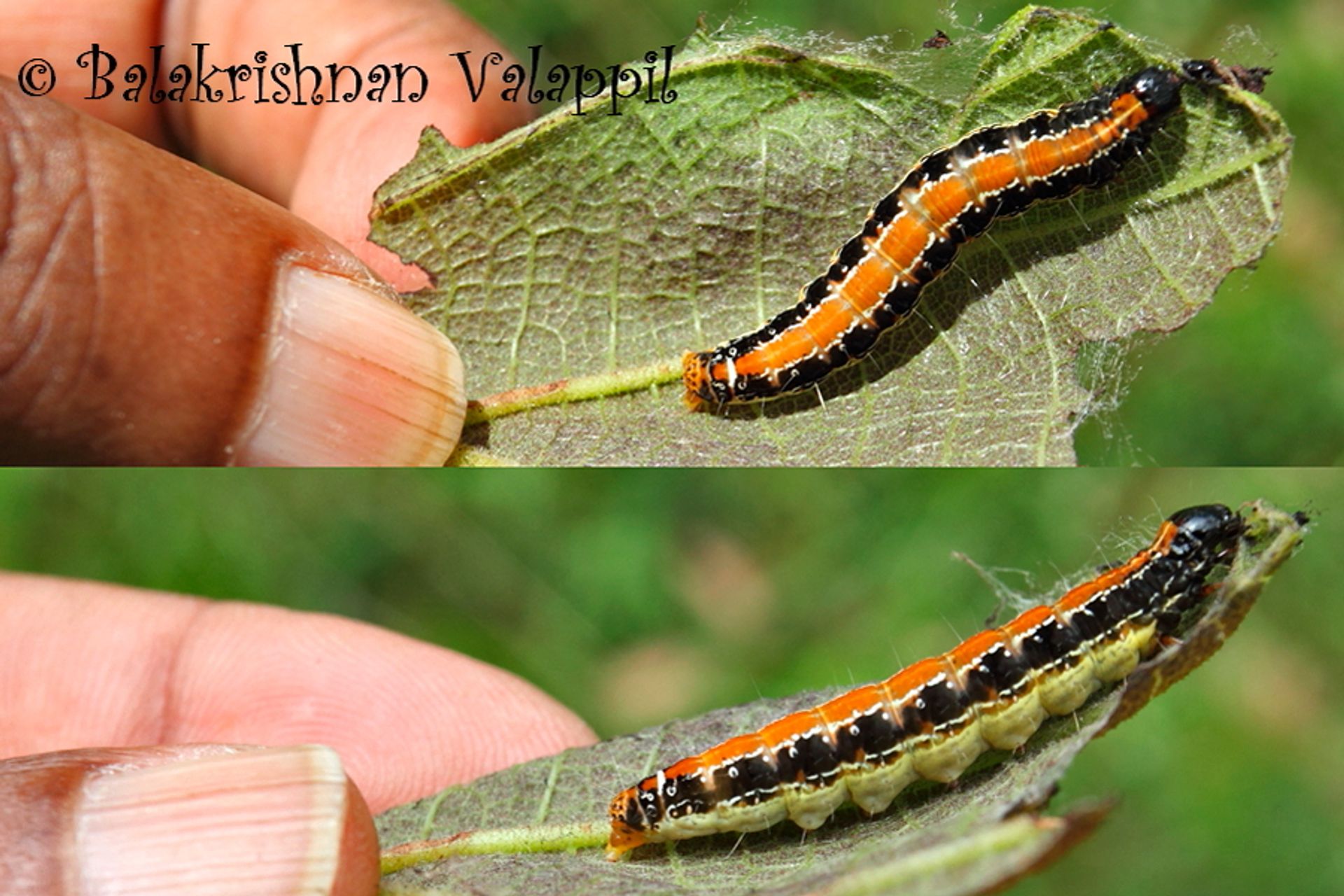
distinguished by small size, greyish-brown forewings, and concealed black and orange-yellow hindwings revealed when wings are spread. Larvae recognized by leaf-shelter construction : third through fifth instars cut leaf flaps, fold them with silk, and feed from within. Color-polymorphic larvae may be confused with other defoliators, but shelter-building behavior is distinctive. Molecular identification via mitochondrial COI gene sequencing has been used to confirm field identifications.
Images
Habitat
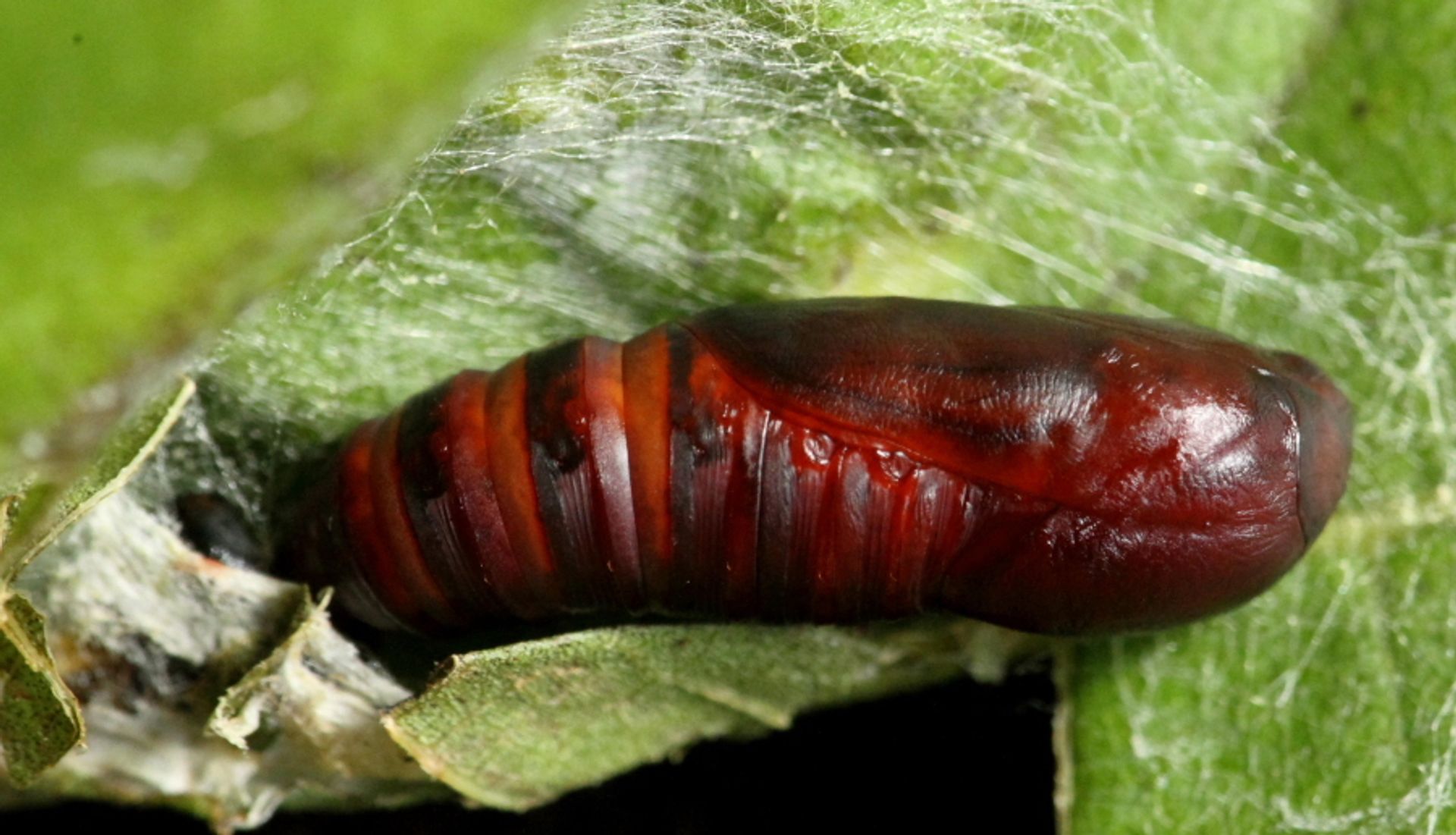
Native to tropical forests, particularly teak plantations and natural forests. Has expanded into mangrove , where it pupates inside rolled leaves rather than in soil due to inundated conditions. In teak plantations, persist year-round at low densities, with centers developing in localized patches of 5,000–15,000 square meters characterized by heavy tree-top .
Distribution
Native range: South and Southeast Asia including India, Sri Lanka, Bangladesh, Thailand, Myanmar, Laos, Cambodia, Vietnam, Malaysia, Indonesia, Philippines, Taiwan, Ryukyu Islands, Nepal, and Papua New Guinea. Established in Australia (north Queensland), Fiji, Samoa, Solomon Islands. Introduced and in Central America (Honduras, Rica, Guadeloupe, Suriname), Africa (Malawi, South Africa, Uganda, Democratic Republic of Congo), and recently reported in Brazil (Paraná, Santa Catarina, Pará) and Saint Barthelemy.
Seasonality
Year-round presence in tropical with seasonal dynamics. In Kerala, India, low densities occur during natural teak defoliation (November–January). High-intensity outbreak centers appear after pre-monsoon showers (late February–March), followed by large- outbreaks April–July. declines to endemic levels by late July–September, with occasional secondary outbreaks in October. In Bangladesh, peaks occur April–July with occasional flatter peaks August–September.
Diet
Larvae feed primarily on tender new leaves of teak (Tectona grandis). Also documented on Vitex negundo, Vitex spp., Clerodendron spp., Spathodea campanulata, Quercus serrata, and mangrove including Avicennia marina, Avicennia officinalis, Acanthus ilicifolius, Bruguiera cylindrica, Rhizophora mucronata, Derris trifoliata, and Volkameria inermis. Young leaves are strongly preferred; consumption and reproductive output decline markedly on mature and foliage.
Host Associations
- Tectona grandis - primary Preferred ; larvae show significantly greater weight gain and survival compared to alternative hosts
- Vitex negundo - secondary Field observations indicate secondary preference; higher phenol content reduces growth rates compared to teak
- Avicennia marina - ( range)Major mangrove in China and India; larvae exhibit modified using host leaf cases
- Avicennia officinalis - ( range) mangrove in Kerala, India; severe defoliation documented in 2024
Life Cycle
Complete with overlapping during periods. hatch in approximately two days. Five larval instars lasting 10–12 days under optimal conditions. First and second instars feed superficially on leaf surfaces; third through fifth instars construct leaf shelters and consume entire leaves except major . Mature larvae descend on silken threads to pupate. Pupal period averages 6–8 days. mate within days of . Females lay approximately 500 eggs (maximum recorded 1,000). No evidence of pupal (hibernation or ).
Behavior
exhibit characteristic resting posture with hindwings folded beneath forewings. Mating occurs within days of . Larvae display -dependent color , with darker forms developing at higher densities. exhibit short-range : when critical densities are reached in a patch, newly emerged disperse to newly flushed teak areas. This spatial dynamic creates a shifting mosaic of centers across landscapes.
Ecological Role
Major defoliator that can cause complete defoliation of teak and mangrove , resulting in significant timber loss and reduced forest productivity. alter structure by reducing leaf area index and potentially affecting understory microclimate. Serves as host for diverse complex (tachinid, eulophid, chalcid, and ichneumonid wasps) and prey for birds, spiders, and mammals, supporting higher during outbreak periods.
Human Relevance
Serious economic pest of teak plantations globally, causing substantial timber yield losses. Subject to intensive research, particularly development of Hyblaea puera (HpNPV) as a fast-acting viral . Consumed as food in Indonesia (known as entung jati), where cocoons are collected from the ground as a protein source. Recent invasion of mangrove threatens coastal conservation efforts and biodiversity in India and China.
Similar Taxa
- Eutectona machaeralisAnother major teak defoliator in the same region; distinguished by different larval and shelter-building
- Hyblaea ibidiasCongeneric ; H. puera distinguished by hindwing color pattern and association
More Details
Biological control
Hyblaea puera (HpNPV) is a Group II alphabaculovirus that kills larvae in 60–72 hours, making it one of the fastest-acting insect viruses. It has been employed as a bio-control agent in India. Natural by averages approximately 9%.
Gut microbiome
Fifth-instar larvae harbor gut bacteria potentially involved in degrading aromatic compounds and synthesizing and vitamins, which may facilitate to chemically defended mangrove . Laboratory rearing significantly alters gut microbial composition compared to field-collected specimens.
Cryptic species complex
Hyblaea puera is recognized as a cryptic , suggesting that reported geographic variation in and use may reflect unrecognized -level diversity.
Sources and further reading
- BugGuide
- Wikipedia
- GBIF taxonomy match
- iNaturalist taxon
- NCBI Taxonomy
- Catalogue of Life
- Bug of the Week
- Hyblaea puera . [Distribution map].
- Analysis of gut microbial diversity and function in Hyblaea puera (Lepidoptera: Hyblaeidae)
- Isolation, identification and molecular phylogenetic analysis of Hyblaea puera Nucleopolyhedrovirus
- EVALUATION OF BIOEFFICACY OF LIPPIA JAVANICA AGAINST HYBLAEA PUERA (LEPIDOPTERA: HYBLAEIDAE) FROM THE FOREST OF ANDHRA PRADESH, INDIA
- Evaluation of Trichogramma chilonis Ishii – An Egg Parasitoid against Teak Defoliator, Hyblaea puera Cramer
- Host plant preference in Hyblaea puera Cramer and role of certain leaf chemicals on growth of defoliator
- Host Plant Biochemical Diversity, Feeding, Growth and Reproduction of Teak Defoliator Hyblaea puera (Cramer) (Lepidoptera: Hyblaeidae)
- Invasive Teak Defoliator Hyblaea puera Outbreak Threatens Mangrove Ecosystems in Kerala, India: Implications for Biodiversity and Coastal Resilience
- Biology of semilooper, Hyblaea puera Cramer, an important pest of Quercus serrata Thunb
- Influence of virus inoculation method and host larval age on productivity of the nucleopolyhedrovirus of the teak defoliator, Hyblaea puera (Cramer)
- Population dynamics of teak defoliator, Hyblaea puera Cram. (Lep., Hyblaeidae) in teak plantations of Bangladesh
- Development and Application of Two Rapid Molecular Detection Assays for Hyblaea puera Cramer (Lepidoptera: Hyblaeoidea), a Major Pest of Mangroves and Teak.