
Sympiesis dolichogaster
Ashmead, 1888
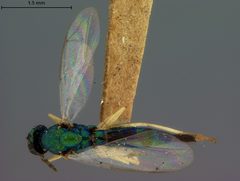
Sympiesis dolichogaster is a of parasitic wasp in the Eulophidae, first described by William H. Ashmead in 1888. The species epithet 'dolichogaster' refers to its elongated . Like other members of its , it is presumed to be a of lepidopteran larvae, though specific records for this species are limited. The species has been documented across a broad geographic range spanning Asia, Australia, and the Caucasus region.
Pronunciation
How to pronounce Sympiesis dolichogaster: /sɪmˈpaɪˈiːsɪs ˌdoʊˌlɪkəˈɡæstər/
These audio files are automatically generated. While they are not always 100% accurate, they are a good starting point.
Identification
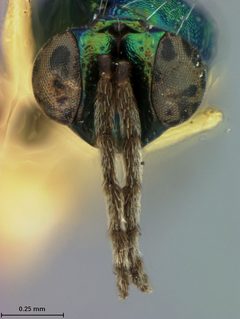
The specific epithet 'dolichogaster' (Greek: 'dolicho-' long, '' belly/stomach) refers to the elongated characteristic of this . Within the Sympiesis, S. dolichogaster may be distinguished by abdominal proportions, though precise diagnostic features require examination of and taxonomic keys.
Images
Distribution
Recorded from Adygey (Caucasus region, Russia), Beijing and Anhui (China), Andhra Pradesh (India), and Australian Capital Territory (Australia). The disjunct distribution suggests either a genuinely wide range or potential cryptic complexity requiring further study.
Ecological Role
As a member of Eulophidae, likely functions as a larval of Lepidoptera, contributing to natural of and larvae.
Similar Taxa
- Sympiesis spp.Congeneric share general body plan and ; differentiation requires examination of abdominal proportions and other subtle morphological characters.